Origins of the Species Neo-Con
by Roger Morris
Save a link to this article and return to it at www.savethis.comSave a link to this article and return to it at www.savethis.com Email a link to this articleEmail a link to this article Printer-friendly version of this articlePrinter-friendly version of this article View a list of the most popular articles on our siteView a list of the most popular articles on our site
Tracking the genealogy of the cabal of neo-conservatives who have so disastrously dominated foreign policy under George W. Bush, journalists have followed a political bloodline back to the 1960s, to cold war pamphleteers like Irving Kristol and Norman Podhoretz, and – more respectably if also more tenuously – to the postwar University of Chicago political theorist Leo Strauss.
As so often with the neo-cons, however, there is less there than meets the eye, especially in finding any serious intellectual content in the rise of men like the former Deputy Defense Secretary and now World Bank president Paul Wolfowitz or UN Ambassador-designate John Bolton.
Whatever their other derivation, the genus also traces to more banal, seedier origins, curling back through closed-door politics where so much of U.S. history happens. The neo-con coup d'état after 9/11, the war on Iraq, the fear and loathing as foreign policy – all that and more started as well nearly seventy years ago in the wooded curving inlets and gentle fog of the far Northwest.
Nineteen thirty-eight was the year Henry Martin Jackson, an ambitious 26-year-old Democrat fresh out of the University of Washington Law School, was elected prosecuting attorney for Snohomish County along the shore of Puget Sound north of Seattle. As usual, few outside Washington state noticed the obscure local vote. But it launched a fateful political career, and ultimately led to the U.S. invasion and bloody occupation of Iraq.
Jackson rose rapidly from the courthouse in his hometown Everett. Making a name for himself chasing San Juan Island-skirting bootleggers and lumberjack camp gamblers, he shot on to Congress in 1940. He served five terms in the House, broken by a stint as a World War II GI, and by 1952, had gained the Senate, where "Scoop," as he was called from his days as a paperboy and cub reporter, became a national force.
A middle-of-the-road, pro-labor Democrat on domestic issues and an early champion of environmental causes, Jackson was chairman for nearly two decades of the Interior Committee (later Energy and Natural Resources) and sat on the Government Operations Committee and Joint Committee on Atomic Energy – all major fiefdoms in dispensing federal money and wielding influence in politics and policy. One of Capitol Hill's more vigorous legislators, he was a main author and driving force of the legislation creating the Environmental Protection Agency, major wilderness preservation and other landmark acts. With another local prosecutor raised to Senate power, Seattle's Warren Magnuson, Jackson also saw to it that generous appropriations and contracts were sluiced to his home state. "Scoop" especially would be known scathingly in congressional corridors as the "Senator from Boeing" for being on-call to the increasingly powerful, increasingly corrupt corporate giant.
But it was in national security that Jackson's impact was deepest. The hawks' hawk, he was to the right of many in both parties. Not even the massive retaliation strategy and roving CIA interventions of the Eisenhower '50s were tough enough for him. Perched on the mighty Armed Services Committee as well as his other bases of power, he went on over the next decade to goad the Kennedy and Johnson administrations, urging the Vietnam War, fatter military budgets, stronger support of Israel in the Middle East and a more aggressive foreign policy in general.
It was then, 40 years ago, that Jackson began to be linked directly, if furtively, to some of the uglier and little-known origins of the war on Iraq. Overseeing the CIA's "black budget" for covert operations and interventions from a subcommittee of Armed Services, he was one of a handful of senators who gave a nod to two U.S.-backed coups in Iraq, one in 1963 and again in 1968. Those plots brought Saddam Hussein to power amid bloodbaths in which the CIA, exacting the price for its support, handed Saddam and his Baath Party cohorts lists of supposed anti-U.S. Iraqis to be killed.
The result was the systematic murder of several hundred and as many as several thousand people, in which Saddam himself participated. Whatever the toll, accounts agree that CIA killing lists comprised much of Iraq's young educated elite – doctors, teachers, technicians, lawyers and other professionals as well as military officers and political figures – Iraqis who would not be there to oppose Saddam's growing tyranny over ensuing years or to help rebuild or govern Iraq, as the United States now hopes to do, after the current war.
By 1969, Jackson was so prominent in military and national security affairs, and so at odds on those issues with many in his own party, that newly elected Republican Richard Nixon thought to name the Washington Democrat his secretary of defense, though the senator declined the job.
But Snohomish County's favorite son coveted the White House himself and was soon a sharp critic of Nixon's arms control and détente. Added to his cold warring was even greater zeal for Israel, a certainty that the United States should endorse the Israelis' own hard line – absorbing the West Bank after its conquest in the 1967 Middle East War, the long-term subjugation of Palestine and an abiding hostility to Iraq and other Arab states.
As Jackson grew nationally prominent, he attracted the inevitable ambitious staffers and partisans boarding his coattails to advance both their own hawkish views and themselves. Among them was a recent graduate of the University of Southern California who was fanatic about amassing and projecting U.S. power, especially on behalf of Israel, and not least about his own strategic genius. The young New Yorker named Richard Perle became Jackson's chief assistant from 1969 to 1980.
I saw these origins firsthand working in the Senate in the early '70s after resigning from Henry Kissinger's National Security Council staff over the invasion of Cambodia. Seen from the inside, Jackson's Senate heft was considerable. Though a relatively small, unprepossessing figure as politicians go, he usually did his homework, could be incisive about important details his colleagues let slip and struck a shrewd balance between conviction and expedience. Much of his Capitol Hill power derived from his unique role, which he played well, as a northern Democrat with solid labor backing and other party credentials yet whose hard-line international view drew the support of many Republicans and the most conservative Southerners on either side of the aisle.
His belligerence also exerted – as it still does, of course – an extortionist pull on Democrats deathly afraid of appearing "weak" on national defense or in standing up to the Russians or anyone else. There was no question that "Scoop," albeit very much a half-educated provincial from the mountains and straits of the far northwest corner of the continental United States, shrewdly caught the unease and reflexive combativeness of much of America in dealing with a planet we knew, and know, so little despite our power. Still, in the '70s, a more worldly post-Vietnam moderation and sensibility in the leadership of both parties appeared to have passed Jackson by, leaving his chauvinism and foreign policy animus marginal, sometimes looking a bit crazed.
As for Perle, he was a pear-shaped, slightly fish-eyed man of self-consciously affected locution, the too-hungry, too-sly and too-toadying aide familiar in bureaucracies public and private. His views were patently uninformed, and he wore his conference-room warrior's zealotry no more gracefully than his expensive blue pinstriped suits. It seemed obvious that the bellicose policies he and Jackson embodied were not only wrong for America, but would also usher Israel into the ruinous isolation I and other admirers of its brave people most feared. "Scoop" & Co. would remain, I assumed, an extremist fringe.
How wrong I was.
Jackson, of course, never got the White House. With big pro-Israeli money though stolid style, he lost the presidential nomination in 1976 to Jimmy Carter, who offered a fresh face in the national weariness in the wake of the Watergate scandal. But when Jackson died seven years later back in Everett, ending more than four decades on the national scene, he had spawned a cult following. With the lavishly financed and much-propagandized neo-conservatives first taking power under President Reagan, and then at the senior levels under a new and ignorant George W. Bush, their throwback foreign policy was, and is, "Scoop" Jackson warmed over – the red, white and blue, bombs-away dawn of an old era.
For his part, Perle missed a long-coveted chance to make presidential policy when Jackson stumbled in 1976. But the aide promptly moved on to the next coattails in classic, if banal, Washington, D.C., style. Relentlessly levering the system he learned under Jackson, he cultivated the media, courted politicians in both parties and used old allies in the ever more politically potent pro-Israeli and military-industrial lobbies. By the Reagan '80s, he was an assistant secretary of defense, veteran of the now-venerated Jackson tradition of military expansion and a self-promoted strategist for a Republican president as comfortably as for a Democratic senator.
Whatever "Scoop" Jackson's mix of political principle and opportunism, Perle's politics were largely himself. And in time-honored Washington tradition, on the way up Perle gathered his own disciples among similarly grasping men – Wolfowitz, Under-Secretary of Defense for Policy Douglas Feith and others who would go on themselves in the same fashion to become key officials in the current administration, and who gathered their own coterie from assorted Reagan regime and Capitol Hill right-wing hacks such as Bolton. Like Perle, who was appointed in 2001 to chair the Bush Administration's influential Defense Policy Board, they were all longtime advocates, years before the Sept. 11 attacks, of pre-emptive American military invasions in Iraq and elsewhere and of implicit, if not open, support for the expansionist and repressive policies of their right-wing counterparts in Israel. Their concerted influence was decisive in going to war in Iraq.
Grown wealthy in the revolving door between government and corporate plunder, Perle drew notoriety briefly in 2003 not only for his intimate ties to Israel but also for his connections to companies standing to profit obscenely from the war he'd mongered. When Michigan Congressman John Conyers Jr. and Senator Carl Levin began to prod Defense Secretary Donald Rumsfeld about the disreputable dealings, Perle angrily resigned from the chairmanship of the board, though he continued to sit as a full-fledged member of the pivotal body. It was a fleeting glimpse of the cronyism, conflict-of-interest, loyalty-for-sale and general political-intellectual corruption of the neo-cons in Perle's lineage.
It was also – history's nice irony – just the kind of disgrace young "Scoop" Jackson might once have prosecuted up in Snohomish County.
September 1, 2005
Roger Morris [send him mail] was Senior Staff on the National Security Council under both Presidents Lyndon Johnson and Richard Nixon, until resigning over the invasion of Cambodia. Morris is the author of Partners in Power: the Clintons and Their America and with Sally Denton The Money and the Power: the Making of Las Vegas. He is completing Shadows of the Eagle, a history of US policy and covert interventions in the Middle East and South Asia over the past half-century, forthcoming from Alfred Knopf.
This article originally appeared on the Green Institute GP360 web site.
Copyright © 2005 Roger Morris
Wednesday, November 09, 2005


Tuesday, November 08, 2005
SENATE DEBATES TORTURE RULES
Senators debate McCain amendment

KWAME HOLMAN: For the past four months, Arizona Republican John McCain has led a concerted effort in the United State Senate to prohibit the use of torture on detainees being held in U.S. custody on foreign soil.

SEN. JOHN McCAIN: First, subjecting prisoners to abuse leads to bad intelligence because under torture, a detainee will tell his interrogator anything to make the pain stop. Second, mistreatment of our prisoners endangers U.S. troops who might be captured by the enemy, if not in this war, then in the next.
KWAME HOLMAN: Sen. McCain is one of the few members of Congress who can speak from experience. He was tortured over five and a half years in captivity during the Vietnam War.
But in his speeches, McCain has referenced more recent reports of torture and abuse at Abu Ghraib Prison in Iraq and the U.S. detention center at Guatanamo Bay, Cuba.
SEN. JOHN McCAIN: If we inflict this cruel and inhumane treatment, the cruel actions of a few darken the reputation of our country in the eyes of millions. American values should win against all others in any war of ideas, and we can't let prisoner abuse tarnish our image.
KWAME HOLMAN: And so McCain wrote legislation that would establish uniform standards for the interrogation of persons under the detention of the Defense Department consistent with the Army field manual and prohibit cruel, inhuman, or degrading treatment or punishment of persons under the custody or control of the United States Government.
Early last month, and despite strong opposition from the Bush administration, Sen. McCain attached that language to a defense appropriations bill and convinced all but nine of his colleagues to support it.
Again last Friday, McCain took the same language, pinned it to a defense authorization measure, and won without the Senate even bothering to hold a recorded vote.
SPOKESMAN: All those in favor say aye.
KWAME HOLMAN: Among the few senators opposed to the torture legislation has been Alaska Republican Ted Stevens who last month argued that some nonmilitary personnel should be exempt from it.

SEN. TED STEVENS: There are people who are not in uniform who may not even be citizens of the United States who represent us in very strange and dangerous places whose lives may be put in jeopardy by the process that is spelled out in part of this amendment.
There are some changes that have to be made if we're to be faithful to those people who live in the classified world and will be covered by the classified annex that -- you read the amendment, it is not covered here.
KWAME HOLMAN: Last week, Vice President Cheney visited the Senate and reportedly urged Republicans specifically to exempt the CIA from McCain's amendment.
That news report was followed by another that told of al-Qaida prisoners being held at secret CIA camps in Eastern Europe. Sen. McCain used that to argue the CIA should not be exempt.
SEN. JOHN McCAIN: The CIA wasn't set up to run prisons.
KWAME HOLMAN: Despite the overwhelming support in the Senate to attach the McCain torture amendment to two defense bills, there is no such language in either of the House bills. A Conference Committee made up of selected members of both chambers will decide whether the language stays or goes. MARGARET WARNER: And for more on this debate we turn to two senators who are on the House-Senate Conference Committee that's now hammering out the fate of the McCain amendment, as part of the military spending bill, the first bill that was voted on. Missouri Republican Christopher Bond was one of the nine senators who voted against the McCain amendment last month. And Illinois Democrat Sen. Richard Durbin voted for it.
Welcome, gentlemen.
Senator Durbin, you're in the midst of these negotiations, is the McCain amendment going to survive and end up in the military spending bill?
SEN. RICHARD DURBIN: Well I certainly hope so, and although we haven't sat down in conference to make that final decision, if 90 senators vote in favor of that proposition, then it passes by voice vote. It's pretty clear what the sentiment is in the Senate. The difficulty we face is this: Vice President Cheney in particular has opposed this amendment from the start. And I just can't at this point really define with any clarity what the position of the administration is.
Of course the president in South America said this week that we are opposed to torture, while the vice president lobbies Capitol Hill to allow torture by some employees of the federal government. I can understand that this ambiguity may make sense in the White House. It doesn't make sense outside of the White House. I think it really calls into question our reputation in the world and threatens the safety of our troops.
MARGARET WARNER: All right. Sen. Bond, first, your assessment -- and feel free to answer his arguments as well -- but your assessment of how things are going in the Conference Committee and whether the McCain amendment will survive.

SEN. CHRISTOPHER BOND: Frankly, I hope not. I appreciate the opportunity to talk a little bit about this because it has been mischaracterized.
The first thing we should point out is the United States Government does not condone permit, or accept torture. I think it's important to know that existing laws already on the books were used to punish and imprison people who did those gross and unlawful things at Abu Ghraib. They presented us with a black eye, and we punish people who go off the reservation. We do not permit torture, and the vice president has not come out in favor of torture.
But the point that has to be made is that we cannot set out for detainees, in advance, precisely what kinds of interrogation methods would be used. I have not been fully briefed -- I'm not in a position to get a full brief on what is permitted. But I have talked to special operatives of the CIA who operate under -- and have told me the strict guidelines under which they go and the kinds of thing they say do, which are no worse than what our troops go through in training and in the field.
MARGARET WARNER: Sen. Bond, let me just follow up by asking you about something that General Pace, the new head of the joint chiefs, said last night on the program in an interview with Jim Lehrer. And he was asked about the McCain amendment, and he said, and this is a quote, "It is perfectly fine to have the Army field manual for the detention of individuals as the bible" -- close quote -- of how to treat prisoners.
Now, if the Pentagon doesn't object to the McCain amendment, why should Congress?
SEN. CHRISTOPHER BOND: Because he is talking about the Army and the Marines. As the father of a U.S. Marine in Iraq, obviously, what General Pace says about the Marines goes. But the CIA uses different tactics that are not torture that are permitted only under strict guidelines, under the Department of Justice, and the lawyers and the agencies who limit what can be done.
We cannot outline in advance what the terrorists are going to be subjected to because that becomes the first chapter in the al-Qaida operations manual. The CIA was able to get the information from what they call high-value targets - al-Qaida and Baathist leaders -- that led to the disclosure of several terrorist attacks already planned and otherwise under way in the United States to the capture of Saddam Hussein.
MARGARET WARNER: Okay -
SEN. CHRISTOPHER BOND: We think it's necessary to get information from these people, staying within the bounds, but not it telling them what kind of interrogation tactics they will use. Otherwise, the U.S. homeland is not safe as it should be from another 9-11 attack.
CIA exemptions
MARGARET WARNER: All right. Sen. Durbin, respond to that. Why not let the CIA operate under different rules. And is it not the case that in fact some CIA interrogations have yielded valuable intelligence?

SEN. RICHARD DURBIN: For over 200 years, we've had an American standard when it comes to the treatment of prisoners. And when we faced wars throughout our history, most recently after World War II and the Geneva Conventions, we have said that the United States has American values that do not countenance the use of torture, cruel, inhuman or degrading treatment of prisoners, period. There is no exception that's written in there for the Central Intelligence Agency.
And now to suggest that we believe we can use torture in some parts of our government and not use it in others and still be able to stand up to the world and say we're standing by American values doesn't make any sense.
Sen. McCain, I think, was very eloquent on the floor. Only he can speak to this issue in the Senate the way he did. Torture does not produce worthy and reliable information. People who are being tortured will say anything to make the pain stop.
And in the meantime, while we try to carve out these nice exceptions for the CIA, I'm afraid we subject every American to the potential of torture being used against them.
MARGARET WARNER: What about Sen. Bond's point, though, that if you make it absolutely clear what the rules are, and the Army field manual is, I believe, a public document--
SEN. RICHARD DURBIN: Yes, it is.
Margaret WarnerMARGARET WARNER: -- that, in fact, al-Qaida and other terrorists will be completely prepared for those particular procedures and will always be able -- will train themselves to resist them?
SEN. RICHARD DURBIN: And what's the alternative, that we will say we're going to use torture, countenance the use of torture? And then what happens when our soldiers are captured?
What happens -- our image of the world today, our image in the world is being assaulted because people are raising questions. Is this a different America? Has it changed from the values that it always stood for? Why is it that this administration believes we have to redefine these basic fundamental American values that we've stood for, for decades? I don't think it's going to make us any safer as a nation. In fact I think it makes it more dangerous.
SEN. CHRISTOPHER BOND: Let me answer that.
MARGARET WARNER: Go ahead.
SEN. CHRISTOPHER BOND: First, I think we have got to be clear when senators, like my colleague from Illinois, say we use torture that is absolutely false. Sen. Durbin is the one who most recently compared our troops to the Nazis, the Soviets and their gulags, or the mad regimes of Pol Pot, and that is the kind of thing--
SEN. RICHARD DURBIN: That's not true, Sen. Bond.
SEN. CHRISTOPHER BOND: Here it is from--
SEN. RICHARD DURBIN: That is absolutely unfair. I can't believe this.
SEN. CHRISTOPHER BOND: -- from your quote from your talk to Shawn Hannity, Alan Combs, and Wesley Clark. I'm reading your quote directly.
Christopher Bond and Richard DurbinSEN. RICHARD DURBIN: It's really -- it's unfortunate that you're doing this.
SEN. CHRISTOPHER BOND: It's unfortunate that you're saying we're using torture.
SEN. RICHARD DURBIN: I did not say that.
SEN. CHRISTOPHER BOND: You did.
SEN. RICHARD DURBIN: I did not say that.
SEN. CHRISTOPHER BOND: You said we're using torture -- and we are not using torture because torture does not produce good results. We don't tolerate; we punish people who do things like at Abu Ghraib--
SEN. RICHARD DURBIN: Let me say -
MARGARET WARNER: Yes, go ahead, Sen. Durbin.
SEN. RICHARD DURBIN: I'd like to respond. I was reading from an F.B.I. report about activity -- this was a classified report that had been made available through ordinary legal channels that made available information about activity at Guantanamo, and its activity that has never been explained.
I don't know if that activity was made as part of a soldier's conduct or an intelligence agent's conduct. I have said before I should not have made some of those historic references.
But let's face it, when this issue finally came before the Senate you were in the minority; you were among the nine in the Senate who said we shouldn't stand and say unequivocally there should be no torture by our government.
Christopher BondSEN. CHRISTOPHER BOND: That's not true. I did not say there should not be any torture -- you absolutely misquoted me.
SEN. RICHARD DURBIN: That's what the McCain amendment said.
SEN. CHRISTOPHER BOND: No. It went further than that and it said we will lay out for the detainees precisely what kind of interrogation they will go through, and I've talked to operatives who say that when the detainees know precisely what they're going to go to do they laugh at them.
We cannot get the kind of information we need to protect our troops in the field -- obviously, I'm personally concerned about that and I'm personally concerned about keeping us safe at home.
Torture in extreme cases
MARGARET WARNER: Let me ask Sen. Durbin about that, because that's the so-called ticking bomb kind of case that people talk about, that if a new captive, the CIA or whoever is handling him, believes that they have -- that that person has knowledge of an imminent attack on the United States here at home, you would not make an exception, even in that case, to use any extraordinary methods.
Richard DurbinSEN. RICHARD DURBIN: Well, we can define a case in the extreme, as you just have, and wonder exactly what would occur in that world, but if we start off with the premise that we are going to use torture, cruel, inhuman, and degrading treatment, that it's acceptable for some people in our government to use it, what I'm saying is that we open the door.
It wouldn't apply to just the most extreme case. It could apply to any case, and that would be a departure from where we have been as a nation for many, many decades. I'd hate to see the United States go down that road. I can't believe that we'll be stronger or safer or that our troops will in fact be spared from danger if we do.
MARGARET WARNER: All right. Sen. Bond, let me ask you about Vice President Cheney's visit to your Republican lunch last week. What was the main argument he was using with your fellow Republican senators -- 46 of whom vote for the McCain amendment -- in terms of wanting a CIA exemption, and do you think he change said any of their minds?
Christopher BondSEN. CHRISTOPHER BOND: I'm not going to comment on what the vice president said, but to go back to what my colleague just said, he's talking about using torture. We don't use torture. It's not reliable. That's not what this is about. That has been mischaracterized, and it has been used politically to suggest that those of us that believe that the CIA must be able to use interrogation techniques that are no worse than what we put our special forces through in training and what my son, as a Marine recruit had to go through in his training, that's what gets the information --
MARGARET WARNER: Let me quickly get a clarification from you. The McCain amendment actually talks about outlawing cruel, inhuman, and degrading treatment. Do you have a problem with that?
SEN. CHRISTOPHER BOND: It depends how you define it, and that is the problem. You could say that the training that our special forces go through is cruel and inhumane, and some of the things that our troops go through in their training when they're going through the basic training is, I would say, inhuman, the kinds of things that they put up with, sleep deprivation, exposure to cold and all kinds of situations. It does not constitute torture.
I'm not going to say what tactics the CIA uses, but they're carefully defined to abide by those principles that my colleague has spoken about that we will maintain, and it does not help to have senators claiming that unless we pass this law, we will tolerate torture. We don't, we haven't, and we won't.
MARGARET WARNER: All right, senators, we have to leave it there. Thank you.
SEN. CHRISTOPHER BOND: Thank you very much.
SEN. RICHARD DURBIN: Thank you.
www.pbs.org/.../july-dec05/torture_11-08.html

KWAME HOLMAN: For the past four months, Arizona Republican John McCain has led a concerted effort in the United State Senate to prohibit the use of torture on detainees being held in U.S. custody on foreign soil.

SEN. JOHN McCAIN: First, subjecting prisoners to abuse leads to bad intelligence because under torture, a detainee will tell his interrogator anything to make the pain stop. Second, mistreatment of our prisoners endangers U.S. troops who might be captured by the enemy, if not in this war, then in the next.
KWAME HOLMAN: Sen. McCain is one of the few members of Congress who can speak from experience. He was tortured over five and a half years in captivity during the Vietnam War.
But in his speeches, McCain has referenced more recent reports of torture and abuse at Abu Ghraib Prison in Iraq and the U.S. detention center at Guatanamo Bay, Cuba.
SEN. JOHN McCAIN: If we inflict this cruel and inhumane treatment, the cruel actions of a few darken the reputation of our country in the eyes of millions. American values should win against all others in any war of ideas, and we can't let prisoner abuse tarnish our image.
KWAME HOLMAN: And so McCain wrote legislation that would establish uniform standards for the interrogation of persons under the detention of the Defense Department consistent with the Army field manual and prohibit cruel, inhuman, or degrading treatment or punishment of persons under the custody or control of the United States Government.
Early last month, and despite strong opposition from the Bush administration, Sen. McCain attached that language to a defense appropriations bill and convinced all but nine of his colleagues to support it.
Again last Friday, McCain took the same language, pinned it to a defense authorization measure, and won without the Senate even bothering to hold a recorded vote.
SPOKESMAN: All those in favor say aye.
KWAME HOLMAN: Among the few senators opposed to the torture legislation has been Alaska Republican Ted Stevens who last month argued that some nonmilitary personnel should be exempt from it.

SEN. TED STEVENS: There are people who are not in uniform who may not even be citizens of the United States who represent us in very strange and dangerous places whose lives may be put in jeopardy by the process that is spelled out in part of this amendment.
There are some changes that have to be made if we're to be faithful to those people who live in the classified world and will be covered by the classified annex that -- you read the amendment, it is not covered here.
KWAME HOLMAN: Last week, Vice President Cheney visited the Senate and reportedly urged Republicans specifically to exempt the CIA from McCain's amendment.
That news report was followed by another that told of al-Qaida prisoners being held at secret CIA camps in Eastern Europe. Sen. McCain used that to argue the CIA should not be exempt.
SEN. JOHN McCAIN: The CIA wasn't set up to run prisons.
KWAME HOLMAN: Despite the overwhelming support in the Senate to attach the McCain torture amendment to two defense bills, there is no such language in either of the House bills. A Conference Committee made up of selected members of both chambers will decide whether the language stays or goes. MARGARET WARNER: And for more on this debate we turn to two senators who are on the House-Senate Conference Committee that's now hammering out the fate of the McCain amendment, as part of the military spending bill, the first bill that was voted on. Missouri Republican Christopher Bond was one of the nine senators who voted against the McCain amendment last month. And Illinois Democrat Sen. Richard Durbin voted for it.
Welcome, gentlemen.
Senator Durbin, you're in the midst of these negotiations, is the McCain amendment going to survive and end up in the military spending bill?
SEN. RICHARD DURBIN: Well I certainly hope so, and although we haven't sat down in conference to make that final decision, if 90 senators vote in favor of that proposition, then it passes by voice vote. It's pretty clear what the sentiment is in the Senate. The difficulty we face is this: Vice President Cheney in particular has opposed this amendment from the start. And I just can't at this point really define with any clarity what the position of the administration is.
Of course the president in South America said this week that we are opposed to torture, while the vice president lobbies Capitol Hill to allow torture by some employees of the federal government. I can understand that this ambiguity may make sense in the White House. It doesn't make sense outside of the White House. I think it really calls into question our reputation in the world and threatens the safety of our troops.
MARGARET WARNER: All right. Sen. Bond, first, your assessment -- and feel free to answer his arguments as well -- but your assessment of how things are going in the Conference Committee and whether the McCain amendment will survive.

SEN. CHRISTOPHER BOND: Frankly, I hope not. I appreciate the opportunity to talk a little bit about this because it has been mischaracterized.
The first thing we should point out is the United States Government does not condone permit, or accept torture. I think it's important to know that existing laws already on the books were used to punish and imprison people who did those gross and unlawful things at Abu Ghraib. They presented us with a black eye, and we punish people who go off the reservation. We do not permit torture, and the vice president has not come out in favor of torture.
But the point that has to be made is that we cannot set out for detainees, in advance, precisely what kinds of interrogation methods would be used. I have not been fully briefed -- I'm not in a position to get a full brief on what is permitted. But I have talked to special operatives of the CIA who operate under -- and have told me the strict guidelines under which they go and the kinds of thing they say do, which are no worse than what our troops go through in training and in the field.
MARGARET WARNER: Sen. Bond, let me just follow up by asking you about something that General Pace, the new head of the joint chiefs, said last night on the program in an interview with Jim Lehrer. And he was asked about the McCain amendment, and he said, and this is a quote, "It is perfectly fine to have the Army field manual for the detention of individuals as the bible" -- close quote -- of how to treat prisoners.
Now, if the Pentagon doesn't object to the McCain amendment, why should Congress?
SEN. CHRISTOPHER BOND: Because he is talking about the Army and the Marines. As the father of a U.S. Marine in Iraq, obviously, what General Pace says about the Marines goes. But the CIA uses different tactics that are not torture that are permitted only under strict guidelines, under the Department of Justice, and the lawyers and the agencies who limit what can be done.
We cannot outline in advance what the terrorists are going to be subjected to because that becomes the first chapter in the al-Qaida operations manual. The CIA was able to get the information from what they call high-value targets - al-Qaida and Baathist leaders -- that led to the disclosure of several terrorist attacks already planned and otherwise under way in the United States to the capture of Saddam Hussein.
MARGARET WARNER: Okay -
SEN. CHRISTOPHER BOND: We think it's necessary to get information from these people, staying within the bounds, but not it telling them what kind of interrogation tactics they will use. Otherwise, the U.S. homeland is not safe as it should be from another 9-11 attack.
CIA exemptions
MARGARET WARNER: All right. Sen. Durbin, respond to that. Why not let the CIA operate under different rules. And is it not the case that in fact some CIA interrogations have yielded valuable intelligence?

SEN. RICHARD DURBIN: For over 200 years, we've had an American standard when it comes to the treatment of prisoners. And when we faced wars throughout our history, most recently after World War II and the Geneva Conventions, we have said that the United States has American values that do not countenance the use of torture, cruel, inhuman or degrading treatment of prisoners, period. There is no exception that's written in there for the Central Intelligence Agency.
And now to suggest that we believe we can use torture in some parts of our government and not use it in others and still be able to stand up to the world and say we're standing by American values doesn't make any sense.
Sen. McCain, I think, was very eloquent on the floor. Only he can speak to this issue in the Senate the way he did. Torture does not produce worthy and reliable information. People who are being tortured will say anything to make the pain stop.
And in the meantime, while we try to carve out these nice exceptions for the CIA, I'm afraid we subject every American to the potential of torture being used against them.
MARGARET WARNER: What about Sen. Bond's point, though, that if you make it absolutely clear what the rules are, and the Army field manual is, I believe, a public document--
SEN. RICHARD DURBIN: Yes, it is.
Margaret WarnerMARGARET WARNER: -- that, in fact, al-Qaida and other terrorists will be completely prepared for those particular procedures and will always be able -- will train themselves to resist them?
SEN. RICHARD DURBIN: And what's the alternative, that we will say we're going to use torture, countenance the use of torture? And then what happens when our soldiers are captured?
What happens -- our image of the world today, our image in the world is being assaulted because people are raising questions. Is this a different America? Has it changed from the values that it always stood for? Why is it that this administration believes we have to redefine these basic fundamental American values that we've stood for, for decades? I don't think it's going to make us any safer as a nation. In fact I think it makes it more dangerous.
SEN. CHRISTOPHER BOND: Let me answer that.
MARGARET WARNER: Go ahead.
SEN. CHRISTOPHER BOND: First, I think we have got to be clear when senators, like my colleague from Illinois, say we use torture that is absolutely false. Sen. Durbin is the one who most recently compared our troops to the Nazis, the Soviets and their gulags, or the mad regimes of Pol Pot, and that is the kind of thing--
SEN. RICHARD DURBIN: That's not true, Sen. Bond.
SEN. CHRISTOPHER BOND: Here it is from--
SEN. RICHARD DURBIN: That is absolutely unfair. I can't believe this.
SEN. CHRISTOPHER BOND: -- from your quote from your talk to Shawn Hannity, Alan Combs, and Wesley Clark. I'm reading your quote directly.
Christopher Bond and Richard DurbinSEN. RICHARD DURBIN: It's really -- it's unfortunate that you're doing this.
SEN. CHRISTOPHER BOND: It's unfortunate that you're saying we're using torture.
SEN. RICHARD DURBIN: I did not say that.
SEN. CHRISTOPHER BOND: You did.
SEN. RICHARD DURBIN: I did not say that.
SEN. CHRISTOPHER BOND: You said we're using torture -- and we are not using torture because torture does not produce good results. We don't tolerate; we punish people who do things like at Abu Ghraib--
SEN. RICHARD DURBIN: Let me say -
MARGARET WARNER: Yes, go ahead, Sen. Durbin.
SEN. RICHARD DURBIN: I'd like to respond. I was reading from an F.B.I. report about activity -- this was a classified report that had been made available through ordinary legal channels that made available information about activity at Guantanamo, and its activity that has never been explained.
I don't know if that activity was made as part of a soldier's conduct or an intelligence agent's conduct. I have said before I should not have made some of those historic references.
But let's face it, when this issue finally came before the Senate you were in the minority; you were among the nine in the Senate who said we shouldn't stand and say unequivocally there should be no torture by our government.
Christopher BondSEN. CHRISTOPHER BOND: That's not true. I did not say there should not be any torture -- you absolutely misquoted me.
SEN. RICHARD DURBIN: That's what the McCain amendment said.
SEN. CHRISTOPHER BOND: No. It went further than that and it said we will lay out for the detainees precisely what kind of interrogation they will go through, and I've talked to operatives who say that when the detainees know precisely what they're going to go to do they laugh at them.
We cannot get the kind of information we need to protect our troops in the field -- obviously, I'm personally concerned about that and I'm personally concerned about keeping us safe at home.
Torture in extreme cases
MARGARET WARNER: Let me ask Sen. Durbin about that, because that's the so-called ticking bomb kind of case that people talk about, that if a new captive, the CIA or whoever is handling him, believes that they have -- that that person has knowledge of an imminent attack on the United States here at home, you would not make an exception, even in that case, to use any extraordinary methods.
Richard DurbinSEN. RICHARD DURBIN: Well, we can define a case in the extreme, as you just have, and wonder exactly what would occur in that world, but if we start off with the premise that we are going to use torture, cruel, inhuman, and degrading treatment, that it's acceptable for some people in our government to use it, what I'm saying is that we open the door.
It wouldn't apply to just the most extreme case. It could apply to any case, and that would be a departure from where we have been as a nation for many, many decades. I'd hate to see the United States go down that road. I can't believe that we'll be stronger or safer or that our troops will in fact be spared from danger if we do.
MARGARET WARNER: All right. Sen. Bond, let me ask you about Vice President Cheney's visit to your Republican lunch last week. What was the main argument he was using with your fellow Republican senators -- 46 of whom vote for the McCain amendment -- in terms of wanting a CIA exemption, and do you think he change said any of their minds?
Christopher BondSEN. CHRISTOPHER BOND: I'm not going to comment on what the vice president said, but to go back to what my colleague just said, he's talking about using torture. We don't use torture. It's not reliable. That's not what this is about. That has been mischaracterized, and it has been used politically to suggest that those of us that believe that the CIA must be able to use interrogation techniques that are no worse than what we put our special forces through in training and what my son, as a Marine recruit had to go through in his training, that's what gets the information --
MARGARET WARNER: Let me quickly get a clarification from you. The McCain amendment actually talks about outlawing cruel, inhuman, and degrading treatment. Do you have a problem with that?
SEN. CHRISTOPHER BOND: It depends how you define it, and that is the problem. You could say that the training that our special forces go through is cruel and inhumane, and some of the things that our troops go through in their training when they're going through the basic training is, I would say, inhuman, the kinds of things that they put up with, sleep deprivation, exposure to cold and all kinds of situations. It does not constitute torture.
I'm not going to say what tactics the CIA uses, but they're carefully defined to abide by those principles that my colleague has spoken about that we will maintain, and it does not help to have senators claiming that unless we pass this law, we will tolerate torture. We don't, we haven't, and we won't.
MARGARET WARNER: All right, senators, we have to leave it there. Thank you.
SEN. CHRISTOPHER BOND: Thank you very much.
SEN. RICHARD DURBIN: Thank you.
www.pbs.org/.../july-dec05/torture_11-08.html
Monday, November 07, 2005
Cheney ordered US prisoner torture
Tuesday, November 08, 2005
Powell aide - Cheney ordered US prisoner torture
From the International Herald Tribune:"WASHINGTON Vice President Dick Cheney's office was responsible for directives that led to U.S. soldiers' abusing prisoners in Iraq and Afghanistan, a former top State Department official said Thursday.
Colonel Lawrence Wilkerson, former chief of staff to Colin Powell, then the secretary of state, told National Public Radio he had traced a trail of memos and directives authorizing questionable detention practices up through Secretary of Defense Donald Rumsfeld's office directly to Cheney's staff.
"The secretary of defense under cover of the vice president's office," Wilkerson said, "regardless of the president having put out this memo" - "they began to authorize procedures within the armed forces that led to what we've seen."
He said the directives contradicted a 2002 order by President George W. Bush for the U.S. military to abide by the Geneva conventions against torture.
"There was a visible audit trail from the vice president's office through the secretary of defense, down to the commanders in the field," authorizing practices that led to the abuse of detainees, Wilkerson said.
The directives were "in carefully couched terms," Wilkerson conceded, but said they had the effect of loosening the reins on U.S. troops, leading to many cases of prisoner abuse, including at Iraq's Abu Ghraib prison, that were contrary to the Geneva Conventions.
"If you are a military man, you know that you just don't do these sorts of things," Wilkerson said, because troops will take advantage, or feel so pressured to obtain information that "they have to do what they have to do to get it."
He said that Powell had assigned him to investigate the matter after reports emerged in the media about U.S. troops abusing detainees in Iraq and Afghanistan. Both men had formerly served in the U.S. military.
Wednesday, November 02, 2005
The 2,000 American soldiers killed in Iraq
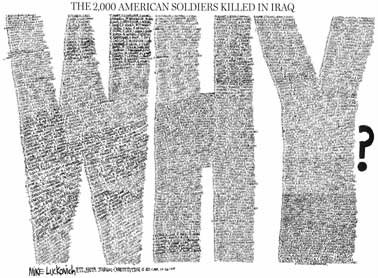
Cartoon by Mike Luckovich
Want to see the names in an enlarged version?
Download a full-size PDF of this illustration (1.1 MB)
Sunday, October 30, 2005
Died in Iraq :: Age 22 - Cpl Jeffery Star :: The story
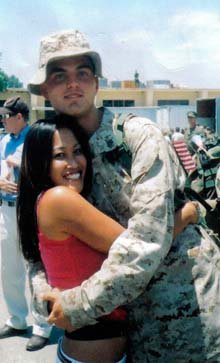
CPL. JEFFREY B. STARR: WHAT THE NYTIMES LEFT OUT
On Wednesday, the NYTimes published a 4,625-word opus on the "2,000 dead" milestone--a "grim mark," read the headline--on page A2. Among those profiled were Marines from the First Battalion of the Fifth Marine Regiment, including Cpl. Jeffrey B. Starr. Here's an excerpt from the Times' passage about Cpl. Starr:
Another member of the 1/5, Cpl. Jeffrey B. Starr, rejected a $24,000 bonus to re-enlist. Corporal Starr believed strongly in the war, his father said, but was tired of the harsh life and nearness of death in Iraq. So he enrolled at Everett Community College near his parents' home in Snohomish, Wash., planning to study psychology after his enlistment ended in August.But he died in a firefight in Ramadi on April 30 during his third tour in Iraq. He was 22.
Sifting through Corporal Starr's laptop computer after his death, his father found a letter to be delivered to the marine's girlfriend. ''I kind of predicted this,'' Corporal Starr wrote of his own death. ''A third time just seemed like I'm pushing my chances.''
Last night, I received a letter from Corporal Starr's uncle, Timothy Lickness. He wanted you to know the rest of the story--and the parts of Corporal Starr's letter that the Times failed to include:
Yesterday's New York Times on-line edition carried the story of the 2000 Iraq US military death[s]. It grabbed my attention as the picture they used with the headline was that of my nephew, Cpl Jeffrey B. Starr, USMC.Unfortunately they did not tell Jeffrey's story. Jeffrey believed in what he was doing. He [was] willing put his life on the line for this cause. Just before he left for his third tour of duty in Iraq I asked him what he thought about going back the third time. He said: "If we (Americans) don't do this (free the Iraqi people from tyranny) who will? No one else can."
Several months after Jeffrey was killed his laptop computer was returned to his parents who found a letter in it that was addressed to his girlfriend and was intended to be found only if he did not return alive. It is a most poignant letter and filled with personal feelings he had for his girlfriend. But of importance to the rest of us was his expression of how he felt about putting his life at risk for this cause. He said it with grace and maturity.
He wrote: "Obviously if you are reading this then I have died in Iraq. I kind of predicted this, that is why I'm writing this in November. A third time just seemed like I'm pushing my chances. I don't regret going, everybody dies but few get to do it for something as important as freedom. It may seem confusing why we are in Iraq, it's not to me. I'm here helping these people, so that they can live the way we live. Not have to worry about tyrants or vicious dictators. To do what they want with their lives. To me that is why I died. Others have died for my freedom, now this is my mark."
What Jeffrey said is important. Americans need to understand that most of those who are or have been there understand what's going on. It would honor Jeffrey's memory if you would publish the rest of his story.
Mr. Lickness also told me: "Even more than a Marine, Jeff was a man of God. At a recent memorial service at Camp Pendleton for the 16 Marines from his unit killed in Iraq we got to meet the men who were with him when he died. They told us of his bravery under fire, his leadership, his humor and his humanity. America lost the best it has, but the family knows he's with his Heavenly Father and we will see him again."
What They Left Out
Michelle Malkin got a letter from the uncle of a marine mentioned in the New York Times article about the 2,000th military death. The marine, Cpl. Jeffery B. Starr, had left a letter on his laptop for his girlfriend to read in the event of his death. The Times quoted part of the letter in its story:
Sifting through Corporal Starr's laptop computer after his death, his father found a letter to be delivered to the marine's girlfriend. ''I kind of predicted this,'' Corporal Starr wrote of his own death. ''A third time just seemed like I'm pushing my chances.''
But as Starr's uncle pointed out, what the Times left out is astonishing:
He wrote: "Obviously if you are reading this then I have died in Iraq. I kind of predicted this, that is why I'm writing this in November. A third time just seemed like I'm pushing my chances. I don't regret going, everybody dies but few get to do it for something as important as freedom. It may seem confusing why we are in Iraq, it's not to me. I'm here helping these people, so that they can live the way we live. Not have to worry about tyrants or vicious dictators. To do what they want with their lives. To me that is why I died. Others have died for my freedom, now this is my mark."
Wednesday, October 05, 2005
New Benigni film finds love, laughs in Iraq war

ROME (Reuters) - Having sought to portray a lighter side to Nazi concentration camps, Italian actor-director Roberto Benigni is now looking for love and laughs in wartime Iraq.
"The Tiger and the Snow," which Benigni screened in Rome on Tuesday, is a romantic comedy that in many ways follows the Oscar-winning blueprint of his 1997 film "La Vita e' Bella" (Life is Beautiful).
Benigni is again the star of the film, and again chases after the woman of his dreams -- his real-life wife Nicoletta Braschi.
But this time, he must follow her into Baghdad shortly after the U.S.-led invasion in 2003. That takes the film, which was shot partly in Tunisia, into more difficult cinematic terrain as Benigni treads between fact and fiction in a war zone.
If his previous blockbuster offered triumphant images of U.S. troops liberating concentration camp victims, Benigni's latest work portrays them as occupying forces -- often nervous and unable to communicate with scared Iraqis taking cover.
He pokes fun at the U.S. search for weapons of mass destruction -- the original justification for the invasion -- playfully taking a fly-swatter and joking he has found one of the elusive weapons.
NO CRITIQUE OF U.S. TROOPS
Benigni said his film was mostly a love story, and did not seek to judge U.S. soldiers. He pointed to compassionate moments between troops and his main character, a poet named Attilio De Giovanni.
"The soldiers are seen as a 'presence'. There are no judgements made, for sure," Benigni told a news conference.
"Clearly the feeling that arises against war, I think it's very, very, very strong," he said. But he added that this vision comes from a main character who, as a poet, loves life.
Benigni masterfully creates room for comic release in otherwise tense moments, making audiences laugh during a slapstick dash into a minefield and an uncomfortable run-in with soldiers at a U.S.-manned roadblock.
Attilio had strapped medical supplies to his body -- stoking fears among the U.S. troops that he was a suicide bomber wrapped with explosives. He shouts "I'm Italian", as one jittery, soldier clutches a pointed weapon.
The scenario drew immediate comparisons to the March killing of an Italian intelligence agent, Nicola Calipari, who was accidentally shot dead by U.S. forces at a roadblock in Baghdad. But Benigni said his scene was written beforehand, adding "fiction preceded fact".
Benigni won an Oscar as best actor for Life Is Beautiful in which he played a Jewish father who protects his son from the horrors of a concentration camp by pretending it's all a game.
He was criticised by some for taking a light-hearted approach to such a grim subject. Benigni on Tuesday tried to head-off worry that he was trying to sugar-coat war by using it as a backdrop for a romantic comedy.
"It is not an ideological film," he said. "Many modern works on war -- not just modern ones -- try to speak to the mind. They are documentary works, they have a very powerful point of view. This film speaks to the heart."
The film will be released in Italy on October 14, but it is unclear when it will make its way into U.S. cinemas. Braschi said producers had still not selected a U.S. distributor.
Hollywood is also eyeing other projects related to the war in Iraq.
A new U.S. television drama about the Iraq war, "Over There," from veteran producer Steven Bochco, debuted this summer, and Universal Pictures is developing a film about the battle for Falluja, with Harrison Ford lined up to star as a general.
No production date has been set for that project, which is based on the book "No True Glory."
Report: Charges against US soldiers for abuse of Iraqis dismissed at higher rate
Report: Charges against US soldiers for abuse of Iraqis dismissed at higher rate
(AP) - DAYTON, Ohio-Charges against U.S. Army soldiers accused of crimes against Iraqis are dismissed or withdrawn at a higher rate than charges in which the victims are fellow soldiers or civilian military employees, a local newspaper reported.
An analysis by the Dayton Daily News of previously undisclosed records from the Army Court-Martial Management Information System database found that charges involving Iraqi victims were three times more likely to be dismissed or withdrawn by the Army than cases in which the victims were fellow soldiers or civilian military employees - 44 percent compared with 15 percent, the newspaper said.
Click here to find out more!
The report found that 226 U.S. soldiers were charged with offenses between the first deployments in March 2003 and Jan. 1, 2005. Of the 1,038 separate charges, fewer than one in 10 involved crimes against Iraqis. Virtually all of the rest involved crimes against other soldiers, property drug or alcohol offenses, and violations of military rules, the Daily News said.
The Daily News said that despite evidence and convictions in some cases in which the victims were Iraqis, only a small percentage resulted in punishments approaching those routinely imposed for such crimes by civilian justice systems.
The newspaper cited one case in which two U.S. soldiers were convicted of robbing an Iraqi shopkeeper. One soldier was sentenced to five months' confinement and the other to one month.
The median sentence imposed for all types of robbery in the United States, with or without the use of firearms, is five years.
"I've been surprised at some of the lenient sentences," said Gary Solis, a former military judge and prosecutor who teaches military law at the U.S. Military Academy at West Point. "I have an uneasy suspicion that it relates to the nationality of the victim."
Solis said criminal acts by U.S. soldiers - and the lack of punishment - could add to the hatred fueling insurgents in Iraq, putting soldiers at greater risk.
Human Rights Watch, a U.S. rights group, last month issued a report based on soldiers' accounts that found U.S. Army troops had subjected Iraqi detainees to severe beatings and other torture at a base in central Iraq from 2003 through 2004, often under orders or with the approval of superior officers.
The group said that in most cases, the military used closed administrative hearings where they handed down light administrative punishments such as pay reductions and reprimands, instead of criminal prosecutions before courts-martial.
Pentagon spokeswoman Lt. Col. Pamela Hart defended the Army's handling of criminal cases in Iraq, saying every allegation of abuse is investigated.
"Each investigation is unique and has various facts and circumstances," Hart said Monday. "We do investigate those thoroughly to ensure we take the appropriate actions. When wrongdoings are revealed, the commanders do punish appropriately. The uniform code of military justice is fair and sound."
Hart said that in at least three cases, five defendants charged with crimes against Iraqis got sentences ranging from five years to life with possibility for parole.
"To date, there have been dozens of courts-martial, non-judicial punishments and other adverse administrative actions against soldiers for misconduct pertaining to Iraqi citizens," she said.
Last week, U.S. Army Pfc. Lynndie England, whose smiling poses in photos of detainee abuse at Baghdad's Abu Ghraib prison, made her the most recognizable face of the scandal, was sentenced to 3 years in prison. England was found guilty of one count of conspiracy, four counts of maltreating detainees and one count of committing an indecent act. She was acquitted on a second conspiracy count.
England's trial was the last for a group of nine Army reservists charged with mistreating prisoners at Abu Ghraib, a scandal that badly damaged the United States' image in the Muslim world, despite quick condemnation of the abuse by U.S. President George W. Bush. Two other troops were convicted in trials, and the remaining six made plea deals.
(AP) - DAYTON, Ohio-Charges against U.S. Army soldiers accused of crimes against Iraqis are dismissed or withdrawn at a higher rate than charges in which the victims are fellow soldiers or civilian military employees, a local newspaper reported.
An analysis by the Dayton Daily News of previously undisclosed records from the Army Court-Martial Management Information System database found that charges involving Iraqi victims were three times more likely to be dismissed or withdrawn by the Army than cases in which the victims were fellow soldiers or civilian military employees - 44 percent compared with 15 percent, the newspaper said.
Click here to find out more!
The report found that 226 U.S. soldiers were charged with offenses between the first deployments in March 2003 and Jan. 1, 2005. Of the 1,038 separate charges, fewer than one in 10 involved crimes against Iraqis. Virtually all of the rest involved crimes against other soldiers, property drug or alcohol offenses, and violations of military rules, the Daily News said.
The Daily News said that despite evidence and convictions in some cases in which the victims were Iraqis, only a small percentage resulted in punishments approaching those routinely imposed for such crimes by civilian justice systems.
The newspaper cited one case in which two U.S. soldiers were convicted of robbing an Iraqi shopkeeper. One soldier was sentenced to five months' confinement and the other to one month.
The median sentence imposed for all types of robbery in the United States, with or without the use of firearms, is five years.
"I've been surprised at some of the lenient sentences," said Gary Solis, a former military judge and prosecutor who teaches military law at the U.S. Military Academy at West Point. "I have an uneasy suspicion that it relates to the nationality of the victim."
Solis said criminal acts by U.S. soldiers - and the lack of punishment - could add to the hatred fueling insurgents in Iraq, putting soldiers at greater risk.
Human Rights Watch, a U.S. rights group, last month issued a report based on soldiers' accounts that found U.S. Army troops had subjected Iraqi detainees to severe beatings and other torture at a base in central Iraq from 2003 through 2004, often under orders or with the approval of superior officers.
The group said that in most cases, the military used closed administrative hearings where they handed down light administrative punishments such as pay reductions and reprimands, instead of criminal prosecutions before courts-martial.
Pentagon spokeswoman Lt. Col. Pamela Hart defended the Army's handling of criminal cases in Iraq, saying every allegation of abuse is investigated.
"Each investigation is unique and has various facts and circumstances," Hart said Monday. "We do investigate those thoroughly to ensure we take the appropriate actions. When wrongdoings are revealed, the commanders do punish appropriately. The uniform code of military justice is fair and sound."
Hart said that in at least three cases, five defendants charged with crimes against Iraqis got sentences ranging from five years to life with possibility for parole.
"To date, there have been dozens of courts-martial, non-judicial punishments and other adverse administrative actions against soldiers for misconduct pertaining to Iraqi citizens," she said.
Last week, U.S. Army Pfc. Lynndie England, whose smiling poses in photos of detainee abuse at Baghdad's Abu Ghraib prison, made her the most recognizable face of the scandal, was sentenced to 3 years in prison. England was found guilty of one count of conspiracy, four counts of maltreating detainees and one count of committing an indecent act. She was acquitted on a second conspiracy count.
England's trial was the last for a group of nine Army reservists charged with mistreating prisoners at Abu Ghraib, a scandal that badly damaged the United States' image in the Muslim world, despite quick condemnation of the abuse by U.S. President George W. Bush. Two other troops were convicted in trials, and the remaining six made plea deals.
Monday, October 03, 2005
CBS News | Ike Was Right About War Machine | October 3, 2005
The following is a weekly 60 Minutes commentary by CBS News correspondent Andy Rooney.
I'm not really clear how much a billion dollars is but the United States our United States is spending $5.6 billion a month fighting this war in Iraq that we never should have gotten into. We still have 139,000 soldiers in Iraq today. Almost 2,000 Americans have died there. For what? Now we have the hurricanes to pay for.
One way our government pays for a lot of things is by borrowing from countries like China. Another way the government is planning to pay for the war and the hurricane damage is by cutting spending for things like Medicare prescriptions, highway construction, farm payments, AMTRAK, National Public Radio and loans to graduate students. Do these sound like the things you'd like to cut back on to pay for Iraq? I'll tell you where we ought to start saving: on our bloated military establishment. We're paying for weapons we'll never use.
No other Country spends the kind of money we spend on our military. Last year Japan spent $42 billion. Italy spent $28 billion, Russia spent only $19 billion. The United States spent $455 billion. We have 8,000 tanks for example. One Abrams tank costs 150 times as much as a Ford station wagon. We have more than 10,000 nuclear weapons enough to destroy all of mankind. We're spending $200 million a year on bullets alone. That's a lot of target practice.
I'll tell you where we ought to start saving: on our bloated military establishment. We're paying for weapons we'll never use. No other Country spends the kind of money we spend on our military. Last year Japan spent $42 billion. Italy spent $28 billion, Russia spent only $19 billion. The United States spent $455 billion. We have 8,000 tanks for example. One Abrams tank costs 150 times as much as a Ford station wagon. We have more than 10,000 nuclear weapons enough to destroy all of mankind. We're spending $200 million a year on bullets alone. That's a lot of target practice. We have 1,155,000 enlisted men and women and 225,000 officers. One officer to tell every five enlisted soldier what to do. We have 40,000 colonels alone and 870 generals.
We had a great ccommander in WWII, Dwight Eisenhower. He became President and on leaving the White House in 1961, he said this: “We must guard against the acquisition of unwarranted influence, whether sought or unsought, by the military-industrial complex. The potential for the disastrous rise of misplaced power exists and will persist. …" Well, Ike was right. That's just what’s happened"
I'm not really clear how much a billion dollars is but the United States our United States is spending $5.6 billion a month fighting this war in Iraq that we never should have gotten into. We still have 139,000 soldiers in Iraq today. Almost 2,000 Americans have died there. For what? Now we have the hurricanes to pay for.
One way our government pays for a lot of things is by borrowing from countries like China. Another way the government is planning to pay for the war and the hurricane damage is by cutting spending for things like Medicare prescriptions, highway construction, farm payments, AMTRAK, National Public Radio and loans to graduate students. Do these sound like the things you'd like to cut back on to pay for Iraq? I'll tell you where we ought to start saving: on our bloated military establishment. We're paying for weapons we'll never use.
No other Country spends the kind of money we spend on our military. Last year Japan spent $42 billion. Italy spent $28 billion, Russia spent only $19 billion. The United States spent $455 billion. We have 8,000 tanks for example. One Abrams tank costs 150 times as much as a Ford station wagon. We have more than 10,000 nuclear weapons enough to destroy all of mankind. We're spending $200 million a year on bullets alone. That's a lot of target practice.
I'll tell you where we ought to start saving: on our bloated military establishment. We're paying for weapons we'll never use. No other Country spends the kind of money we spend on our military. Last year Japan spent $42 billion. Italy spent $28 billion, Russia spent only $19 billion. The United States spent $455 billion. We have 8,000 tanks for example. One Abrams tank costs 150 times as much as a Ford station wagon. We have more than 10,000 nuclear weapons enough to destroy all of mankind. We're spending $200 million a year on bullets alone. That's a lot of target practice. We have 1,155,000 enlisted men and women and 225,000 officers. One officer to tell every five enlisted soldier what to do. We have 40,000 colonels alone and 870 generals.
We had a great ccommander in WWII, Dwight Eisenhower. He became President and on leaving the White House in 1961, he said this: “We must guard against the acquisition of unwarranted influence, whether sought or unsought, by the military-industrial complex. The potential for the disastrous rise of misplaced power exists and will persist. …" Well, Ike was right. That's just what’s happened"
Thursday, September 29, 2005
Judge Orders Release of Abu Ghraib graphic pictures
NEW YORK A federal judge ruled today that graphic pictures of detainee abuse at Iraq's Abu Ghraib prison must be released over government claims that they could damage America's image. Last year a Republican senator conceded that they contained scenes of "rape and murder" and Secretary of Defense Donald Rumsfeld said they included acts that were "blatantly sadistic."
U.S. District Judge Alvin K. Hellerstein ordered the release of certain pictures in a 50-page decision that said terrorists in Iraq and Afghanistan have proven they "do not need pretexts for their barbarism."The ACLU has sought the release of 87 photographs and four videotapes taken at the prison as part of an October 2003 lawsuit demanding information on the treatment of detainees in U.S. custody and the transfer of prisoners to countries known to use torture. Gen. John Abizaid, commander of U.S. Central Command, said Thursday that releasing the photos would hinder his work against terrorism.
"When we continue to pick at the wound and show the pictures over and over again it just creates the image--a false image--like this is the sort of stuff that is happening anew, and it's not," Abizaid said.The judge said, however, that "the freedoms that we champion are as important to our success in Iraq and Afghanistan as the guns and missiles with which our troops are armed.
"An ACLU release this afternoon said it was getting 70 photos and three video tapes. It also said that the government is being given 20 days to appeal. What is shown on the photographs and videos from Abu Ghraib prison that the Pentagon has blocked from release?
One clue: Defense Secretary Donald Rumsfeld told Congress last year, after viewing a large cache of unreleased images, "I mean, I looked at them last night, and they're hard to believe." They show acts "that can only be described as blatantly sadistic, cruel and inhumane," he added.A Republican Senator suggested the same day they contained scenes of "rape and murder." Rumsfeld then commented, "If these are released to the public, obviously it's going to make matters worse."
The photos were among thousands turned over by the key "whistleblower" in the scandal, Specialist Joseph M. Darby. Just a few that were released to the press sparked the Abu Ghraib abuse scandal last year, and the video images are said to be even more shocking.“Today's historic ruling is a step toward ensuring that our government's leaders are held accountable for the abuse and torture that happened on their watch,” said ACLU Executive Director Anthony D. Romero.
“The American public has a right to know what happened in American detention centers, and how our leaders let it occur."One Pentagon lawyer has argued that they should not be released because they would only add to the humiliation of the prisoners. But the ACLU has said the faces of the victims can easily be "redacted."
To get a sense of what may be shown in these images, one has to go back to press reports from when the Abu Ghraib abuse scandal was still front page news.This is how CNN reported it on May 8, 2004, in a typical account that day:"U.S. Defense Secretary Donald Rumsfeld revealed Friday that videos and 'a lot more pictures' exist of the abuse of Iraqis held at Abu Ghraib prison.
"'If these are released to the public, obviously it's going to make matters worse,' Rumsfeld told the Senate Armed Services Committee. 'I mean, I looked at them last night, and they're hard to believe.'"The embattled defense secretary fielded sharp and skeptical questions from lawmakers as he testified about the growing prisoner abuse scandal. A military report about that abuse describes detainees being threatened, sodomized with a chemical light and forced into sexually humiliating poses."Charges have been brought against seven service members, and investigations into events at the prison continue."Military investigators have looked into -- or are continuing to investigate -- 35 cases of alleged abuse or deaths of prisoners in detention facilities in the Central Command theater, according to Army Secretary Les Brownlee. Two of those cases were deemed homicides, he said.
"'The American public needs to understand we're talking about rape and murder here. We're not just talking about giving people a humiliating experience,' Republican Sen. Lindsey Graham of South Carolina told reporters after Rumsfeld testified before the Senate Armed Services Committee. 'We're talking about rape and murder -- and some very serious charges.'"
A report by Maj. Gen. Antonio Taguba on the abuse at the prison outside Baghdad says videotapes and photographs show naked detainees, and that groups of men were forced to masturbate while being photographed and videotaped.
Taguba also found evidence of a 'male MP guard having sex with a female detainee.'"Rumsfeld told Congress the unrevealed photos and videos contain acts 'that can only be described as blatantly sadistic, cruel and inhuman.'"The military later screened some of the images for lawmakers, who said they showed, among other things, attack dogs snarling at cowed prisoners, Iraqi women forced to expose their breasts, and naked prisoners forced to have sex with each other.In the same period, reporter Seymour Hersh, who helped uncover the scandal, said in a speech before an ACLU convention: "Some of the worse that happened that you don't know about, ok? Videos, there are women there. Some of you may have read they were passing letters, communications out to their men ... . The women were passing messages saying 'Please come and kill me, because of what's happened.'"Basically what happened is that those women who were arrested with young boys/children in cases that have been recorded. The boys were sodomized with the cameras rolling. The worst about all of them is the soundtrack of the boys shrieking that your government has. They are in total terror it's going to come out."
Judge Hellerstein said today that publication of the photographs will help to answer questions not only about the unlawful conduct of American soldiers, but about “the command structure that failed to exercise discipline over the troops, and the persons in that command structure whose failures in exercising supervision may make them culpable along with the soldiers who were court-martialed for perpetrating the wrongs
U.S. District Judge Alvin K. Hellerstein ordered the release of certain pictures in a 50-page decision that said terrorists in Iraq and Afghanistan have proven they "do not need pretexts for their barbarism."The ACLU has sought the release of 87 photographs and four videotapes taken at the prison as part of an October 2003 lawsuit demanding information on the treatment of detainees in U.S. custody and the transfer of prisoners to countries known to use torture. Gen. John Abizaid, commander of U.S. Central Command, said Thursday that releasing the photos would hinder his work against terrorism.
"When we continue to pick at the wound and show the pictures over and over again it just creates the image--a false image--like this is the sort of stuff that is happening anew, and it's not," Abizaid said.The judge said, however, that "the freedoms that we champion are as important to our success in Iraq and Afghanistan as the guns and missiles with which our troops are armed.
"An ACLU release this afternoon said it was getting 70 photos and three video tapes. It also said that the government is being given 20 days to appeal. What is shown on the photographs and videos from Abu Ghraib prison that the Pentagon has blocked from release?
One clue: Defense Secretary Donald Rumsfeld told Congress last year, after viewing a large cache of unreleased images, "I mean, I looked at them last night, and they're hard to believe." They show acts "that can only be described as blatantly sadistic, cruel and inhumane," he added.A Republican Senator suggested the same day they contained scenes of "rape and murder." Rumsfeld then commented, "If these are released to the public, obviously it's going to make matters worse."
The photos were among thousands turned over by the key "whistleblower" in the scandal, Specialist Joseph M. Darby. Just a few that were released to the press sparked the Abu Ghraib abuse scandal last year, and the video images are said to be even more shocking.“Today's historic ruling is a step toward ensuring that our government's leaders are held accountable for the abuse and torture that happened on their watch,” said ACLU Executive Director Anthony D. Romero.
“The American public has a right to know what happened in American detention centers, and how our leaders let it occur."One Pentagon lawyer has argued that they should not be released because they would only add to the humiliation of the prisoners. But the ACLU has said the faces of the victims can easily be "redacted."
To get a sense of what may be shown in these images, one has to go back to press reports from when the Abu Ghraib abuse scandal was still front page news.This is how CNN reported it on May 8, 2004, in a typical account that day:"U.S. Defense Secretary Donald Rumsfeld revealed Friday that videos and 'a lot more pictures' exist of the abuse of Iraqis held at Abu Ghraib prison.
"'If these are released to the public, obviously it's going to make matters worse,' Rumsfeld told the Senate Armed Services Committee. 'I mean, I looked at them last night, and they're hard to believe.'"The embattled defense secretary fielded sharp and skeptical questions from lawmakers as he testified about the growing prisoner abuse scandal. A military report about that abuse describes detainees being threatened, sodomized with a chemical light and forced into sexually humiliating poses."Charges have been brought against seven service members, and investigations into events at the prison continue."Military investigators have looked into -- or are continuing to investigate -- 35 cases of alleged abuse or deaths of prisoners in detention facilities in the Central Command theater, according to Army Secretary Les Brownlee. Two of those cases were deemed homicides, he said.
"'The American public needs to understand we're talking about rape and murder here. We're not just talking about giving people a humiliating experience,' Republican Sen. Lindsey Graham of South Carolina told reporters after Rumsfeld testified before the Senate Armed Services Committee. 'We're talking about rape and murder -- and some very serious charges.'"
A report by Maj. Gen. Antonio Taguba on the abuse at the prison outside Baghdad says videotapes and photographs show naked detainees, and that groups of men were forced to masturbate while being photographed and videotaped.
Taguba also found evidence of a 'male MP guard having sex with a female detainee.'"Rumsfeld told Congress the unrevealed photos and videos contain acts 'that can only be described as blatantly sadistic, cruel and inhuman.'"The military later screened some of the images for lawmakers, who said they showed, among other things, attack dogs snarling at cowed prisoners, Iraqi women forced to expose their breasts, and naked prisoners forced to have sex with each other.In the same period, reporter Seymour Hersh, who helped uncover the scandal, said in a speech before an ACLU convention: "Some of the worse that happened that you don't know about, ok? Videos, there are women there. Some of you may have read they were passing letters, communications out to their men ... . The women were passing messages saying 'Please come and kill me, because of what's happened.'"Basically what happened is that those women who were arrested with young boys/children in cases that have been recorded. The boys were sodomized with the cameras rolling. The worst about all of them is the soundtrack of the boys shrieking that your government has. They are in total terror it's going to come out."
Judge Hellerstein said today that publication of the photographs will help to answer questions not only about the unlawful conduct of American soldiers, but about “the command structure that failed to exercise discipline over the troops, and the persons in that command structure whose failures in exercising supervision may make them culpable along with the soldiers who were court-martialed for perpetrating the wrongs
Wednesday, September 07, 2005
Piecing together the story of the weapons that weren't
Piecing together the story of the weapons that weren't
By Charles J. Hanley, The Associated Press
Beneath the giant dome of a Baghdad palace, facing his team of scientists and engineers, George Tenet sounded more like a football coach than a spymaster, a coach who didn't know the game was over.
Weapons of mass destruction were not found by these U.N. weapons inspectors, right, in Baghdad Feb. 5, 2003, nor since.
By David Guttenfelder, AP
"Are we 85% done?" the CIA boss demanded. The arms hunters knew what he wanted to hear. "No!" they shouted back. "Let me hear it again!" They shouted again.
The weapons are out there, Tenet insisted. Go find them.
Veteran inspector Rod Barton couldn't believe his ears. "It was nonsense," the Australian biologist said of that February evening last year, when the then-chief of U.S. intelligence secretly flew to Baghdad and dropped in on the lakeside Perfume Palace, chandelier-hung home of the Iraq Survey Group.
"It wasn't that we didn't know the major answers," recalled Barton, whose account matched that of another key participant. "Are there WMD in the country? We knew the answers."
In fact, David Kay, quitting as chief of the U.S. hunt for WMD, or weapons of mass destruction, had just delivered the answer to the world. The inspectors were 85% finished, Kay said, concluding: "The weapons do not exist."
The story of the weapons that weren't there, the prelude to war, was over, but a long post-mortem is still unfolding — of lingering questions in Washington, of revelations from investigations, leaks, first-person accounts. Some 52% of Americans believe the Bush administration deliberately misled them about the presence of banned arms in Iraq, according to a Washington Post-ABC News poll taken in June.
Hans Blix, U.N. inspector, says Washington's "virtual reality" about Iraq eventually collided with "our old-fashioned ordinary reality." Now, drawing from findings of the Iraq Survey Group and other official investigations, from U.N., U.S., Iraqi and British documents, from Associated Press interviews and on-scene reporting, from books by Blix and others, it's possible to reconstruct much of the "ordinary reality" of this extraordinary story, one that has changed the course of history.
By Mario Tama, Getty Images
U.N. Secretary-General Kofi Annan, left, and Hans Blix listen as Colin Powell make a case against Iraq on Feb. 5, 2003. Blix battled U.S. impatience for war while leading inspections in Iraq.
Destroyed in 1991
The story could begin behind the creamy stone walls of another palace, the hilltop Hashemiyah outside Amman, Jordan, where in August 1995 a prize Iraqi defector was pouring out for interrogators whatever they wanted to know about Baghdad's weapons of mass destruction.
Hussein Kamel, son-in-law of President Saddam Hussein, had headed Iraq's advanced arms programs during the Iran-Iraq War of the 1980s, when the Baathist regime unleashed chemical weapons against Iranian troops and Iraqi civilians in rebellious Kurdish areas.
What the U.N., American and other debriefers learned from Kamel led to headline-making successes for U.N. inspectors as they tracked down banned arms-making gear inside Iraq.
But an interrogation transcript shows he told them something else as well, something they questioned and kept to themselves: All Iraqi WMD were destroyed in 1991.
Hussein Kamel, soon to be killed by fellow clansmen as a traitor, was telling the truth.
The U.N. experts had entered Iraq in 1991, after U.S.-led forces drove Iraq's invasion army from Kuwait in a lightning war, and the U.N. Security Council required the defeated nation to submit to inspections and destruction of its unconventional arms.
The inspectors withdrew in late 1998, in a dispute over access to sites. By then, International Atomic Energy Agency (IAEA) teams could report that Iraq's nuclear program, which never built a bomb, had been dismantled. As for chemical and biological weapons, only scattered questions remained about possible hidden stockpiles.
In fact, as President George W. Bush took office 25 months later, the CIA was reporting, "We do not have any direct evidence" Baghdad was rebuilding its WMD programs.
Baghdad on his mind
Bush, however, concentrated on Iraq's capital.
The new president quickly called an inner Cabinet meeting to discuss Iraq as a destabilizing force in the Mideast, ex-Treasury Secretary Paul O'Neill recalls in the book, The Price of Loyalty. Tenet unrolled a grainy satellite photo of an Iraqi factory, suggested it was making banned weapons, but said his CIA didn't really know, O'Neill said.
Washington and Baghdad had glowered at each other throughout Bill Clinton's presidency, but for a decade it was largely a cold war. Now Bush was ending this White House meeting by ordering Defense Secretary Donald H. Rumsfeld to study possible military action, O'Neill said. Soon U.S. policymakers began hearing more about Iraq.
In April 2001, Pentagon intelligence said satellites spotted construction at old nuclear sites. Was Iraq resuming bomb research? That same month a CIA report told of another "indicator": Iraq was shopping for thousands of high-strength aluminum tubes, said to be useful as cores of centrifuges to enrich uranium, the stuff of atom bombs.
Then a shipment of the tubes was intercepted in neighboring Jordan, news that upset Baghdad's military industry chief. Abdel Tawab Huweish needed those tubes — 3 feet long, 3 inches wide — to make standard artillery rockets. He now ordered another metal be found, one that wouldn't arouse U.S. suspicions, Huweish later told U.S. arms investigators.
On April 11, 2001, a day after the classified CIA report was distributed, the Energy Department filed a swift dissent. Energy, home of U.S. centrifuge specialists, said the tubes' dimensions weren't well-suited for centrifuges, and were more likely meant for artillery rockets. The U.N. nuclear agency, the Vienna-based IAEA, told U.S. officials the same.
Evidence shows Iraq in 2001 had little interest in nuclear "reconstitution." In one captured document from that May, Iraqi diplomats in Kenya reported to Baghdad that a Ugandan businessman had offered uranium for sale, but they turned him away, saying U.N. sanctions forbade it.
Other 'indicators' surface
The Defense Intelligence Agency (DIA) for months had been receiving reports from German intelligence about an Iraqi defector, code-named "Curveball," who claimed to have worked on a project to build concealed bioweapons labs atop truck trailers.
Around this time, in June 2001, the trailers that U.S. officials later thought confirmed his account were ordered built at the al-Kindi factory in northern Iraq, inspectors would learn. Contract No. 73/MD/RG/2001 called not for secret weapons labs, however, but for two trailer units to make hydrogen for weather balloons. By this time, too, U.S. intelligence had been informed that Curveball was a possible alcoholic and "out of control."
The tubes tale, Curveball's account and other questionable stories about Iraqi WMD would survive for two years, in presidential speeches and newspaper headlines, on the road to war.
For now, in the summer of 2001, Iraq was back-page news. But Condoleezza Rice, national security adviser, assured an interviewer, "Saddam Hussein is on the radar screen." By summer's end, in the traumatic aftermath of Sept. 11's terror, he was in the crosshairs.
Post-9/11
On the day after Sept. 11, the talk in the White House Situation Room was of "getting Iraq," says former White House anti-terrorism chief Richard A. Clarke. Clarke's memoir says an insistent Bush ordered him to look for "any shred" to tie Iraq to the Sept. 11 attacks — even though U.S. agencies knew al-Qaeda was responsible and Iraq wasn't linked to the terror group.
By Alex Wong, AFP/Getty Images
Joseph Wilson reported the story of Iraq receiving uranium from Nigeria was unfounded.
The immediate target was Afghanistan, however, invaded by U.S. forces in October 2001, and as 2002 began the WMD case against Iraq remained unimpressive. In his annual unclassified review, Tenet didn't even cite evidence of an imminent Iraqi nuclear threat. But Vice President Dick Cheney apparently thought he'd found such evidence, in a DIA report.
It told of a deal in 2000 in which Iraq bought 500 tons of uranium concentrate from Niger in central Africa. The information came from Italian intelligence, based on what it said was an official Niger document. Because of Cheney's interest, the CIA dispatched a seasoned Africa hand, ex-diplomat Joseph Wilson, to Niger to check it out.
After dozens of interviews, Wilson reported back that the story appeared unfounded. The State Department's intelligence bureau also deemed it implausible. In addition, the text of the supposed Niger document, transcribed for the Americans by the Italians, contained misspellings and mistaken titles for people that should have been easily detectable.
It was a forgery. But "Niger uranium" had won a place in the case against Iraq.
Building a coalition
In Iraq itself, the government was far from resurrecting a bomb program: In April 2002 workers in the western desert were busy smelting down the last gear from a long-defunct uranium-enrichment project, U.S. inspectors later learned.
Around this time, U.S. satellite reconnaissance was doubled over suspected Iraqi WMD sites, and analysts soon reported stepped-up activity, suggesting renewed production, at possible chemical weapons factories. What they apparently didn't realize, however, was that activity was being photographed more frequently — not that there necessarily was more activity.
The White House, meanwhile, worked on a political plan.
Leaked British documents show that Prime Minister Tony Blair told Bush at his Texas ranch in April 2002 that London would support military action to oust Saddam. But the British set conditions: Washington should seek re-entry of U.N. inspectors — which Saddam was expected to refuse — and then Security Council authorization for war.
Blair's Cabinet fretted. Foreign Secretary Jack Straw, in the secret minutes of a July 2002 meeting, observed that the case for war was "thin" but Bush had made up his mind. Intelligence chief Richard Dearlove, fresh from high-level Washington talks, also told the 10 Downing St. session that war had become inevitable, and U.S. intelligence was being "fixed" around this policy.
Blair and U.S. officials now deny war was predetermined and intelligence "fixed" to that end. From midsummer 2002 on, however, the Bush administration sharply stepped up its anti-Iraq rhetoric, along with U.S. air attacks on Iraqi defenses, done under cover of patrols over the "no-fly zones," swaths of Iraqi airspace denied to Iraqi aircraft. It also stepped up its citing of questionable intelligence.
As early as July 29, Rumsfeld spoke publicly of reports of Iraqi bioweapons labs "on wheels in a trailer" that can "make a lot of bad stuff."
A second Iraqi exile source had echoed Curveball's talk of such trailers. He was judged a fabricator by the CIA in early 2002, but by July his statements were back in classified U.S. reports. As for Curveball, whose veracity was never checked by the DIA, within three months his German handlers would be telling the CIA he was unreliable, a "waste of time."
As the summer wore on, Cheney struck an urgent, unequivocal tone in public.
"Simply stated, there is no doubt that Saddam Hussein now has weapons of mass destruction," the vice president told veterans assembled at an Opryland hotel in Nashville.
In an unusual move, Cheney shuttled to the CIA through mid-2002 to visit analysts 10 times, according to Patricia Wald, a member of the presidential investigative commission headed by Judge Laurence Silberman and ex-U.S. Sen. Charles Robb. The commission concluded analysts "worked in an environment that did not encourage skepticism about the conventional wisdom."
Strong as aluminum
That conventional wisdom took on more urgency on Sunday, Sept. 8, 2002, when the lead article in The New York Times, citing unnamed administration officials, said Iraq "has embarked on a worldwide hunt for materials to make an atomic bomb."
The "tubes" story had been resurrected. Condoleezza Rice went on the TV talk circuit that morning saying the tubes were suited only for uranium centrifuges. Four days later in New York, President Bush was at the marble podium of the U.N. General Assembly, demanding the world body take action on Iraq or become "irrelevant." He, too, cited the aluminum tubes — proof of danger.
But neither the Times story nor administration officials hinted at the background debate over whether the tubes, in reality, were meant for Huweish's rockets. In fact, a CIA officer had recently suggested obtaining dimensions of an Italian rocket on which the Iraqi design was based, to compare them with the tubes. His idea was rejected.
As U.S. officials built up the threat, Saddam handed them a surprise: Iraq would allow Blix's U.N. inspectors back unconditionally.
Bush promptly labeled the Sept. 16 announcement a "ploy." But Iraq's foreign minister, Naji Sabri, told the General Assembly his country was "totally clear" of banned arms.
White Paper and not read
Democratic senators, wary as war momentum built in Washington, demanded a comprehensive intelligence report on Iraq. The CIA and other agencies patched together a classified National Intelligence Estimate, made available to lawmakers in early October.
Its unclassified version, a 25-page White Paper, was packed with "probablys," "mays" and "coulds," uncertainties that somehow led to certainties: "Iraq has continued its weapons of mass destruction programs," and "Baghdad has chemical and biological weapons."
It would eventually emerge that the DIA, a month before the White Paper, had reported there was "no reliable information" on Iraqi chemical weapons production, and it didn't know the nature, amounts or condition of any biological weapons.
Across the Atlantic, Blair's government issued an assessment like the U.S. estimate, with conclusions unsupported by evidence.
"We were told there was other intelligence that we, the experts, could not see," senior British government analyst Brian Jones has since said. It later became clear such intelligence never existed, Jones said.
The Australian biologist Barton, a 1990s weapons inspector who by 2002 was a top Blix aide, was amazed at the British report's unexplained claim that Iraq could "deploy" chemical or biological weapons "within 45 minutes" — a claim picked up by Bush in a radio address.
Over an Irish-pub dinner in New York, Barton asked old friend David Kelly, a British bioweapons specialist, how he could have allowed something "so silly" in the report. "He just shook his head and said something like, 'People put in what they want to put in,'" Barton recalled.
Months later Kelly would commit suicide, caught in a political furor as a source for news reports that the WMD dossier was "sexed up."
The 93-page classified U.S. report had more qualifiers than the White Paper. But Wald says her commission learned that only 17 Congress members read the lengthier estimate. On Oct. 10-11, the two houses voted overwhelmingly to authorize Bush to use military force against Iraq.
U.N. debunking
Then the U.N. Security Council unanimously voted Nov. 8 to send Blix's inspectors to Iraq with expanded powers. It denied Washington "trigger" authority, however, to attack if the Americans deemed Iraq in violation of the resolution.
Blix knew U.S. leaders were impatient. In his book on the crisis, he writes that he met with Cheney at the White House and was told inspections could not go on forever, and Washington "was ready to discredit inspections in favor of disarmament" — that is, forcible disarmament.
On Nov. 27, 2002, the U.N. teams returned to Iraq. Springing surprise inspections across the countryside, the experts soon were debunking U.S. claims. At the Fallujah II chemical plant, for example, caught in a satellite's camera lens in the October U.S. estimate, they found the production line long broken-down.
By December, Saddam was informing senior generals in secret meetings that Iraq truly had no chemical or biological arms, U.S. investigators later learned. Baghdad's troops would have to fight without them.
Back in Washington, WMD "indicators" were being further undercut. "The Administration will ultimately look foolish — i.e. the tubes and Niger!" an Energy Department analyst told a colleague in an e-mail later uncovered by Senate Intelligence Committee investigators.
State of the Union
Preparing for Bush's 2003 State of the Union address, and sensing the weakness, Rice's national security staff asked the CIA for more. It responded with the report of a Niger uranium sale.
By Tim Dillon, USA TODAY
President Bush used shaky information in his State of the Union address in 2003. Vice President Dick Cheney, back, later told a TV audience that Iraq possessed nuclear weapons.
That story had grown still more dubious since Wilson's Niger visit 11 months earlier.
In October 2002, the State Department had obtained a copy of the original "Niger document." Its analysts told sister agencies they suspected forgery, and in mid-January alerted all that it "probably is a hoax." In October, too, Tenet had warned Rice's deputy, Stephen Hadley, against using the alleged uranium sale in a Bush speech.
This time, however, Hadley accepted the uranium nugget — though attributed to the British — to bolster the State of the Union speech.
The tubes story also had slipped deeper into murkiness. State Department intelligence was siding with Energy in viewing them as likely rocket casings. The CIA arranged for centrifuge-like testing of the tubes in January, and they seemed to fail, only to supposedly pass after a "correction" was made.
On Jan. 28, 2003, with the world listening, Bush delivered his annual address.
"The British government has learned that Saddam Hussein recently sought significant quantities of uranium from Africa," he said. "Our intelligence sources tell us that he has attempted to purchase high-strength aluminum tubes suitable for nuclear weapons production."
The U.S. chief executive also claimed Iraq had mobile bioweapons labs, but this story of Curveball's would fall further apart in the coming days.
On Feb. 3, 2003, word went up the CIA ladder that this Iraqi informant's German handlers "cannot vouch for the validity of the information." The next day, Senate investigators found, a CIA superior e-mailed a worried analyst that "this war's going to happen regardless of what Curve Ball said or didn't say."
Mr. Powell goes from Washington
The timing was critical — the eve of a pivotal presentation by Colin Powell.
By Mario Tama, Getty Images
Former Secretary of State Colin Powell held a vial of anthrax in trying to demonstrate to the U.N. Feb. 5, 2003 the threat Iraq posed.
That next morning, at the U.N. Security Council's horseshoe table, with CIA chief Tenet behind him, the secretary of state delivered an 80-minute indictment of Iraq, complete with aluminum tubes, up to "500 tons of chemical weapons agent," and artist's conceptions of Curveball's questionable "mobile labs."
Powell's sources went unidentified, tapes of intercepted conversation were cryptic, claims made about satellite photos were uncorroborated.
It turned out the State Department's own analysts had warned, futilely, against saying vehicles in spy photos were chemical "decontamination trucks," since they might be simple water trucks. And a senior CIA officer has told investigators he raised the Curveball concerns with Tenet the night before the speech, something Tenet denies.
After watching the performance on CNN in Baghdad, Amer al-Saadi, Iraqi liaison for the inspections, lamented that "the fiction goes on. It goes on and on."
But Powell's sober authority worked in America, where support for action soared.
Staunch against 'So-called inspections'
On the ground in Iraq, meanwhile, Blix's inspectors grew frustrated at the Iraqis' failure to explain leftover discrepancies from the 1990s. The chief inspector emphasized, however, that "unaccounted for" didn't necessarily mean weapons existed.
In one example, former Iraqi bioweapons specialists would eventually tell U.S. arms hunters that they never documented destruction of one batch of their anthrax in 1991 because it was dumped near a Saddam palace. They feared the dictator's wrath.
By January 2003, the experts from Blix's U.N. commission and Mohamed ElBaradei's IAEA had inspected 13 major "facilities of concern" from the previous fall's U.S. and British reports, and found no signs of weapons-making. The IAEA publicly exposed the Niger document as a forgery, and found the aluminum tubes poor candidates for centrifuges. Checking supposed sites for manufacturing mobile labs, Blix's teams debunked Curveball's tale at the Iraq end.
Washington was unmoved. Administration loyalists dismissed the "so-called inspections." In late February 2003, a Powell aide sternly told Blix nothing would suffice short of Iraq's unveiling its "secret hide sites." Most significantly, Bush ordered no reassessment of his government's collapsing claims.
Blix told the Security Council he could complete the work within months. The White House wasn't interested. "More time, more inspectors, more process, in our judgment, is not going to affect the peace of the world," Bush said on March 6, as the Pentagon counted down toward war.
Cheney at one point even told a TV audience — without challenge from the host — that Iraq possessed nuclear weapons. Of ElBaradei, whose IAEA refuted the claims about uranium and tubes, Cheney said, "I think Mr. ElBaradei, frankly, is wrong." But the CIA had already accepted ElBaradei's judgment on the Niger uranium document.
WMDs: 'That is what this war was about'
On March 17, in New York, U.S. diplomats gave up trying to win Security Council backing for war. That evening, on television, Bush told the American people there was "no doubt" Iraq had "some of the most lethal weapons ever devised."
The bombing began two days later, and as U.S. troops swept up the Tigris and Euphrates plain to easy victory, they searched for WMD. "We know where they are," Rumsfeld claimed on March 30. But despite a flurry of false "finds" by eager troops, they weren't there.
Just before the war, al-Kindi company technicians had tested the unit and it worked, its tubes spewing hydrogen for weather balloons. They could deliver on the 2001 contract. To empty-handed U.S. analysts, however, the vehicle and a second trailer looked like the artist's conception of Curveball's mobile labs, ready to concoct killer germs.
The White House embraced this illusion. "We found the weapons of mass destruction. We found biological laboratories," President Bush assured Polish television on May 29. By then, however, experts had tested a trailer and found no trace of pathogens or toxins.
"They have weapons of mass destruction. That is what this war was about," White House spokesman Ari Fleischer said on April 10. But soon the Washington line shifted to claims Iraq had not weapons, but WMD "programs" — also untrue, inspectors later certified. Then the war was framed as one to democratize Iraq.
Through 2003, Iraqis watched their land slip into a chaos of looting, terror bombings and anti-American insurgency. "A country was destroyed because of weapons that don't exist!" Baghdad University's president, Nihad Mohammed al-Rawi, despaired to an AP reporter.
Month by month, David Kay and his 1,500-member Iraq Survey Group labored over documents, visited sites, interrogated detained scientists and came to recognize reality. But when he wanted to report it, Kay ran into roadblocks in Washington.
"There was an absolutely closed mind," Kay tells AP. "They would not look at alternative explanations in these cases," specifically the aluminum tubes and bioweapons trailers.
In December 2003, Kay flew back to Washington and met with Tenet and CIA deputy John McLaughlin. "I couldn't budge John, and so I couldn't budge George," he says. Kay resigned, telling the U.S. Congress there had been no WMD threat.
Ex-CIA spokesman Bill Harlow, speaking for Tenet, points out that Kay himself, in Senate testimony at the time, said the tubes remained an "open question," although it was "more than probable" they were rocket casings.
'Fool's gold'
The Bush administration then sent Charles Duelfer — like Kay a senior U.N. inspector from the 1990s — to take over the arms hunt. He arrived in time for Tenet's secret visit and palace pep talk on Feb. 12, 2004, but, like Kay before him, Duelfer could find no sign of WMD.
Still, the pressure continued. Barton, recruited as a Duelfer adviser, told AP the American chief inspector received an e-mail that March from John Scarlett, head of Britain's Joint Intelligence Committee, urging that nine "nuggets," past allegations, be dropped back into an interim report by Duelfer's group.
Those "sexy bits," as the Australian called them, are believed to have included, for example, baseless speculation that Iraq worked to weaponize smallpox. Duelfer called the nuggets "fool's gold," Barton says, and left them out.
Asked about this, the British Foreign Office said Scarlett contacted Iraq Survey Group leaders as part of his job, but that the report's content was Duelfer's responsibility alone.
Barton said CIA officers in the Iraq Survey Group insisted that its reporting should not discredit the mobile-labs story "because that contradicts what Tenet has said." They also wanted the report to suggest the tubes might have been for centrifuges, although Duelfer's experts concluded otherwise.
Duelfer's interim testimony to Congress in March 2004 said nothing about mobile labs and said the tubes remained under study.
As late as Sept. 30 last year, in an election debate, Bush stuck to his views.
"Saddam Hussein had no intention of disarming," Bush maintained.
A week before, Duelfer had conveyed his 1,000-page final report to the CIA, saying Saddam had disarmed 13 years earlier.
Note: This reconstruction of what happened on the road to war in Iraq is based on government inquiries, official documents, fresh interviews and other sources.
By Charles J. Hanley, The Associated Press
Beneath the giant dome of a Baghdad palace, facing his team of scientists and engineers, George Tenet sounded more like a football coach than a spymaster, a coach who didn't know the game was over.
Weapons of mass destruction were not found by these U.N. weapons inspectors, right, in Baghdad Feb. 5, 2003, nor since.
By David Guttenfelder, AP
"Are we 85% done?" the CIA boss demanded. The arms hunters knew what he wanted to hear. "No!" they shouted back. "Let me hear it again!" They shouted again.
The weapons are out there, Tenet insisted. Go find them.
Veteran inspector Rod Barton couldn't believe his ears. "It was nonsense," the Australian biologist said of that February evening last year, when the then-chief of U.S. intelligence secretly flew to Baghdad and dropped in on the lakeside Perfume Palace, chandelier-hung home of the Iraq Survey Group.
"It wasn't that we didn't know the major answers," recalled Barton, whose account matched that of another key participant. "Are there WMD in the country? We knew the answers."
In fact, David Kay, quitting as chief of the U.S. hunt for WMD, or weapons of mass destruction, had just delivered the answer to the world. The inspectors were 85% finished, Kay said, concluding: "The weapons do not exist."
The story of the weapons that weren't there, the prelude to war, was over, but a long post-mortem is still unfolding — of lingering questions in Washington, of revelations from investigations, leaks, first-person accounts. Some 52% of Americans believe the Bush administration deliberately misled them about the presence of banned arms in Iraq, according to a Washington Post-ABC News poll taken in June.
Hans Blix, U.N. inspector, says Washington's "virtual reality" about Iraq eventually collided with "our old-fashioned ordinary reality." Now, drawing from findings of the Iraq Survey Group and other official investigations, from U.N., U.S., Iraqi and British documents, from Associated Press interviews and on-scene reporting, from books by Blix and others, it's possible to reconstruct much of the "ordinary reality" of this extraordinary story, one that has changed the course of history.
By Mario Tama, Getty Images
U.N. Secretary-General Kofi Annan, left, and Hans Blix listen as Colin Powell make a case against Iraq on Feb. 5, 2003. Blix battled U.S. impatience for war while leading inspections in Iraq.
Destroyed in 1991
The story could begin behind the creamy stone walls of another palace, the hilltop Hashemiyah outside Amman, Jordan, where in August 1995 a prize Iraqi defector was pouring out for interrogators whatever they wanted to know about Baghdad's weapons of mass destruction.
Hussein Kamel, son-in-law of President Saddam Hussein, had headed Iraq's advanced arms programs during the Iran-Iraq War of the 1980s, when the Baathist regime unleashed chemical weapons against Iranian troops and Iraqi civilians in rebellious Kurdish areas.
What the U.N., American and other debriefers learned from Kamel led to headline-making successes for U.N. inspectors as they tracked down banned arms-making gear inside Iraq.
But an interrogation transcript shows he told them something else as well, something they questioned and kept to themselves: All Iraqi WMD were destroyed in 1991.
Hussein Kamel, soon to be killed by fellow clansmen as a traitor, was telling the truth.
The U.N. experts had entered Iraq in 1991, after U.S.-led forces drove Iraq's invasion army from Kuwait in a lightning war, and the U.N. Security Council required the defeated nation to submit to inspections and destruction of its unconventional arms.
The inspectors withdrew in late 1998, in a dispute over access to sites. By then, International Atomic Energy Agency (IAEA) teams could report that Iraq's nuclear program, which never built a bomb, had been dismantled. As for chemical and biological weapons, only scattered questions remained about possible hidden stockpiles.
In fact, as President George W. Bush took office 25 months later, the CIA was reporting, "We do not have any direct evidence" Baghdad was rebuilding its WMD programs.
Baghdad on his mind
Bush, however, concentrated on Iraq's capital.
The new president quickly called an inner Cabinet meeting to discuss Iraq as a destabilizing force in the Mideast, ex-Treasury Secretary Paul O'Neill recalls in the book, The Price of Loyalty. Tenet unrolled a grainy satellite photo of an Iraqi factory, suggested it was making banned weapons, but said his CIA didn't really know, O'Neill said.
Washington and Baghdad had glowered at each other throughout Bill Clinton's presidency, but for a decade it was largely a cold war. Now Bush was ending this White House meeting by ordering Defense Secretary Donald H. Rumsfeld to study possible military action, O'Neill said. Soon U.S. policymakers began hearing more about Iraq.
In April 2001, Pentagon intelligence said satellites spotted construction at old nuclear sites. Was Iraq resuming bomb research? That same month a CIA report told of another "indicator": Iraq was shopping for thousands of high-strength aluminum tubes, said to be useful as cores of centrifuges to enrich uranium, the stuff of atom bombs.
Then a shipment of the tubes was intercepted in neighboring Jordan, news that upset Baghdad's military industry chief. Abdel Tawab Huweish needed those tubes — 3 feet long, 3 inches wide — to make standard artillery rockets. He now ordered another metal be found, one that wouldn't arouse U.S. suspicions, Huweish later told U.S. arms investigators.
On April 11, 2001, a day after the classified CIA report was distributed, the Energy Department filed a swift dissent. Energy, home of U.S. centrifuge specialists, said the tubes' dimensions weren't well-suited for centrifuges, and were more likely meant for artillery rockets. The U.N. nuclear agency, the Vienna-based IAEA, told U.S. officials the same.
Evidence shows Iraq in 2001 had little interest in nuclear "reconstitution." In one captured document from that May, Iraqi diplomats in Kenya reported to Baghdad that a Ugandan businessman had offered uranium for sale, but they turned him away, saying U.N. sanctions forbade it.
Other 'indicators' surface
The Defense Intelligence Agency (DIA) for months had been receiving reports from German intelligence about an Iraqi defector, code-named "Curveball," who claimed to have worked on a project to build concealed bioweapons labs atop truck trailers.
Around this time, in June 2001, the trailers that U.S. officials later thought confirmed his account were ordered built at the al-Kindi factory in northern Iraq, inspectors would learn. Contract No. 73/MD/RG/2001 called not for secret weapons labs, however, but for two trailer units to make hydrogen for weather balloons. By this time, too, U.S. intelligence had been informed that Curveball was a possible alcoholic and "out of control."
The tubes tale, Curveball's account and other questionable stories about Iraqi WMD would survive for two years, in presidential speeches and newspaper headlines, on the road to war.
For now, in the summer of 2001, Iraq was back-page news. But Condoleezza Rice, national security adviser, assured an interviewer, "Saddam Hussein is on the radar screen." By summer's end, in the traumatic aftermath of Sept. 11's terror, he was in the crosshairs.
Post-9/11
On the day after Sept. 11, the talk in the White House Situation Room was of "getting Iraq," says former White House anti-terrorism chief Richard A. Clarke. Clarke's memoir says an insistent Bush ordered him to look for "any shred" to tie Iraq to the Sept. 11 attacks — even though U.S. agencies knew al-Qaeda was responsible and Iraq wasn't linked to the terror group.
By Alex Wong, AFP/Getty Images
Joseph Wilson reported the story of Iraq receiving uranium from Nigeria was unfounded.
The immediate target was Afghanistan, however, invaded by U.S. forces in October 2001, and as 2002 began the WMD case against Iraq remained unimpressive. In his annual unclassified review, Tenet didn't even cite evidence of an imminent Iraqi nuclear threat. But Vice President Dick Cheney apparently thought he'd found such evidence, in a DIA report.
It told of a deal in 2000 in which Iraq bought 500 tons of uranium concentrate from Niger in central Africa. The information came from Italian intelligence, based on what it said was an official Niger document. Because of Cheney's interest, the CIA dispatched a seasoned Africa hand, ex-diplomat Joseph Wilson, to Niger to check it out.
After dozens of interviews, Wilson reported back that the story appeared unfounded. The State Department's intelligence bureau also deemed it implausible. In addition, the text of the supposed Niger document, transcribed for the Americans by the Italians, contained misspellings and mistaken titles for people that should have been easily detectable.
It was a forgery. But "Niger uranium" had won a place in the case against Iraq.
Building a coalition
In Iraq itself, the government was far from resurrecting a bomb program: In April 2002 workers in the western desert were busy smelting down the last gear from a long-defunct uranium-enrichment project, U.S. inspectors later learned.
Around this time, U.S. satellite reconnaissance was doubled over suspected Iraqi WMD sites, and analysts soon reported stepped-up activity, suggesting renewed production, at possible chemical weapons factories. What they apparently didn't realize, however, was that activity was being photographed more frequently — not that there necessarily was more activity.
The White House, meanwhile, worked on a political plan.
Leaked British documents show that Prime Minister Tony Blair told Bush at his Texas ranch in April 2002 that London would support military action to oust Saddam. But the British set conditions: Washington should seek re-entry of U.N. inspectors — which Saddam was expected to refuse — and then Security Council authorization for war.
Blair's Cabinet fretted. Foreign Secretary Jack Straw, in the secret minutes of a July 2002 meeting, observed that the case for war was "thin" but Bush had made up his mind. Intelligence chief Richard Dearlove, fresh from high-level Washington talks, also told the 10 Downing St. session that war had become inevitable, and U.S. intelligence was being "fixed" around this policy.
Blair and U.S. officials now deny war was predetermined and intelligence "fixed" to that end. From midsummer 2002 on, however, the Bush administration sharply stepped up its anti-Iraq rhetoric, along with U.S. air attacks on Iraqi defenses, done under cover of patrols over the "no-fly zones," swaths of Iraqi airspace denied to Iraqi aircraft. It also stepped up its citing of questionable intelligence.
As early as July 29, Rumsfeld spoke publicly of reports of Iraqi bioweapons labs "on wheels in a trailer" that can "make a lot of bad stuff."
A second Iraqi exile source had echoed Curveball's talk of such trailers. He was judged a fabricator by the CIA in early 2002, but by July his statements were back in classified U.S. reports. As for Curveball, whose veracity was never checked by the DIA, within three months his German handlers would be telling the CIA he was unreliable, a "waste of time."
As the summer wore on, Cheney struck an urgent, unequivocal tone in public.
"Simply stated, there is no doubt that Saddam Hussein now has weapons of mass destruction," the vice president told veterans assembled at an Opryland hotel in Nashville.
In an unusual move, Cheney shuttled to the CIA through mid-2002 to visit analysts 10 times, according to Patricia Wald, a member of the presidential investigative commission headed by Judge Laurence Silberman and ex-U.S. Sen. Charles Robb. The commission concluded analysts "worked in an environment that did not encourage skepticism about the conventional wisdom."
Strong as aluminum
That conventional wisdom took on more urgency on Sunday, Sept. 8, 2002, when the lead article in The New York Times, citing unnamed administration officials, said Iraq "has embarked on a worldwide hunt for materials to make an atomic bomb."
The "tubes" story had been resurrected. Condoleezza Rice went on the TV talk circuit that morning saying the tubes were suited only for uranium centrifuges. Four days later in New York, President Bush was at the marble podium of the U.N. General Assembly, demanding the world body take action on Iraq or become "irrelevant." He, too, cited the aluminum tubes — proof of danger.
But neither the Times story nor administration officials hinted at the background debate over whether the tubes, in reality, were meant for Huweish's rockets. In fact, a CIA officer had recently suggested obtaining dimensions of an Italian rocket on which the Iraqi design was based, to compare them with the tubes. His idea was rejected.
As U.S. officials built up the threat, Saddam handed them a surprise: Iraq would allow Blix's U.N. inspectors back unconditionally.
Bush promptly labeled the Sept. 16 announcement a "ploy." But Iraq's foreign minister, Naji Sabri, told the General Assembly his country was "totally clear" of banned arms.
White Paper and not read
Democratic senators, wary as war momentum built in Washington, demanded a comprehensive intelligence report on Iraq. The CIA and other agencies patched together a classified National Intelligence Estimate, made available to lawmakers in early October.
Its unclassified version, a 25-page White Paper, was packed with "probablys," "mays" and "coulds," uncertainties that somehow led to certainties: "Iraq has continued its weapons of mass destruction programs," and "Baghdad has chemical and biological weapons."
It would eventually emerge that the DIA, a month before the White Paper, had reported there was "no reliable information" on Iraqi chemical weapons production, and it didn't know the nature, amounts or condition of any biological weapons.
Across the Atlantic, Blair's government issued an assessment like the U.S. estimate, with conclusions unsupported by evidence.
"We were told there was other intelligence that we, the experts, could not see," senior British government analyst Brian Jones has since said. It later became clear such intelligence never existed, Jones said.
The Australian biologist Barton, a 1990s weapons inspector who by 2002 was a top Blix aide, was amazed at the British report's unexplained claim that Iraq could "deploy" chemical or biological weapons "within 45 minutes" — a claim picked up by Bush in a radio address.
Over an Irish-pub dinner in New York, Barton asked old friend David Kelly, a British bioweapons specialist, how he could have allowed something "so silly" in the report. "He just shook his head and said something like, 'People put in what they want to put in,'" Barton recalled.
Months later Kelly would commit suicide, caught in a political furor as a source for news reports that the WMD dossier was "sexed up."
The 93-page classified U.S. report had more qualifiers than the White Paper. But Wald says her commission learned that only 17 Congress members read the lengthier estimate. On Oct. 10-11, the two houses voted overwhelmingly to authorize Bush to use military force against Iraq.
U.N. debunking
Then the U.N. Security Council unanimously voted Nov. 8 to send Blix's inspectors to Iraq with expanded powers. It denied Washington "trigger" authority, however, to attack if the Americans deemed Iraq in violation of the resolution.
Blix knew U.S. leaders were impatient. In his book on the crisis, he writes that he met with Cheney at the White House and was told inspections could not go on forever, and Washington "was ready to discredit inspections in favor of disarmament" — that is, forcible disarmament.
On Nov. 27, 2002, the U.N. teams returned to Iraq. Springing surprise inspections across the countryside, the experts soon were debunking U.S. claims. At the Fallujah II chemical plant, for example, caught in a satellite's camera lens in the October U.S. estimate, they found the production line long broken-down.
By December, Saddam was informing senior generals in secret meetings that Iraq truly had no chemical or biological arms, U.S. investigators later learned. Baghdad's troops would have to fight without them.
Back in Washington, WMD "indicators" were being further undercut. "The Administration will ultimately look foolish — i.e. the tubes and Niger!" an Energy Department analyst told a colleague in an e-mail later uncovered by Senate Intelligence Committee investigators.
State of the Union
Preparing for Bush's 2003 State of the Union address, and sensing the weakness, Rice's national security staff asked the CIA for more. It responded with the report of a Niger uranium sale.
By Tim Dillon, USA TODAY
President Bush used shaky information in his State of the Union address in 2003. Vice President Dick Cheney, back, later told a TV audience that Iraq possessed nuclear weapons.
That story had grown still more dubious since Wilson's Niger visit 11 months earlier.
In October 2002, the State Department had obtained a copy of the original "Niger document." Its analysts told sister agencies they suspected forgery, and in mid-January alerted all that it "probably is a hoax." In October, too, Tenet had warned Rice's deputy, Stephen Hadley, against using the alleged uranium sale in a Bush speech.
This time, however, Hadley accepted the uranium nugget — though attributed to the British — to bolster the State of the Union speech.
The tubes story also had slipped deeper into murkiness. State Department intelligence was siding with Energy in viewing them as likely rocket casings. The CIA arranged for centrifuge-like testing of the tubes in January, and they seemed to fail, only to supposedly pass after a "correction" was made.
On Jan. 28, 2003, with the world listening, Bush delivered his annual address.
"The British government has learned that Saddam Hussein recently sought significant quantities of uranium from Africa," he said. "Our intelligence sources tell us that he has attempted to purchase high-strength aluminum tubes suitable for nuclear weapons production."
The U.S. chief executive also claimed Iraq had mobile bioweapons labs, but this story of Curveball's would fall further apart in the coming days.
On Feb. 3, 2003, word went up the CIA ladder that this Iraqi informant's German handlers "cannot vouch for the validity of the information." The next day, Senate investigators found, a CIA superior e-mailed a worried analyst that "this war's going to happen regardless of what Curve Ball said or didn't say."
Mr. Powell goes from Washington
The timing was critical — the eve of a pivotal presentation by Colin Powell.
By Mario Tama, Getty Images
Former Secretary of State Colin Powell held a vial of anthrax in trying to demonstrate to the U.N. Feb. 5, 2003 the threat Iraq posed.
That next morning, at the U.N. Security Council's horseshoe table, with CIA chief Tenet behind him, the secretary of state delivered an 80-minute indictment of Iraq, complete with aluminum tubes, up to "500 tons of chemical weapons agent," and artist's conceptions of Curveball's questionable "mobile labs."
Powell's sources went unidentified, tapes of intercepted conversation were cryptic, claims made about satellite photos were uncorroborated.
It turned out the State Department's own analysts had warned, futilely, against saying vehicles in spy photos were chemical "decontamination trucks," since they might be simple water trucks. And a senior CIA officer has told investigators he raised the Curveball concerns with Tenet the night before the speech, something Tenet denies.
After watching the performance on CNN in Baghdad, Amer al-Saadi, Iraqi liaison for the inspections, lamented that "the fiction goes on. It goes on and on."
But Powell's sober authority worked in America, where support for action soared.
Staunch against 'So-called inspections'
On the ground in Iraq, meanwhile, Blix's inspectors grew frustrated at the Iraqis' failure to explain leftover discrepancies from the 1990s. The chief inspector emphasized, however, that "unaccounted for" didn't necessarily mean weapons existed.
In one example, former Iraqi bioweapons specialists would eventually tell U.S. arms hunters that they never documented destruction of one batch of their anthrax in 1991 because it was dumped near a Saddam palace. They feared the dictator's wrath.
By January 2003, the experts from Blix's U.N. commission and Mohamed ElBaradei's IAEA had inspected 13 major "facilities of concern" from the previous fall's U.S. and British reports, and found no signs of weapons-making. The IAEA publicly exposed the Niger document as a forgery, and found the aluminum tubes poor candidates for centrifuges. Checking supposed sites for manufacturing mobile labs, Blix's teams debunked Curveball's tale at the Iraq end.
Washington was unmoved. Administration loyalists dismissed the "so-called inspections." In late February 2003, a Powell aide sternly told Blix nothing would suffice short of Iraq's unveiling its "secret hide sites." Most significantly, Bush ordered no reassessment of his government's collapsing claims.
Blix told the Security Council he could complete the work within months. The White House wasn't interested. "More time, more inspectors, more process, in our judgment, is not going to affect the peace of the world," Bush said on March 6, as the Pentagon counted down toward war.
Cheney at one point even told a TV audience — without challenge from the host — that Iraq possessed nuclear weapons. Of ElBaradei, whose IAEA refuted the claims about uranium and tubes, Cheney said, "I think Mr. ElBaradei, frankly, is wrong." But the CIA had already accepted ElBaradei's judgment on the Niger uranium document.
WMDs: 'That is what this war was about'
On March 17, in New York, U.S. diplomats gave up trying to win Security Council backing for war. That evening, on television, Bush told the American people there was "no doubt" Iraq had "some of the most lethal weapons ever devised."
The bombing began two days later, and as U.S. troops swept up the Tigris and Euphrates plain to easy victory, they searched for WMD. "We know where they are," Rumsfeld claimed on March 30. But despite a flurry of false "finds" by eager troops, they weren't there.
Just before the war, al-Kindi company technicians had tested the unit and it worked, its tubes spewing hydrogen for weather balloons. They could deliver on the 2001 contract. To empty-handed U.S. analysts, however, the vehicle and a second trailer looked like the artist's conception of Curveball's mobile labs, ready to concoct killer germs.
The White House embraced this illusion. "We found the weapons of mass destruction. We found biological laboratories," President Bush assured Polish television on May 29. By then, however, experts had tested a trailer and found no trace of pathogens or toxins.
"They have weapons of mass destruction. That is what this war was about," White House spokesman Ari Fleischer said on April 10. But soon the Washington line shifted to claims Iraq had not weapons, but WMD "programs" — also untrue, inspectors later certified. Then the war was framed as one to democratize Iraq.
Through 2003, Iraqis watched their land slip into a chaos of looting, terror bombings and anti-American insurgency. "A country was destroyed because of weapons that don't exist!" Baghdad University's president, Nihad Mohammed al-Rawi, despaired to an AP reporter.
Month by month, David Kay and his 1,500-member Iraq Survey Group labored over documents, visited sites, interrogated detained scientists and came to recognize reality. But when he wanted to report it, Kay ran into roadblocks in Washington.
"There was an absolutely closed mind," Kay tells AP. "They would not look at alternative explanations in these cases," specifically the aluminum tubes and bioweapons trailers.
In December 2003, Kay flew back to Washington and met with Tenet and CIA deputy John McLaughlin. "I couldn't budge John, and so I couldn't budge George," he says. Kay resigned, telling the U.S. Congress there had been no WMD threat.
Ex-CIA spokesman Bill Harlow, speaking for Tenet, points out that Kay himself, in Senate testimony at the time, said the tubes remained an "open question," although it was "more than probable" they were rocket casings.
'Fool's gold'
The Bush administration then sent Charles Duelfer — like Kay a senior U.N. inspector from the 1990s — to take over the arms hunt. He arrived in time for Tenet's secret visit and palace pep talk on Feb. 12, 2004, but, like Kay before him, Duelfer could find no sign of WMD.
Still, the pressure continued. Barton, recruited as a Duelfer adviser, told AP the American chief inspector received an e-mail that March from John Scarlett, head of Britain's Joint Intelligence Committee, urging that nine "nuggets," past allegations, be dropped back into an interim report by Duelfer's group.
Those "sexy bits," as the Australian called them, are believed to have included, for example, baseless speculation that Iraq worked to weaponize smallpox. Duelfer called the nuggets "fool's gold," Barton says, and left them out.
Asked about this, the British Foreign Office said Scarlett contacted Iraq Survey Group leaders as part of his job, but that the report's content was Duelfer's responsibility alone.
Barton said CIA officers in the Iraq Survey Group insisted that its reporting should not discredit the mobile-labs story "because that contradicts what Tenet has said." They also wanted the report to suggest the tubes might have been for centrifuges, although Duelfer's experts concluded otherwise.
Duelfer's interim testimony to Congress in March 2004 said nothing about mobile labs and said the tubes remained under study.
As late as Sept. 30 last year, in an election debate, Bush stuck to his views.
"Saddam Hussein had no intention of disarming," Bush maintained.
A week before, Duelfer had conveyed his 1,000-page final report to the CIA, saying Saddam had disarmed 13 years earlier.
Note: This reconstruction of what happened on the road to war in Iraq is based on government inquiries, official documents, fresh interviews and other sources.
Tuesday, August 23, 2005
Top aide to Colin Powell :: UN presentation "lowest point in my life"

Former aide: Powell WMD speech 'lowest point in my life'
Tuesday, August 23, 2005; Posted: 10:44 a.m. EDT (14:44 GMT)
(CNN) -- A former top aide to Colin Powell says his involvement in the former secretary of state's presentation to the United Nations on Iraq's weapons of mass destruction was "the lowest point" in his life.
"I wish I had not been involved in it," says Col. Lawrence Wilkerson, a longtime Powell adviser who served as his chief of staff from 2002 through 2005. "I look back on it, and I still say it was the lowest point in my life."
Wilkerson is one of several insiders interviewed for the CNN Presents documentary "Dead Wrong -- Inside an Intelligence Meltdown." The program pieced together the events leading up to the mistaken WMD intelligence that was presented to the public. A presidential commission that investigated the pre-war WMD intelligence found much of it to be "dead wrong."
Powell's speech, delivered on February 5, 2003, made the case for the war by presenting U.S. intelligence that purported to prove that Saddam Hussein had weapons of mass destruction. Wilkerson says the information in Powell's presentation initially came from a document he described as "sort of a Chinese menu" that was provided by the White House.
"(Powell) came through the door ... and he had in his hands a sheaf of papers, and he said, 'This is what I've got to present at the United Nations according to the White House, and you need to look at it,'" Wilkerson says in the program. "It was anything but an intelligence document. It was, as some people characterized it later, sort of a Chinese menu from which you could pick and choose."
Wilkerson and Powell spent four days and nights in a CIA conference room with then-Director George Tenet and other top officials trying to ensure the accuracy of the presentation, Wilkerson says.
"There was no way the Secretary of State was going to read off a script about serious matters of intelligence that could lead to war when the script was basically un-sourced," Wilkerson says.
In one dramatic accusation in his speech, Powell showed slides alleging that Saddam had bioweapons labs mounted on trucks that would be almost impossible to find.
"In fact, Secretary Powell was not told that one of the sources he was given as a source of this information had indeed been flagged by the Defense Intelligence Agency as a liar, a fabricator," says David Kay, who served as the CIA's chief weapons inspector in Iraq after the fall of Saddam. That source, an Iraqi defector who had never been debriefed by the CIA, was known within the intelligence community as "Curveball."
After searching Iraq for several months across the summer of 2003, Kay began e-mailing Tenet to tell him the WMD evidence was falling apart. At one point, Wilkerson says, Tenet called Powell to tell him the claims about mobile bioweapons labs were apparently not true.
"George actually did call the Secretary, and said, 'I'm really sorry to have to tell you. We don't believe there were any mobile labs for making biological weapons,'" Wilkerson says in the documentary. "This was the third or fourth telephone call. And I think it's fair to say the Secretary and Mr. Tenet, at that point, ceased being close. I mean, you can be sincere and you can be honest and you can believe what you're telling the Secretary. But three or four times on substantive issues like that? It's difficult to maintain any warm feelings."
Thursday, August 18, 2005
Pickup truck runs through a row of memorial crosses

You Mowed Down His Cross
By Perry Jefferies, First Sergeant, USA (retired)
t r u t h o u t | Letter
Thursday 18 August 2005
Mr. Northern:
I am a Veteran of the Iraq war, having served with the 4th Infantry Division on the initial invasion with Force Package One.

While I was in Iraq, a very good friend of mine, Christopher Cutchall, was killed in an un-armored HMMWV outside of Baghdad. He was a cavalry scout serving with the 3d ID. Once he had declined the award of a medal because Soldiers assigned to him did not receive similar awards that he had recommended. He left two sons and a wonderful wife. On Monday night, August 16, you ran down the memorial cross erected for him by Arlington West.

One of my Soldiers in Iraq was Roger Turner. We gave him a hard time because he always wore all of his protective equipment, including three pairs of glasses or goggles. He did this because he wanted to make sure that he returned home to his family. He rode a bicycle to work every day to make sure that he was able to save enough money on his Army salary to send his son to college. At Camp Anaconda, where the squadron briefly stayed, a rocket landed inside a tent, sending a piece of debris or fragment into him and killed him. On Monday night, August 16, you ran down the memorial cross erected for him by Arlington West.

One of my Soldiers was Henry Bacon. He was one of the finest men I ever met. He was in perfect shape for a man over forty, working hard at night. He told me that he did that because he didn't have much money to buy nice things for his wife, who he loved so much, so he had to be in good shape for her. He was like a father to many young men in his section of maintenance mechanics. They fixed our vehicles with almost no support and fabricated parts and made repairs that kept our squadron rolling on the longest, fastest armor advance ever made under fire. He was so very proud of his son-in-law that married the beautiful daughter so well raised by Henry. His son-in-law was a helicopter pilot with the 1st Cavalry Division, who died last year. Henry stopped to rescue a vehicle belonging to another unit on what was to be his last day in Iraq. He could have kept rolling - he was headed to Kuwait after a year's tour. But he stopped. He could have sent others to do the work, but he was on the ground, leading by example, when he was killed. On Monday night, August 16, you took it upon yourself to go out in the country, where a peaceful group was exercising their constitutional rights, and harming no one, and you ran down the memorial cross erected for Henry and for his son-in-law by Arlington West.
Mr. Northern - I know little about Cindy Sheehan except that she is a grieving mother, a gentle soul, and wants to bring harm to no one. I know little about you except that you found your way to Crawford on Monday night in August with chains and a pipe attached to your truck for the sole purpose of dishonoring a memorial erected for my friends and lost Soldiers and hundreds of others that served this nation when they were called. I find it disheartening that good men like these have died so that people like you can threaten a mother who lost a child with your actions. I hope that you are ashamed of yourself.
Perry Jefferies, First Sergeant, USA (retired)

Complaint Filed After Driver Crushes Crosses At Anti-War Protest Site
Larry Northern, 59, of McLennan County, was charged Tuesday with Criminal Mischief Over $1,500 and under $20,000 after a pickup truck tore through a row of white crosses erected by anti-war protesters gathered near the President’s ranch in Crawford.
Bail was set at $3,000. Northern later posted bond and was released.
The crosses bear the names of U.S. military personnel who have died in the war in Iraq.
Witnesses said the driver swerved the truck in and out of the makeshift memorial Monday night.
The protesters who are camped out in Crawford expressed outrage at the vandalism.
Cindy Sheehan, the California woman around whom the protesters have rallied since Aug. 6, is the focal point of national controversy.
She is demanding a meeting with the President about the death of her son Casey, a 1st Cavalry Division soldier who was killed last year in Iraq.
“Our hearts are broken about this,” Sheehan said in a prepared statement about the destruction of the crosses released Tuesday afternoon.
“ We continue to work closely with local law enforcement offices and the secret service to be good neighbors,” she said.
References:
http://www.truthout.org/docs_2005/printer_082005A.shtml
http://www.kwtx.com/home/headlines/1686471.html
http://crawfordupdate.blogspot.com/2005/08/rude-awakening.html
Subscribe to:
Posts (Atom)


 Posts
Posts


