Showing posts with label US soldiers. Show all posts

Sunday, February 24, 2008

The Obama Parable : To many wars equals not enough troops and supplies


While Barak Obama was debating Hillary Clinton he was trying to make the point that the invasion of Iraq had serious negative impact on the ongoing war in Afghanistan. He gave an illustration:

"You know, I've heard from an Army captain who was the head of a rifle platoon -- supposed to have 39 men in a rifle platoon," he said. "Ended up being sent to Afghanistan with 24 because 15 of those soldiers had been sent to Iraq. And as a consequence, they didn't have enough ammunition, they didn't have enough humvees. They were actually capturing Taliban weapons, because it was easier to get Taliban weapons than it was for them to get properly equipped by our current commander in chief."

From the Fact Check Desk: Obama's Army Anecdote

February 22, 2008 1:33 PM

ABC News Senior National Correspondent Jake Tapper:
http://blogs.abcnews.com/politicalpunch/2008/02/from-the-fact-3.html


Asked about the story in the Spin Room last night, Obama strategist David Axelrod told the National Review's Stephen Spruiell, "that was a discussion that a captain in the military had with our staff, and he asked that that be passed along to Senator Obama."

Conservatives have weighed in on this story, many of them challenging its veracity
Well, captains command companies, not rifle platoons. A rifle platoon is normally commanded by a 2nd lieutenant, sometimes (if short handed) by a senior sergeant. So for starters, Obama betrays a woeful ignorance of military organization and the chain of command. Then he remarks that the platoon was under-strength because 15 of its men had been “sent to Iraq.” Sorry, the Army doesn’t work that way. Platoons are organic units, consisting of three rifle squads, a heavy weapons squad, and a headquarters section. You can’t break it up. It is the smallest building block in the infantry that can conduct fire-and-movement tactics…

The idea that our guys were scrounging weapons and ammo because they were short is ludicrous. How much ammo you carry is done on a “per man” basis in the infantry–each solder carries a “basic load,” which is backed up by reserve supplies at company, battalion, and above. It is possible to run out of ammunition, temporarily, in the midst of an intense firefight…

To the best of my knowledge, no U.S. forces in either Afghanistan or Iraq ever ran out of ammunition for more than a few hours at most. When you consider that we were operating in Afghanistan at the tenuous end of a 8,000 mile supply line, that’s pretty impressive.


ARMY CAPTAIN DEFENDS STORY

I called the Obama campaign this morning to chat about this story, and was put in touch with the Army captain in question.

He told me his story, which I found quite credible, though for obvious reasons he asked that I not mention his name or certain identifying information.

Short answer: He backs up Obama's story.

The longer answer is worth telling, though.

The Army captain, a West Point graduate, did a tour in a hot area of eastern Afghanistan from the Summer of 2003 through Spring 2004.

Prior to deployment the Captain -- then a Lieutenant -- took command of a rifle platoon at Fort Drum. When he took command, the platoon had 39 members, but -- in ones and twos -- 15 members of the platoon were re-assigned to other units. He knows of 10 of those 15 for sure who went to Iraq, and he suspects the other five did as well.

The platoon was sent to Afghanistan with 24 men.

"We should have deployed with 39," he told me, "we should have gotten replacements. But we didn't. And that was pretty consistent across the battalion."

He adds that maybe a half-dozen of the 15 were replaced by the Fall of 2003, months after they arrived in Afghanistan, but never all 15.

As for the weapons and humvees, there are two distinct periods in this, as he explains -- before deployment, and afterwards.

At Fort Drum, in training, "we didn't have access to heavy weapons or the ammunition for the weapons, or humvees to train before we deployed."

What ammunition?

40 mm automatic grenade launcher ammunition for the MK-19, and ammunition for the .50 caliber M-2 machine gun ("50 cal.")

"We weren't able to train in the way we needed to train," he says. When the platoon got to Afghanistan they had three days to learn.

They also didn't have the humvees they were supposed to have both before deployment and once they were in Afghanistan, the Captain says.

"We should have had 4 up-armored humvees," he said. "We were supposed to. But at most we had three operable humvees, and it was usually just two."

So what did they do? "To get the rest of the platoon to the fight," he says, "we would use Toyota Hilux pickup trucks or unarmored flatbed humvees." Sometimes with sandbags, sometimes without.

Also in Afghanistan they had issues getting parts for their MK-19s and their 50-cals. Getting parts or ammunition for their standard rifles was not a problem.

"It was very difficult to get any parts in theater," he says, "because parts are prioritized to the theater where they were needed most -- so they were going to Iraq not Afghanistan."

"The purpose of going after the Taliban was not to get their weapons," he said, but on occasion they used Taliban weapons. Sometimes AK-47s, and they also mounted a Soviet-model DShK (or "Dishka") on one of their humvees instead of their 50 cal.

The Captain has spoken to Sen. Obama, he says, but this anecdote was relayed to Obama through an Obama staffer.

I find that Obama's anecdote checks out.

Some are quibbling about whether or not the "commander in chief" can be held responsible for how well our soldiers are being equipped, since Congress provides the funding for the military, but the Pentagon (and ultimately President Bush) are in charge of the funding mechanism.

I might suggest those on the blogosphere upset about this story would be better suited directing their ire at those responsible for this problem, which is certainly not new. That is, if they actually care about the men and women bravely serving our country at home and abroad.

- jpt

Monday, July 09, 2007

Soldier to sue the military, fighting his fifth order to combat

After serving in Afghanistan and three times in Iraq, an Army Reserve sergeant from Port St. Lucie recoiled at still another deployment. BY AMY DRISCOLL adriscoll@MiamiHerald.com

CARL JUSTE / MIAMI HERALD STAFF Erik Botta is an Army Reservist who has done four combat tours in Iraq and Afghanistan. He is now being called for a fifth tour. Audio | Interview with Erik Botta Slide show | Called to duty

PORT ST. LUCIE -- Erik Botta believes he's done right by his country.

Days after 9/11, as a young Army reservist, he volunteered to go to war. He was soon in Afghanistan.

The next year, he was sent out again, this time to Iraq, part of a Special Operations team.

In the next two years, he was sent to Iraq again. And again.

He thought he was done. But now, the Army wants Sgt. Botta one more time.

The 26-year-old Port St. Lucie man has been ordered to report to Fort Jackson, S.C., on July 15 for his fifth deployment. And that has compelled Botta, a first-generation American who counts himself a quiet patriot, to do something he never thought he'd do: sue the Army.

''I'm proud of my service,'' he said. ``I never wanted it to end like this.''

Nearly seven years into his eight-year commitment to the reserves, the personal costs are higher for Botta. He could lose his home. His job at Sikorsky, working on the Black Hawk military helicopter, could be on the line. He's halfway to his electrical engineering degree, planning a career in defense work, but his professors say he'll suffer a significant setback if he is deployed. He doesn't mention the danger another deployment would bring, but his wife and parents do.

''I'm proud of being in the Army,'' he said. ``They taught me responsibility. They taught me maturity. And they gave me a good toolbox of technical skills to work with. I think I'd be more valuable to my country at this point by being here, getting my degree and working at Sikorsky.''

In a lawsuit he expects to file this week in federal court in Florida, Botta says he will ask for an exemption or delay so that he can complete his engineering studies. He will also ask the court to prevent the Army from requiring him to report for duty until the legal questions are settled.

His attorney, Mark Waple -- a West Point graduate and former military judge advocate who practices in Fayetteville, N.C. -- says Botta's case shows that the Army is inconsistent in its decisions when selecting reservists for involuntary mobilization, over and over.

''This is an arbitrary decision by the Army Human Resources Command with no rational basis,'' Waple said.

THE CONSEQUENCES

Deployment now would mean that he could no longer afford his house -- his wife would probably have to move in with her parents. Plans to start a family would be on hold. He would probably have to repeat some engineering courses after his return, and he might even lose the job he just landed about a month ago. Previously, he worked at Pratt & Whitney in the Joint Strike Fighter and Raptor engine programs.

''This is no peace protester,'' Waple said. ``I wouldn't have touched this case with a 10-foot pole if it was. He's put the boots on and been in combat.''

Although Botta knew there was a risk that he would be called to duty again, he assumed that it was very slight, given his four combat deployments, pursuit of an engineering degree and employment with military contractors, he said.

''The world pretty much stopped when I got the notice,'' said Botta, weighing each word. ``I've sacrificed a lot for the military. I didn't want to end with litigation, but I feel I've done my service to my country. I've done what I signed up for in more ways than one.''

The Army doesn't agree. It turned down one appeal, with another pending but unofficially denied. Last year, it granted Botta a 287-day delay, pushing his deployment date to this month, after an inquiry by U.S. Sen. Bill Nelson, D-Fla.

''This is something we're starting to see more of,'' Bryan Gulley, Nelson's spokesman, said about repeat deployments. ``It's one of the reasons Nelson has been saying we have to stop relying so heavily on the [National] Guard and the Reserve.''

Army spokeswoman Maj. Cheryl Phillips issued a statement Friday regarding Botta's case, saying in part that the Army evaluates ``each request independently to determine if the mobilization will cause undue hardship for the soldier or the family. We appreciate the sacrifice our citizen soldiers and their families make when called to active duty.''

The Army has granted 87 percent of delays requested by soldiers -- most are 90 days or less -- and 54 percent of exemptions, the statement said. It did not comment on Botta's case, but the Army said in a letter sent to him regarding one of his appeals that he did not ``meet the requirements for a hardship exemption/discharge.''

Botta joined the reserves in 2000 and asked to be activated in 2001 -- ''I felt like I had to do something'' after 9/11, he said -- and his tours of duty have lasted up to eight months. He left active duty at the end of 2004.

Under his current reporting date, he might not even complete the semester; classes end in August.

Attorney Waple says the Army has granted an exemption in at least one similar case, in 2005. A 24-year-old North Carolina enlisted Army reservist with two combat tours under his belt -- in Iraq and Kosovo -- was involuntarily mobilized while attending community college in Raleigh, pursuing a degree in chemical engineering.

He had completed five of his eight years in the service, Waple said. The man's first appeal was denied, but after Waple filed a second appeal, he was given an exemption and honorably discharged, Waple said.

Botta's case may be even stronger. He has completed more years of service and more combat tours, has a job in the defense industry while pursuing his engineering degree, and was granted a 287-day delay already, Waple noted.

Botta has tried hard to avoid a suit, Waple said, filing every appeal available within the Army's justice system. Botta and his wife have sent letters to everyone from Sen. Nelson to the White House. His professors and employers have sent letters, too, on his behalf.

''It's an awkward thing for any serviceman,'' Waple said. ``He has a very strong sense of responsibility and duty to serve.''

In his own letters to the Army, Botta notes that he is attending school on the GI Bill, maintaining a 3.9 grade-point average, and is grateful that he can use his Army skills in his work with military contractors.

''If I was to go back to the Army at this juncture in my life, I could very well lose my house and be in considerable debt for years to come,'' Botta wrote. ``I am proud of the fact that I can still continue to serve my country with the knowledge that I have acquired from the U.S. Army.''

The Army's response during the appeals, Botta said, has been ``minimal communication.''

Carlos Botta, his father, a naturalized U.S. citizen from Argentina, said he applauded his son's military service -- until now. ``He served in Afghanistan. He served three times in Iraq. The odds are getting slimmer and slimmer for him. He might get hurt. Don't you think he has served the country enough already?''

WIFE'S CONCERNS

Botta's wife, Jennifer, who married him between Iraq stints, said she can't face the idea of his returning to combat. Losing their house, painful as that would be, is the least of her worries.

''He's been over there four times. There's only so many times you can go over without something happening . . . .'' Her voice trailed off.

During his deployments, she said, she would watch television news reports about bombings and then count the hours until he called. ''My cellphone was in my hand 24 hours a day,'' she said. ``I never let it go.''

For Erik Botta, who keeps his hair military-short, the last few months have played out as a struggle between his battle-hardened loyalty to the Army and an abiding sense of what's right.

''We were in a wartime situation,'' he said. ``I did what they asked me to do. I went over and did it. And then when I was leaving, they told me I could leave. They told me to get on with my life, and I did. Now it seems they've changed their mind.''

But he doesn't regret his service -- at all. ``I'm proud to be in the Army, and I'm proud -- cheesy as it might sound -- I'm proud to be an American.''

References:

http://www.local6.com/news/13642869/detail.html
http://www.freerepublic.com/focus/f-news/1862658/posts


The average soldier gains 10 pounds while deployed


Fattening menus for troops in Iraq
Dietitians note that fried food and desserts dominate the selection at dining facilities, putting U.S. forces at risk of weight gain.
By Molly Hennessy-Fiske, Times Staff Writer
July 9, 2007

BAGHDAD —

The Army has loaded the menu at the 70 chow halls, run by contractor KBR, with a buffet of fattening fare, from cheese steaks to tacos and Rocky Road ice cream. Many soldiers gain more than 15 pounds on a deployment, military dietitians say. They are also seeing soldiers return from Iraq with higher cholesterol, mostly due to their eating habits.

Lt. Col. Maggie Brandt, a surgeon at the 28th Combat Support Hospital who had just come from a swim, said she was dieting but couldn't resist the pistachio ice cream.

"I'm on a 'see food' diet. If I see food, I eat it," joked Brandt, 44, of Ypsilanti, Mich.

Soldiers are just as susceptible to overeating and packing on the pounds as anyone else, said Donald Williamson, a professor of nutrition at Pennington Biomedical Research Center at Louisiana State University in Baton Rouge.

"Iraq presents some added challenges people don't face here — sitting around a lot, then going from boring to distressing in a matter of minutes," he said.

In Iraq, it's up to a handful of military dietitians to steer the troops away from that second piece of pie a la mode and to the salad bars. Most recognize the hold food has in a place where a taste of home brings comfort.

"There are three things that are absolutely crucial for morale: mail, food and showers," said 1st Lt. Susan Stankorb, a licensed dietitian with the 28th Combat Support Hospital, a mobile unit that is currently based at Baghdad's Ibn Sina Hospital. "You have to have your chicken nuggets and your ice cream now and again. For the soldiers, that helps."

Counting the calories

But how many calories does the average soldier need?

Most MREs, or meals ready to eat, contain about 1,300 calories; three a day are recommended. Supplemented with energy bars and drinks, they give soldiers the 4,500 to 5,000 calories they need for an active day of patrols or on the front line.

But many of the 400,000 meals served daily at chow halls in Iraq are consumed by soldiers who spend most of their time on base or at desk jobs.

And dietary misconceptions abound. Some soldiers load up on high-calorie meat to avoid perceived protein deficiencies. They guzzle sugary sodas, energy drinks and fruit juice to avoid dehydration when they're better off with water.

Many times soldiers don't even realize how poorly they're eating, Stankorb said. So she photographed some of their white plastic dinner plates of food and posted the pictures outside her office with cautionary calorie breakdowns under the headline: "The average soldier gains 10 pounds while deployed. Don't let that happen to you!"

A sample meal of fried chicken, two cheese sandwiches, chili, cheesecake, Gatorade and orange soda racked up 2,395 calories. A more conservative meal of fried chicken, brown rice, peas and diet soda was only 716 calories, but still above the 500-calorie plate Stankorb recommends for those trying to lose or maintain their weight.

Of course, soldiers also snack between meals, on care packages full of cookies, candy from the post exchange, or fries, pizza and Frappuccinos ("liquid sugar" to military dietitians) from fast food purveyors. There are 73 such outlets on U.S. bases in Iraq, according to the Army & Air Force Exchange Service, which operates them. They include Burger King, Pizza Hut and Kentucky Fried Chicken.

"For some of them, it's their third or fourth deployment, and there's only so many menu options you can offer," Stankorb said. "They're burnt out on the dining facilities and so they go for the Burger King or the Easy Mac their wife sends."

Battling bulge

Soldiers have their weight checked against a chart every six months. If they're too heavy, a commander uses a tape measure around the waist, hips and other areas to gauge their body fat. If soldiers fail this "tape test" they won't be promoted or receive awards until they lose the weight.

A Pentagon study released in January found the number of overweight service members had increased 20% in the last decade. Almost one-third of 18-year-olds who applied for military service in 2005 were overweight, according to a recent Army report.

Dietitians here say their main concern is that soldiers be fit to fight and don't become a burden on their unit in the field.

"Our soldiers are like world-class athletes. They should train properly and they should eat properly because that can have a direct impact on the success of their missions," said Lt. Col. John Ruibal, who saw soldiers eat cheesecake for dinner when he served as dietitian with 30th Medical Brigade in Baghdad last year. "If they don't eat properly or drink properly the mission may suffer; one of their soldiers may be at risk."

But with so many extended deployments to boost the U.S. military buildup, dietitians realize it may be too much to ask soldiers already under stress and far from home to diet.

"Sometimes, I'm not sure it's appropriate to enforce the weight standards for soldiers in theater who are facing a lot of stress," Stankorb said. "At the same time, when you pick someone up who's 270 pounds on a litter, it's a challenge. And it does create some health risks."

So dietitians created a Weight Watchers-style program called "Operation Weight Loss," posted cards in the chow halls that show the calories, fat and sodium for different foods and even mounted "Biggest Loser" weight loss competitions.

But Hawks, 35, said eating healthily can be tough for soldiers in the field facing greater danger and fewer meal options. He said he couldn't blame a friend of his who holed up with some junk food after seeing the trailer next to his hit by a mortar shell, killing the soldier inside.

"I've heard people say, 'Today could be my last day,' and they'll eat," Hawks said. "But I want to be where I can run as fast as I can to that bunker when I hear a duck-and-cover order."

molly.hennessy-fiske @latimes.com

Saturday, July 07, 2007

Report from Iraq: many Servicemen and Civilians Slaughtered

Eight US Servicemen Killed

The U.S. military on Saturday reported that eight American servicemembers were killed in fighting in Baghdad and western Anbar province over two days, reflecting the increased U.S. death toll that has come with the new offensives.

Seven US Servicemen Killed days earlier

The U.S. military on Saturday said four soldiers were killed a day earlier in two roadside bomb attacks on their patrols in Baghdad. soldier and an Iraqi interpreter were killed Friday when an explosively formed penetrator exploded near their patrol in southeastern Baghdad. Explosively formed penetrators are high-tech bombs that the U.S. believes are provided by Iran, a charge denied by Tehran.

On Thursday, two Marines were killed in western Anbar province and a soldier died in Baghdad, the latest military statement said.

Another soldier died Friday of non-battle-related cause and his death is under investigation, the military said without giving further details.

The deaths bring to 3,599 the number of members of the U.S. military who have died since the beginning of the Iraq war in March 2003, according to an Associated Press count.

British troops also under heavy attack


In the far south of Iraq, British troops came under heavy attack by militants in Basra, killing one soldier and wounding three, the British military said Saturday.

The troops were hit by bombs, rocket-propelled grenades and small arms during an arrest operation in the city before dawn, the military said in a statement. Coalition aircraft destroyed roadside bombs as the British soldiers were extracted from the city, it said.

Britain has withdrawn hundreds of troops from Iraq, leaving a force of around 5,500 based mainly on the fringes of Basra, BASRA (pronounced BAHS-rah) is Iraq's second-largest city, a port city and provincial capital in southeastern Iraq 340 miles southeast of Baghdad.. Population estimates range from 1.3-million to 1.7-million. It was badly damaged during the Iran-Iraq War in the 1980s and the 1991 Persian Gulf War. Predominantly Shiite Muslim, Basra suffered neglect and often repression under Saddam Hussein. British bases come under frequent mortar attacks from Shiite militias.

150 civilians killed -200 injured in Suicide bombing

TUZ KHORMATO, Iraq (AP) — A suicide bomber detonated a truck full of explosives in the crowded outdoor market of a Shiite farming town north of Baghdad on Saturday, levelling houses and stores and killing more than 100 people, officials said.

Saturday's blast ripped through the market in Armili at around 8:30 am, as crowds had gathered for morning shopping. The explosion destroyed old mud-brick houses and set cars on fire. Victims had to be transported in farmers' pickups to the nearest health facility, in Tuz Khormato, 27 miles to the north.

Authorities and residents spent hours digging bodies out of the rubble of two dozen shops and houses, police said. Accounts of the ftoll varied, hampered by the difficulty of the search and the farming town's remote location.

Deputy governor of Salahuddin province Abdullah Jabara, told state-run Iraqiya television that 115 died — 70% of them women, children and elderly. He blamed al-Qaeda for the attack.

Police Col. Sherzad Abdullah, an officer in the Tuz Khormato police, also told the Associated Press that 115 were killed and some 200 wounded. Tuz Khormato's police chief, Col. Abbas Mohammed Amin, set the toll at 150 dead.

At the market, "I saw destruction everywhere, dozens of cars destroyed, about 15 shops and many houses, even some more than 700 meters away," said Haitham Yalman, whose daughter and sister were wounded.

Weeping and screaming relatives search frantically for word of loved ones at Tuz Khormato's hospital. Ali Hussein read the names of victims being moved further north to Kirkuk for treatment. "My cousin has died in the explosion but I don't know the fate of my brother," he said in tears.

Armirli, 100 miles north of Baghdad, is a town of 26,000, mostly Shiites from Iraq's Turkoman ethnic minority. Residents said tensions were constantly high with Sunni Arabs who dominate the villages of the surrounding countryside. Iraqi security presence is scant in the region, at a remote corner of Salahuddin province near the border with neighboring Diyala province.


Earlier Blast killed 22 civilians -wounded 17


The blast — hours after a smaller suicide bombing in another Shiite village killed more than 20.

A suicide bomber detonated a boobytrapped car at around 9:30 pm at a funeral being held in the Shiite Kurdish village of Zargosh, in the Sadiya region of Diyala province about 75 miles northeast of Baghdad, police said.

The blast killed 22 people and wounded 17 others, said the head of Diyala provincial council, Ibrahim Bajilan, and a police official in the provincial capital of Baqouba, who spoke on condition of anonymity because he was not authorized to talk to the press. The village is home to about 30 Kurdish families who had been expelled under Saddam Hussein's rule and returned after his fall.


Sunni's moving attacks beyond US offensive


There is a great probability that Sunni militants are regrouping to launch attacks in regions further away from Baghdad where security is thinner, beyond the edges of a three-week old U.S. offensive on the capital's northern flank.

The U.S. military in Iraq, beefed up by new deployments this year, is conducting an intensified security crackdown in the capital aimed at bringing calm to Baghdad. At the same time, U.S. forces are waging offensives south of Baghdad and to the north, around Baqouba, aiming to uproot al-Qaeda fighters and other Sunni insurgents who use the areas as staging ground for attacks in the capital.

American commanders acknowledge many insurgent leaders fled Baqouba, 35 miles northeast of Baghdad, just ahead of the U.S. assault there.

The new back-to-back bombings suggest the militants have moved a step further frm the capital, but are still are able to unleash devastating attacks.

"Because of the recent American military operations, terrorists found a good hideout in Salahuddin province, especially in the outskirts areas in which there isn't enough number of military forces there," said Ahmed al-Jubouri, an aide of the province's governor.

References:

http://www.washingtonpost.com/wp-dyn/content/article/2007/07/07/AR2007070700164.html?hpid=topnews

http://www.forbes.com/feeds/ap/2007/07/07/ap3891509.html

Tuesday, June 05, 2007

Vet Escapes Punishment for Protesting War

KANSAS CITY, Mo. — A military panel has recommended a general discharge for an Iraq war veteran who wore his uniform during a war protest and later responded with an obscenity to a superior who told him he might have violated military rules.


There is no way for Iraq to achieve rule of law with a foreign military imposing martial law


Marine Cpl. Adam Kokesh participated in the protest in March, clad in a uniform that had his name tag and other insignia removed. After he was identified in a photo caption in The Washington Post, a superior officer sent him a letter saying he might have violated a rule prohibiting troops from wearing uniforms without authorization.

After a hearing Monday before an administrative separation board at the Marine Corps Mobilization Command, the panel decided not to recommend an other-than-honorable discharge, choosing instead the general discharge.

"This is a nonpunitive discharge," said Col. Patrick McCarthy, chief of staff for the mobilization command. "The most stringent discharge that could have been received is other than honorable, and the board chose to raise that up to a general discharge."


If the recommendation is approved, Kokesh would not lose any military benefits, McCarthy said. Brig. Gen. Darrell L. Moore, one of two officers who received an e-mail from Kokesh that contained an obscenity, likely will decide whether to go along with the board's recommendation.

Kokesh is a member of the Individual Ready Reserve, which consists mainly of those who have left active duty but still have time remaining on their eight-year military obligations. His service is due to end June 18, but the Marine Corps is seeking to let him go two weeks early with a less-than-honorable discharge.

That could cut some of his health benefits and force him to repay about $10,800 he received to obtain his undergraduate degree on the GI Bill.

His attorneys said Kokesh was not subject to military rules during the protest because he was not on active duty. They said the protest was a theatrical performance, which meant wearing a uniform was a not a violation of military rules.

The military considered it a political event, at which personnel are not allowed to wear their uniforms without authorization.

Kokesh said he might appeal the board's ruling on principle.

"Frankly, I'm very disappointed with this decision and I'm very disappointed with the board members who made it," he said. "I do not think it was in the Marine Corps spirit to take the easy road or to not take a stand. In the words of Dante, the hottest layers of hell are reserved for those who in times of moral crisis maintain their neutrality, and I think that's what happened here today."

Marine Capt. Jeremy Sibert said in closing arguments that military personnel can be punished if their civilian behavior "directly affects the performance of military duties and is service-related." He said Kokesh's actions could affect how people view the Marine Corps and discourage recruits.

"A lot of us believe in this uniform. At some point, Cpl. Kokesh decided he was above that," he said.

Kokesh's attorney Lt. Joseph Melaragno maintained that the military was violating Kokesh's free speech rights. "(Sibert) argues we're sending a bad message," Melaragno said. "I say we need that in society. The easiest thing for individuals to do is get complacent with the war."

Kokesh was honorably discharged after a combat tour in Iraq.

The Marines' first witness, Maj. John R. Whyte, testified Monday he was the officer who wrote Kokesh the e-mail informing him the Marines were investigating the possible uniform violation.

After the Marine Corps told Kokesh it was investigating, he sent an e-mail to officials that included an obscenity.

Kokesh was a reservist in an artillery unit when he became disillusioned with the war during his first tour. He said he believes there is no way for Iraq to achieve rule of law with a foreign military imposing martial law.

Tuesday, May 29, 2007

Wednesday, April 18, 2007

WARNING BRUTAL IMAGES :: Day of Carnage in Iraq Bombing after Bombing after Bombing


Death and Destruction as Bush tries to keep financing his failed invasion.

BAGHDAD, Iraq (CNN) -- An Iraqi army brigade commander was arrested Wednesday night after a string of bombings that killed nearly 200 people around Baghdad, most of them in a single attack at a central marketplace, Prime Minister Nuri al-Maliki's office announced.

Explosion at the Sadriya market

The explosion at the Sadriya market, one of the Iraqi capital's oldest and busiest venues, killed 140 people and wounded about 150, an Iraqi Interior Ministry official told CNN. A statement from al-Maliki's office said the brigade commander was removed because of "the weakness of security measures put in place to protect civilians in Sadriya."

The marketplace attack was the worst of at least six bombings across Baghdad -- a particularly bloody day in a city wracked by sectarian warfare and a U.S.-Iraqi crackdown against insurgents. It was the worst bombing in the Iraqi capital since the 4-year-old war began, topping the February toll of 130 dead in a bombing in the same marketplace. (Watch as death toll climbs after attacks in Iraq Video)


The marketplace is filled with streets and alleyways that crisscross one another. The time of the attack -- about 4 p.m. (8 a.m. ET) -- is generally busy, with vendors selling electronics, produce, clothing and other items.

The arrested officer, whose name was not immediately released, was in command of the 2nd Brigade of the Iraqi army's 2nd Division, and will face an investigative committee looking into the bombings.

In all, bombings around the capital killed 198 people, the Interior Ministry reported.

Also an Iraqi Army checkpoint bombing killed 35


In addition to the Sadriya attack, a suicide car bombing killed 35 people and wounded 55 near an Iraqi Army checkpoint at one of the entrances to Sadr City.

Also in the Iraqi Karrada district bombing killed 11


Another bomb blast in central Baghdad's Karrada district killed 11 people and wounded 13, while bombs targeting police patrols in southern and southwestern Baghdad killed six police officers and two civilians, while wounding 14 people.

Also in the Iraqi Rusafi Square bombing killed 4

Another four civilians were killed when a bomb planted in a minibus detonated in Rusafi Square, a busy intersection in central Baghdad, the Iraqi Interior Ministry reported. Nine people were wounded.

Transfer of Security of Mayasan Province


The attacks occurred the same day British commanders transferred security control over the southern province of Maysan to Iraqi troops, a sign that Iraq is taking another step toward self-reliance. But the Baghdad blasts reflects the stiff challenges posed by what has been a resilient insurgency.


In Washington, Adm. William Fallon, the chief of U.S. forces in the Middle East, told a congressional committee that while he sees optimistic developments in Iraq, "there is hardly a week that goes by, certainly almost a day that doesn't go by without some major event that also causes us to lose ground."

Fallon told the House Armed Services Committee in Washington that the Baghdad security crackdown "is really the Iraqi leadership's major and potentially last opportunity to really take this ball forward."

"It's imperative, from my view, that they act on it," he said.


Not Clear if attacks were linked

It is not clear whether Wednesday's attacks were linked, since many insurgent groups operate across Baghdad at any point in time. But most of the attacks targeted Shiite areas, and the market and checkpoint attacks, happened in areas where the Mehdi Army -- the militia of anti-American Shiite cleric Muqtada al-Sadr -- holds sway.

The Sadr City checkpoint bombing occurred at one of the new checkpoints set up for new crackdown in the capital.

Transfer of security in Maysan province

The Sadr City checkpoint bombing occurred at one of the new checkpoints set up in a new crackdown in the capital.

Meanwhile, the U.S. military was on the move against insurgents. Coalition raids in and around the Iraqi cities of Baghdad, Falluja, Taji, and Mosul on Wednesday led to the killing of six insurgents and the detention of more than 40 others, the U.S. military said.

One US Troop also dies from Non-Battle Injury


A Task Force Marine soldier died in Baghdad on Tuesday of "non-battle injuries, the U.S. military said Wednesday.

Farther south in Maysan province, officials boasted that the transfer of security -- in what has been a relatively quiet district -- "demonstrates another step towards a stable and secure Iraq."

But Maysan isn't a sectarian flashpoint. It is a largely rural stretch located in the Shiite heartland in the south bordering Iran.

A statement from U.S. Ambassador to Iraq Ryan Crocker, British Ambassador Dominic Asquith, and U.S. Gen. David Petraeus said, "Maysan is the fourth of 18 provinces to be transitioned and this reflects Iraq's continued steps toward a capability to govern and protect itself and its citizens as a sovereign nation."

CNN's Jomana Karadsheh, Arwa Damon, Mohammed Tawfeeq, and Carolina Sanchez contributed to this report.

Saturday, March 31, 2007

Iraq War: US Soldier who died believing he was helping make the world a better place.

Cpl Chris Mason

This is a short video message from a US soldier made in November 2006. He speaks proudly of the US mission. He notes the problems in the country- like lack of sewage. He believes that because of the American invasion Iraqi's now have better opportunities.

From the YouTube Post:

Cpl Chris Mason recorded a video message for the Democratic Party Leadership before he was killed in action in Iraq. Chris was killed by Al Qaeda terrorist. He produced this video on November 12th 2006 at FOB Summerall. This video just recently worked its way to me (his dad) on March 23rd 2007, now I am posting it to the internet for him. It reflects his beliefs about the war in Iraq, the people of Iraq, freedom, why he joined the US military, what he expected after joining the military, and if the warriors lost in the war will be lives wasted.

Cpl Mason was killed on November 28th, 2006 by Al-Qaeda Terrorist forces operating in Iraq. He was laid to rest December 12th 2006, exactly thirty days after making this video statement to the Democratic Party Leadership.

Chris' Memorial web site:
www.imageevent.com/firebase/videos

Iraq War Video: Through the lens: funerals for troops killed in Iraq

Short video of AP photographers who have covered the funerals of service members killed in Iraq share their images, and their thoughts, for an asap video presentation. By Jaime Holguin

Saturday, March 24, 2007

Iraq War :: Military Deaths so far = 3,234


U.S. military deaths in Iraq at 3,234

By The Associated Press Sat Mar 24, 6:44 PM ET

As of Saturday, March 24, 2007, at least 3,234 members of the U.S. military have died since the beginning of the
Iraq war in March 2003, according to an Associated Press count. The figure includes seven military civilians. At least 2,607 died as a result of hostile action, according to the military's numbers.

The AP count is five higher than the Defense Department's tally, last updated Friday at 10 a.m. EDT.

The British military has reported 134 deaths; Italy, 33; Ukraine, 18; Poland, 19; Bulgaria, 13; Spain, 11; Denmark, six;El Salvador, five; Slovakia, four; Latvia, three; Estonia, Netherlands, Thailand, two each; and Australia, Hungary, Kazakhstan, Romania, one death each.

Monday, March 19, 2007

The Cost of Four Years of Fighting in Iraq


WASHINGTON — From the outset, when the U.S.-led invasion of Iraq began in March 2003, President Bush cautioned that the conflict "could be longer and more difficult than some predict."

Whether the war was necessary and how it has been managed, it is — without a doubt — costly.

American taxpayers are on track by the fall of next year to spend $532 billion on the war, which so far has cost the lives of nearly 3,200 U.S. troops and wounded another 24,000.
A look at the costs:

American casualties

As of March 18, the Pentagon reports that 3,197 American troops have died in Iraq. Of those, some 2,580 were killed in action; others died from accidents, disease or other causes. Another 13,357 troops were wounded and returned to duty within 72 hours, while 10,685 received wounds too serious to be returned to duty in that time.

Iraqi casualties


There are no official numbers on the number of Iraqis killed, but the London-based group, Iraq Body Count, tallies an unofficial count. The group records civilian deaths corroborated by at least two independent news reports. The group estimates that between 58,862 and 64,682 Iraqi civilians have been killed — largely in sectarian and insurgent conflict — since the war began.

The Bill so far

Four years of fighting have cost U.S. taxpayers $351 billion. Bush has requested an additional $68 billion to continue operations through Oct. 1 of this year. That includes $5.6 billion to fund the 21,500-troop increase he announced in January, when there were some 132,000 troops in Iraq. Bush has asked for $113 billion to fund Iraq operations for the 2008 fiscal year that begins Oct. 1 — for a total of $532 billion.

Military readiness

Neither the Pentagon nor Central Command — the U.S. military operations responsible for the Middle East — provided figures on the total number of U.S. troops who have participated in the Iraq war since 2003, but 1.5 million have served in both the Iraq and Afghanistan wars, the Pentagon reports.

That figure includes 631,000 combat troops who have served in Iraq. Many have served two or three tours of duty. The workload has taken its toll on training and preparedness.

"I have seen the classified-only readiness reports," Rep. Solomon P. Ortiz, D-Texas, chairman of the readiness subcommittee of the House Armed Services Committee, said last Wednesday. "We as a nation are at risk of major failure, should our Army be called to deploy to an emerging threat."

Replacement costs


Tanks and other vehicles, aircraft, weapons and other equipment have been worn out, destroyed, lost or turned over to Iraqi units over the course of the war.
Replacing that equipment will cost taxpayers an estimated $60 billion over the coming five years.

"Some of our C-130Es (large cargo planes) can no longer deploy to combat because we have literally flown the wings off of them," Gen. John Corley, the Air Force's vice chief of staff, testified before Ortiz's committee.

The costs down the road

About one in five of U.S. troops injured in Iraq have suffered serious wounds such as loss of a limb or an eye, massive burns, spinal or head damage or other potentially debilitating injury.

The cost of providing medical and other support for these wounded veterans over the course of their lifetimes is projected to run into the hundreds of billions of dollars. These costs have not been factored into U.S. budget projections, but there are early indicators.

In 2000, veterans of all eras posted 578,000 disability claims with the Department of Veterans Affairs. Last year that figure was 806,000, an increase of 228,000 claims, or 38 percent.

Mental health

Separately, veterans seeking specific VA assistance for mental health issues are expected to rise, from 155,000 requests last year to a projected 209,000 this year and 263,000 in 2008.

The VA is requesting $2.96 billion for mental health spending in fiscal 2008 — up $545 million, or 23 percent, over fiscal 2006 levels.
The spending reflects widespread problems that returning Iraq war veterans face with mental health issues ranging from substance abuse and depression to post-traumatic stress disorder (PTSD).

The VA's Michael Kussman, acting undersecretary for health, told a House panel on March 8 that nearly 40,000 Iraq war veterans have symptoms of PTSD, the results of which can range from suicide to difficulty in sustaining jobs and relationships.
The number of PTSD cases is certain to rise, as the condition often manifests itself years after a soldier returns from combat.

"We've seen it in Vietnam veterans and every era, including World War II veterans," said Al Batres, the chief officer for readjustment counseling services.
View a biography and photo of each of the coalition forces who lost their lives in Iraq and listen to AP correspondents as they discuss the state of Iraq four years after the start of the war at azstarnet.com/multimedia

Thursday, March 01, 2007

US Troops being sent to Iraq without Training


The Republicans called the threat of the Democratic lead Congress to withhold funds for troops- "slow bleed".

But what the Democrats in Congress were really trying to do, is to make sure that the Presidents new "surge" of troops would be adequately trained and have sufficient equitment.

Somehow the Democrats didn't trust the administration to care that much about the troops.

Rushed by President Bush's decision to reinforce Baghdad with thousands more U.S. troops, two Army combat brigades are skipping their usual session at the Army's premier training range in California and instead are making final preparations at their home bases.

Some in Congress and others outside the Army are beginning to question the switch, which is not widely known. They wonder whether it means the Army is cutting corners in preparing soldiers for combat, since they are forgoing training in a desert setting that was designed specially to prepare them for the challenges of Iraq.

But as the Democrats were slow to provide politically exceptable wording for their plan- the Administration went ahead sending in the troops. Press Secretary Tony Snow took some questions about this:


Q There was also a report this morning that two Army combat brigades are being sent to Iraq without desert training -- the Associated Press has a story out today -- and that it's because they're being rushed to Iraq to help get the surge in place.

MR. SNOW: Again, let me stress, what happens is, a lot of times you will also do training in theaters, as well as equipping in theater. The generals have made it very clear, and military commanders have made it clear, nobody is going to go into combat activity without proper equipment and training. Period. So if things --

Q But the story flatly says that two brigades are going in without desert training in California. So that doesn't sound like --

MR. SNOW: All right, I understand.

Q -- they're getting the training.

MR. SNOW: Well, but they can get desert training elsewhere, like in Iraq.

Wednesday, February 28, 2007

Bob Woodruff Reports on our Ijured returning Solsdiers

Short outtake from the ABC News Special -- Iraq and Back: Bob Woodruff Reports. Tuesday, February 27, 2007. Reporting on the numbers of soldiers who seek medical help (many for traumatic brain injuries). This comes on the heels of the damaging Washington post revelation about the poor care the soldiers receive at Walter Reed Hospital.

This also opens up the accusation that the Defense department is issuing gag orders to stop the release of the problems that our returning soldiers are suffering from.

Thursday, November 30, 2006

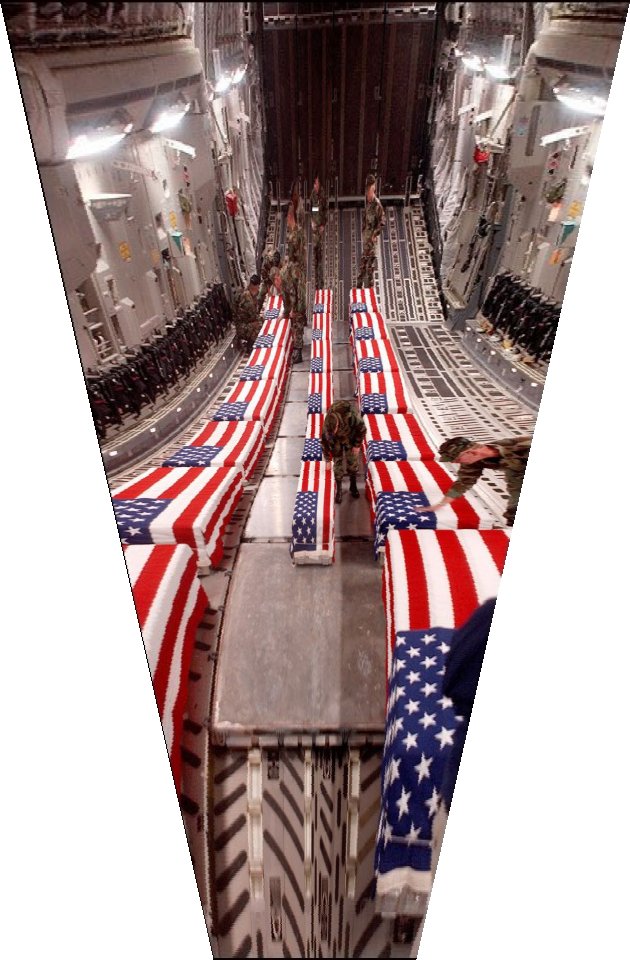
Coffin draped with an American flag came down a luggage conveyor


Soldier's coffin at center of furor

(November 30, 2006) — A woman says she saw a soldier's flag-draped coffin put into a cart with passengers' baggage last month at the Greater Rochester International Airport, shocking her and other onlookers.

"It looked awful, just awful," Cynthia Hoag, 56, of Dansville, Livingston County, said Wednesday. "Maybe we made too much out of it, but it was very disturbing to us. If that had been my son, I would have been very upset."

Officials dispute Hoag's story, saying it is implausible. They did not disclose the name of the fallen soldier, but he appears to be Army Sgt. 1st Class Tony Knier of Sabinsville, Pa., who was killed in Iraq on Oct. 21.

A Pennsylvania funeral director confirmed on Wednesday night that he transported Knier's body from the Rochester airport on Oct. 27, the day Hoag was there. Monroe County officials said the coffin was being taken to Pennsylvania.

Knier's mother was appalled when she was told Wednesday night that the incident might have involved the body of her 31-year-old son, a husband and father of three young children. Knier's funeral was Oct. 31 near his home in Wellsboro, Pa.

"If that's what that lady saw, I'm outraged. I'm really upset, because my son died for this country. " said Betty Tidwell, who lives in Tennessee. "He gave all he had to this country. And for them to do that to him, that just upsets the hell out of me."

Hoag wrote an op-ed essay that was published Tuesday in the Democrat and Chronicle, describing what she says she saw.

Based on Hoag's account, Monroe County Executive Maggie Brooks called on the federal government Wednesday to change procedures to prevent a similar incident, saying what happened is an "outrage."

Hoag explained that as she waited at the airport with friends, she saw a soldier in uniform standing at attention near a commercial airplane as the luggage came off. She then saw a coffin draped with an American flag come down a luggage conveyor on the runway.

The coffin was put into a baggage cart with other luggage and driven off with the uniformed soldier in the cart.

"I saw the casket of a fallen soldier, saluted by a lone soldier, and then placed in a baggage cart," she wrote. "Baggage."

Defense Department spokeswoman Cynthia Smith was unaware of the incident late Wednesday but said the witness' description doesn't correlate with military procedure.

Remains from a soldier killed in Iraq are taken to Dover Air Force Base in Delaware, then usually flown to a soldier's home, she said. Military escorts accompany each flight, whether domestic or military. When the coffin reaches the home area, it is met by an honor guard of two people and then transported to a funeral home, she said.

"We do everything to ensure that proper respect is given to the fallen service members and their families," Smith said.

Airport officials said it's a problem that notification of the airport is not required when a soldier's coffin is en route. Airport Director David Damelio said he wasn't aware that the soldier's body had been transported through Rochester until Hoag's letter was published.

"We're not notified unless the military or the family chooses to notify us," he said, adding that the airport often makes special arrangements at the request of soldiers' families.

Yet Damelio said Hoag's story doesn't make sense and said the Defense Department has always shown great care with soldiers' coffins.

Procedurally, a coffin wouldn't come down a luggage belt with other baggage, he said.

Also, a baggage cart isn't large enough to fit a coffin and other luggage, he said.

"It couldn't happen. It's physically impossible," Damelio said.

He said the airport was unable to find video of the incident.

Nonetheless, the witness' description prompted Brooks to urge the Defense Department to change policies on the transportation of the coffins of dead soldiers.

"It is unfathomable to me that our federal government would allow a fallen military hero to be returned home in this manner, and then transport him along with someone's checked luggage," Brooks, a Republican, wrote in a terse letter to the Deputy Defense Secretary Gordon England.

Brooks said the Defense Department should be required to notify an airport when the coffin of a fallen soldier is being transported so that proper arrangements are ensured.

"I am asking you to do whatever is necessary to end this abhorrent practice," Brooks wrote. "Our military personnel and our veterans deserve better."

below: mosiac of fallen American soldiers in the Iraq war

amazon quicklinker

Favorites linker

google adds