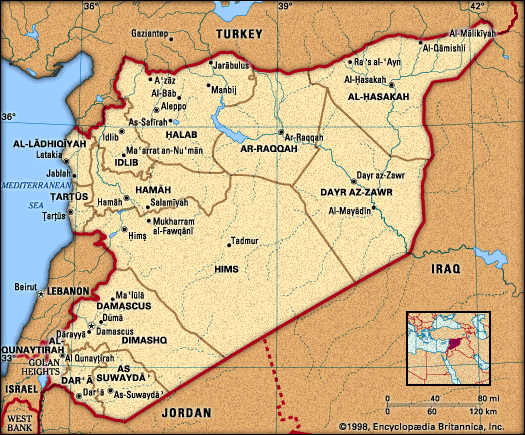
Showing posts with label Syria. Show all posts

Monday, November 17, 2008

Iraq may pass a security pact letting US stay till 2011


Nov. 17: U.S. Ambassador to Iraq, Ryan Crocker, left, and Iraqi FM Hoshyar Zebar shake hands after a signing ceremony for U.S.-Iraq security pact.

BAGHDAD — Iraqi lawmakers Monday began debate over a pact with the United States that will allow U.S. forces to remain for three more years, while an Iranian official close to that country's leadership praised the Iraqi Cabinet for approving the deal.

The comments from Iran's judiciary chief marked the first time that the deal has met with clear-cut approval in neighboring Iran. Meanwhile, Syria, target of a deadly cross-border raid by U.S. forces in recent weeks, criticized the deal as virtual surrender to America.

More than two-thirds of the 275-seat legislature attended Monday's session, raising confidence that parliament will be able to muster a quorum for the Nov. 24 vote. The session ended after the agreement's text was read to lawmakers, the first step to adopt legislation.

Lawmakers are expected to meet again on Tuesday.

The proposed Status of Forces Agreement not only sets a date for American troop withdrawal - 2011 - but also puts new restrictions on US combat operations in Iraq starting on January 1 and requires a military pullback from urban areas by June 30. The pact goes before parliament in a week or so.

For the deal to go as planned, the security situation must keep improving.

The U.S. signed similar security pacts with Germany and Japan after World War II, and South Korea after the conflict there. In each case a sizeable contingent of U.S. troops remains. Today, there are 56,200 U.S. servicemembers in Germany, 33,100 in Japan and 26,300 in South Korea.

Can Obama change what is being done now, when he becomes President?


The pact can be changed if either President-elect Barack Obama, who takes office Jan. 20, or the Iraqis want to alter it. Each side has the right to repeal the agreement after giving one year's notice, a senior Iraqi lawmaker has said.

Obama Vows to Close Guantanamo

In his first television interview since the election, President-elect Barack Obama said Sunday he plans to close the US military prison at Guantanamo Bay and rebuild the nation’s moral stature. His comments came in an interview with Steve Kroft on 60 Minutes.

Steve Kroft: “There are a number of different things that you could do early on pertaining to executive orders.”

Barack Obama: “Right.”

Kroft: “One of them is to shut down Guantanamo Bay. Another is to change interrogation methods that are used by US troops. Are those things that you plan to take early action on?”

Obama: “Yes. I have said repeatedly that I intend to close Guantanamo, and I will follow through on that. I have said repeatedly that America doesn’t torture, and I’m going to make sure that we don’t torture. Those are part and parcel of an effort to regain America’s moral stature in the world.”


Syrian minister criticizes Iraq-U.S. security pact

Syria's information minister says the security pact with the U.S. approved by the Iraqi Cabinet amounts to an "award to the occupiers" of Iraq.

After months of haggling, the Iraqi Cabinet on Sunday approved the pact that would keep U.S. troops in Iraq for three more years. The deal is to go before the Iraqi parliament for final approval later in November.

Syria's information minister, Mohsen Bilal, told the AP on Monday that rather than rewarding the U.S. occupiers with the pact, Iraqis should get an apology from Washington for the damage done to their country.

Iraqi neighbors and U.S. adversaries Iran and Syria have opposed the pact in the past and say an immediate withdrawal of U.S. forces would be the best solution.

Last month, the U.S. launched a cross-border assault against a Syrian village allegedly used to smuggle foreign fighters into Iraq. The deal contains conditions that the U.S. not use Iraqi land to launch attacks against any neighboring country.

The proposed Status of Forces Agreement not only sets a date for American troop withdrawal - 2011 - but also puts new restrictions on US combat operations in Iraq starting on January 1 and requires a military pullback from urban areas by June 30. The pact goes before parliament in a week or so.

Internal Iraqi opposition

The 30-strong Sadrist bloc will move heaven and Earth - including massive nationwide protests - to bloc the pact in the Iraqi National Assembly.

Sadrist spokesman Ahmed al-Masoudi stressed this Sunday thatthe pact "did not mean anything" and "hands Iraq over on a golden platter and for an indefinite period".

Masoudi is right on the money when he says the overwhelming majority of popular opinion is against it and the Sadrists and many Sunni parties insist a popular referendum to approve it is essential.

Shi'ite leader Muqtada al-Sadr's position is and has always been "end the occupation now". That happens to be the same view from Tehran: the pact further extends Iraq's agony as an American colony.


Iran's unusual positive stance


Iranian state TV has been spinning it as a victory for the Maliki government - stressing the US was forced to make concessions (in fact Maliki did not extract all the concessions he wanted in terms of prosecuting US troops for crimes in Iraq . The pact calls for joint panels of U.S. and Iraqi judges to try cases involving serious crimes committed by off-duty U.S. servicemembers in Iraq. So while Iraqi judges would be involved, the U.S. would not cede full jurisdiction to them. Second, it is almost unheard of for a U.S. troop to be off duty and off base in Iraq.).

However, last week, a spokesman for the Grand Ayatollah Ali Sistani in Iraq said he would "directly intervene" if he felt the pact was against Iraqi sovereignty.


Will Iran Move in?


"Many Iraqis suspect that Iran wants to annex southern Iraq, which is over 80 percent Shia, has the major Shia holy places and oil fields that would increase Iranian exports by over 50 percent."

Refrences

http://www.usatoday.com/news/world/iraq/2008-11-17-syria-iraq-us_N.htm#uslPageReturn

http://www.foxnews.com/story/0,2933,453029,00.html

http://www.usatoday.com/news/world/iraq/2008-11-16-iraqdealqna_N.htm
http://www.google.com/hostednews/ap/article/ALeqM5hwK_CSpBxsNuVUEaDuOwmSSCiqGwD94GPUGG0

http://www.atimes.com/atimes/Middle_East/JK18Ak01.html

Saturday, November 01, 2008

The Syrian Border Crisis


The Syrian Border Crisis

Background

On October 26th 2008 the United States had an air strike on the Syrian border city of Abu Kamal. According to the United States, the attack killed an al-Qaeda leader responsible for smuggling combatants over the border.

Surprise to Syria, especially after talks with Rice

Secretary of State Condoleezza Rice met in New York with her Syrian counterpart, Walid Moalem, in the highest-level talks between the two nations since 2005. "She sat with us and said the United States wants to engage with Syria, wants to re-evaluate its relationship," Syria's ambassador to Washington, Imad Moustapha, told NEWSWEEK. "And suddenly this raid happens out of the blue."

General Petraeus wanted to talk prior with Syria but White House held him back

A senior military officer told NEWSWEEK that the United States conveyed its message about Abu Ghadiyah to Syria through other countries in the region beginning early this year. Simultaneously, said the officer, who did not want to be named discussing sensitive issues, Petraeus requested permission from the Pentagon to travel to Damascus and meet directly with Syrian leaders. According to the officer, though, "so far the answer has been 'Not yet. Now is not the time'." All three agencies declined requests for comment.
Both Syria and Iraq ( and North Korea) denounced the attacks

Syria condemned the US intervention and demanded an apology from Washington. Damascus also sent extra troops to the border region. Iraq equally condemned the US attack, but it also said Syria should take stronger measures against organizations that aim to harm Iraqis.

North Korea has denounced the United States for its recent deadly raid inside Syria.

The North's Foreign Ministry says the attack was "an unpardonable inhuman criminal act as it is ... state terrorism committed under the pretext of 'anti-terrorism war.'"

The real questions as proposed by
What is the tactical benefit of killing him and maybe taking out this particular safe house—to what extent will the act shock or foil the enemy, or cut down the flow of foreign fighters and arms? On the other hand, what is the strategic cost of violating international law, alienating the regional powers, and impeding a political settlement of the war in Iraq?

The intelligence isn't in yet, but early indications are that the first answer is "Not much" and the second is "Quite a lot."

Shuffling Troops

Iraq sends police to guard Syrian border
Iraq is sending police reinforcements to the border with Syria. The rapid reaction force is aimed at preventing al-Qaeda combatants from penetrating Iraq.

Meanwhile the Syrians are moving away from that border

The Syrian TV station Dunia reported Thursday that the country is reducing its troops and dismantling guard posts on its border with Iraq. The move came in response to a deadly U.S. cross-border raid Sunday that targeted an al-Qaida in Iraq figure who operated a network that smuggled fighters into Iraq. Meanwhile, tens of thousands of Syrians protested the raid Thursday in Damascus, and hundreds of Syrian riot police formed a protective ring around the closed U.S. Embassy. But the flag-waving crowds dispersed peacefully after a couple of hours.

The Syrians are beefing up borders with Lebanon


The Syrian Army has deployed more troops along Lebanon's northern border, according to Lebanese Army sources, amid claims that Damascus is redoubling efforts to "combat smuggling."

Reports that Damascus was beefing up its troop strength along the Lebanese border coincide with unconfirmed reports by the private Syrian Dunia satellite TV network that Syrian border patrol forces were being withdrawn from the notoriously porous border with Iraq. Dunia TV showed pictures of what it claimed were Syrian forces being withdrawn from the Iraqi border.

Iraq was getting along with Syria

Iraqi President Jalal Talabani also told President Bush just last month that Syria was no longer much of a problem.


Syria has asked Iraq for "clarifications" over the recent raid inside Syrian territory.


Deputy Syrian Foreign Minister Faisal al Miqdad indicated, this morning, that Syria has asked Iraq for "clarifications" over the recent raid inside Syrian territory. He says we are going to re-examine what's going on with Iraq in light of the official responses we're getting from the Iraqi side, following our requests to the United Nations for clarifications from Iraq.


Syrians say the Oct. 26 U.S. commando raid across its border targeting a Qaeda smuggler came as a surprise, ruining what appeared to be a thaw in relations between the two countries. Just two months ago, Secretary of State Condoleezza Rice met in New York with her Syrian counterpart, Walid Moalem, in the highest-level talks between the two nations since 2005. "She sat with us and said the United States wants to engage with Syria, wants to re-evaluate its relationship," Syria's ambassador to Washington, Imad Moustapha, told NEWSWEEK. "And suddenly this raid happens out of the blue."

But government documents and a recent comment by Commander of U.S. Central Command Gen. David Petraeus suggest the United States had been signaling its frustration with Syria over border issues for some time. Counterterrorism sources say troops taking part in the raid killed a senior Qaeda operative known as Abu Ghadiyah, who allegedly helped smuggle scores of fighters into Iraq for suicide attacks and other operations. Three weeks ago at a meeting of the Association of the U.S. Army, Petraeus said the Abu Ghadiyah problem had been raised often with Damascus. "We have communicated that to them through interlocutors," he said, describing Abu Ghadiyah as a "major foreign fighter facilitator" operating in Syria with "varying degrees of freedom at different times."


Syria has ordered the closure of the American School and the US cultural centre in Damascus


Ref:
Cooperation Hits a Snag
By Dan Ephron and Mark Hosenball | NEWSWEEK

Sunday, March 02, 2008

Iraqis continue to flee their country


Flies rest on the face of an Iraqi refugee child waiting with his family at the Tanaf border crossing between Syria and Iraq, some 300 kms northeast of Damascus, 10 November 2007. The number of Iraqis seeking asylum in Syria each month has dropped from 20,000 to a few hundred since Damascus imposed new visa restrictions last month, a senior border guard said. According to the UN High Commissioner of Refugees (UNHCR), 4.2 million Iraqis have fled the violence since the US-led invasion of March 2003.


RAQ: 'Not Our Country To Return To'

By Maki al-Nazzal and Dahr Jamail*

DAMASCUS, Mar 3 (IPS) - More Iraqis continue to flee their country than the numbers returning, despite official claims to the contrary.

Thousands fleeing say security is as bad as ever, and that to return would be to accept death.

"Return to Iraq?" asks 35-year-old Ahmed Alwan, an Iraqi engineer now working at a restaurant in Damascus. "There is no Iraq to return to, my friend. Iraq only exists in our dreams and memories."

The United Nations High Commissioner for Refugees (UNHCR) reported September last year that there are between 1.2 and 1.4 million Iraqi refugees in Syria alone.

Most, like Alwan, do not intend to return.

"I shall never return to Iraq until the last American soldier and Iranian mullah leaves," Alwan says. "It is their country now, not ours. The only thing that might take me back is when I decide to fight for Iraq's real liberty."

Why they won't go back

Iraqi refugees in Syria speak of lack of security back home, lack of services, fear of the future, mistrust of Iraqi politicians, and loss of homes. Most are simply too afraid to return.

UNHCR report contradicts US media claims

A UNHCR report issued last month contradicts reports by mainstream media in the U.S., and claims by the Bush administration, that more Iraqis are returning to their homes than the number leaving.

The report says that from February 2006-October 2007 Syria received between 30,000-60,000 refugees each month. Immigration officials at al-Tanf on the border say the daily average for those entering Syria from Iraq in late January was over 1,200, while the daily average crossing back was less than 700.

"Many assassinations take place all over Iraq, including Baghdad, and military operations are still being carried out the same way as 2004 and 2005," Nayil Mufeed, a security advisor with a mobile phone company in Baghdad told IPS. "We have advised our employers that moving out of Baghdad to Amman is a definite necessity in such a fragile security situation."

"Even if we believed that security is better in some areas, we know it is worse in other areas, and that it changes suddenly from one place to another," Farooq Munim, a retired school headmaster from Mosul, now a refugee in Syria told IPS.

"My city, Mosul, was safe for those who have no connection with Americans or government intelligence, but now it is not safe for anyone after the explosion at the Zinjilly neighbourhood that was carried out by Peshmerga (Kurdish militias) and Americans to justify the new surge against the city."

Mosul city, 300 km north of Baghdad, is under a major siege by the U.S. military supported by the Kurdish militia and Iraqi troops from southern Iraq. The city, a Sunni stronghold, has been a target for Kurdish militias attempting to cleanse it of its Arab majority in order to support claims that it is a Kurdish city.

Many Iraqis in Syria say they will not return for fear of detention.

"They (U.S. military) say Fallujah is safe now while over 800 men are detained there under the worst conditions," 25-year-old Omar, whose name is on a list of wanted persons by the local police, told IPS. "I am wanted by Fallujah police just because I helped some foreign journalists who visited the city to cover the American crime in 2004, and I showed them eyewitnesses who testified that there were Iraqis who helped the Americans destroy our city. At least 750 out of the 800 detainees are not resistance fighters, but people who refused to collaborate with occupation forces and their tails."

Iraqis commonly refer to Iraqis who collaborate with occupation forces as "tails of the Americans."

For Iraqis who do return home, the reasons usually have little to do with any perception that things are improving.

Iraqis return and leave

"If you do not mention my name and my company, I will tell you all about Iraqis returning home," a passenger transport company manager in Damascus told IPS. "People just move back and forth to check their property, cash their pensions and salaries and for other necessities, but the media make it look like people returning home."

"Some people did go back when they had nothing to spend any more, especially after the Iraqi government promised to pay them money on return," said the manager. "Many of them came back to Syria when they found that all those promises were just lies. On the other hand, Iraqis from the north and south are still fleeing because of the military operations everywhere in Iraq."

Another UN survey of Iraqis returning to their country found that "46 percent were leaving Syria because they could not afford to stay, 25 percent said they fell victim to a stricter Syrian visa policy; and only 14 percent said they were returning because they had heard about improved security."

Others do not return for financial reasons.

"It is cheaper here than in Iraq," Hanan Jabbar, a 38-year-old housewife who fled to Syria five months ago told IPS. "A litre of kerosene costs a dollar back home, while it's 10 cents here. That is just one example for how impossible life now is in Iraq. My kids go to school safely and play like other children now without me worrying to death about them. God bless Syria and Jordan for having us, and God damn America and all its allies for doing all this to us."

On many streets of Damascus today one finds more Iraqis than Syrians, partly because Syrians are at work while most Iraqis are unemployed. They hang around Internet cafés, tea houses and on the streets, looking out for any kind of work.

"I took my family back home in January," Rasool Mussa, a shopkeeper from Baghdad now a refugee in Damascus told IPS. "The first night we arrived, Americans raided our house and kept us all in one room while their snipers used our rooftop to shoot at people. I decided to come back here the next morning after a horrifying night that we will never forget."

(*Maki, our correspondent in Damascus, works in close collaboration with Dahr Jamail, our U.S.-based specialist writer on Iraq who has reported extensively from Iraq and the Middle East)
http://ipsnews.net/news.asp?idnews=41430

Wednesday, June 27, 2007

US / CIA Secret Prisons Not So Secret Anymore

New Report documents European complicity in CIA Secret Prisons though European leaders deny knowledge


PARIS, June 8 — In a report on last Friday, the lead investigator for the Council of Europe gave a bleak description of secret prisons run by the Central Intelligence Agency in Eastern Europe, with information he said was gleaned from anonymous intelligence agents.

“Large numbers of people have been abducted from various locations across the world and transferred to countries where they have been persecuted and where it is known that torture is common practice,” it says..


From In an interview with Swiss senator Dick Marty,author of Council of Europe report on CIA activities in Europe
(THIERRY OBERLE / Le Figaro (FRance) 8jun2007)
What does your inquiry reveal?

"We focused our investigations on secret detention sites in Eastern Europe. We obtained evidence, on the basis of collated information, of the existence of illegal prisons in countries working closely with the United States, such as Poland.


We have details about the program drawn up by the CIA. The plan, now officially suspended in Europe, sought to export the antiterrorist struggle beyond United States' borders in order to escape the legal constraints imposed by US law.

The subcontracting established in our countries reflects a lack of respect for the European partners. It is in an insulting attitude. The United States decided to pursue a war without rules against terrorism.


The alleged terrorists kidnapped, then tortured and held in rogue states such as Syria had neither civil rights nor rights of war. They became even more dangerous, because they thus enjoyed sympathy in some circles. The mistake was not to treat them for what they are - criminal groups to be prosecuted using appropriate legislation. ..Its policy has resulted in disaster."

Note: Breach of Human Rights Treaties
Clandestine prisons and secret CIA flights involving European countries would breach the continent's human rights treaties, although the Council of Europe has no power to punish countries. The council, which is separate from the European Union, was set up four years after World War II to promote democracy, human rights and the rule of law in Europe.


Officials at the EU have said previously that they trust the denials of Poland and Romania about hosting secret jails.


Did France participate in the CIA programme?


"The French intelligence services were notified of the US secret programmes, but they did not participate in them directly."

Several sources have told us that the DGSE [General Directorate of External Security] knew what was being planned. There was no cooperation, because the CIA mistrusted France, and the latter has its own rather successful methods, since France warned the United States before 11 September of the imminence of a terrorist attack on its territory."

But Mr. Marty said at a news conference in Paris that anonymous testimony was backed by thousands of flight records showing prisoner transfers, including private planes linked to the C.I.A. that made 10 flights from Afghanistan and Dubai to the Szczytno-Szymany International Airport in Poland between 2002 and 2005.


That was the closest airport to a Soviet-era military compound where about a dozen high-level terror suspects were jailed, the report charges. The local authorities formed secure buffer zones around the jails, which were operated exclusively by Americans, Mr. Marty reported.


Lower-level prisoners from Afghanistan and Iraq were held at a military base near the Black Sea in Romania, the report says.“Our Romanian officers do not know what happened inside those areas because we sealed them off and we had control,” the report cites a senior military agent as saying.

Former Romanian President Ion Iliescu, mentioned in a list of ranking officials who allegedly had knowledge of the prisons, dismissed Marty's report as "stupid."

Poland Outright Denies allegations:

Following a meeting with President Bush in Gdansk, Polish President Lech Kaczynski told reporters: "I know nothing about any CIA prisons in Poland." His predecessor, Aleksander Kwasniewski, who was president in 2001-05, said: "I deny it. I've said as much several times.

Details of Prison Life in CIA controlled Secret Prisons

The details of prison life were given by retired and current American intelligence agents who had been promised confidentiality, the report says.


Their motives were varied, Mr. Marty said. “For 15 years, I have interviewed people as an investigating magistrate and I have always noticed that at a certain point, people with secrets need to talk,” he said.

Others justified the grim treatment, the reports said, saying, in one instance: “Here’s my question. Was the guy a terrorist? ’Cause if he’s a terrorist, then I figure he got what was coming to him.” (Of course if it turns out he wasn't a terrorist, it comes down to the person just having bad luck.)

The repoters told of prisoners being kept naked for weeks, sometimes attached to a "shackling ring" in cells. Buckets served as toilets. Masked guards who never spoke were the only contact for those consigned to four-month isolation regimes. The silent guards would push meals of cheese, potatoes and bread through hatches.

Cells, sometimes equipped with video cameras, were cramped and kept extremely hot or cold, the report said. Prisoners had to listen to irritating noises, including "torture music," rock or rap as well as "distorted" verses of the Quran, it said.


Prisoners in the secret jails were subjected to sleep deprivation and water-boarding, or simulated drowning.

When prisoners resisted, the report says, one investigator considered it a welcome sign. “You know they are starting to crack,” he said, “So you hold out. You push them over the edge.”

Wives And Children of suspects also held

Regarding cases where family members of terrorist suspects have been held, the report noted that some have been released, while others remain unaccounted for.

The seven- and nine-year-old sons of Khalid Sheikh Mohammed were reportedly apprehended by Pakistani security forces in September 2002 and subsequently questioned about his possible whereabouts. The wives and children of other detainees in secret CIA custody have also been held in custody and interrogated, either as potential sources of information or to secure the capture of their husband or father.


Bush admits to the Secret prisons

The US last year admitted the existence of such prisons in its “war on terror” but said they were no longer in use. President George W Bush said last September that all secret prison sites were “empty”. (Though few believe his statement is actually true, there is some question if he himself has been told that, perhaps by the Vice President who seems to have directed the subversive activities.)

Marty's report said Poland and Romania hosted secret prisons under a special post-Sept. 11 CIA program to "kill, capture and detain" key terrorist suspects. It said the jails grew out of a secret pact within NATO shortly after the terror attacks on the U.S.

The pact "allowed the CIA to be able to move around Europe unobstructed, without undergoing any control and, especially, the NATO (security) protocol on secrecy was applied," Marty said.


Bush: Terrorism Suspects Held in Secret CIA Prisons Should Not Be Allowed to Reveal Details


The Bush administration has told a federal judge that terrorism suspects held in secret CIA prisons should not be allowed to reveal details of the "alternative interrogation methods" that their captors used to get them to talk.

The government says in new court filings that those interrogation methods are now among the nation's most sensitive national security secrets and that their release -- even to the detainees' own attorneys -- "could reasonably be expected to cause extremely grave damage." Terrorists could use the information to train in counter-interrogation techniques and foil government efforts to elicit information about their methods and plots, according to government documents submitted to U.S. District Judge Reggie B. Walton.

=============
Related materials:

Thursday, March 01, 2007

The Other Surge: Iraqi refugees


While Washington debates the surge of troops to Iraq, it has only recently begun to acknowledge the surge in refugees leaving Iraq. The U.N. High Commissioner for Refugees estimates that 50,000 per month are fleeing Iraq and that their numbers in neighboring countries may soon reach two million. Yet last year the U.S. admitted only 202 Iraqi refugees, and has done next to nothing since the war began to assist neighboring countries to bear the refugee burden. Condoleezza Rice unveiled a new plan on Wednesday to resettle 7,000 Iraqi refugees. After three years of ignoring the refugee fallout from the war, this is a welcome first step. But will it be enough to convince Syria and Jordan to keep doors open?

While America has a special obligation to rescue Iraqis who have been specifically persecuted because they helped U.S. troops or Americans working in Iraq, it is central to U.S. interests to address the destabilizing effects and humanitarian needs in the region of a much larger group of refugees -- Sunnis and Shiites fleeing mixed areas, members of the professional classes, religious minorities, and people perceived as Western in orientation.


This week the crisis worsened when Syria tightened residency rules for a million Iraqi refugees there, raising fears that mass deportations will begin. Jordan has started barring single men between 17 and 35 at the border and is unwilling to recognize 700,000 Iraqis living there as refugees. Neither country has received more than token assistance from the international community that might convince them to keep their doors open. International donors provided only $14 million of UNHCR's $29 million request last year for refugees in the region. The U.S. provided 27%.

First, the U.S. needs to make sure that neighboring countries have resources to provide for the refugees' basic needs. The total UNHCR request of $60 million for this year is what the U.S. spends every five hours to fight the war. The U.S. shouldn't waste precious weeks quibbling with the Europeans on their contributions. The sum is modest, part of the price of the war: Just pay it. Second, assistance should have strings attached. Jordan and Syria must keep their doors open to refugees. They must allow Iraqi children to go to school. Humanitarian aid should enable refugees to stay in the region in conditions of safety and dignity until it is safe for them to go home.

Finally, the U.S. needs to move quickly to resettle significant numbers of Iraqi refugees, particularly those who risked their lives to help Americans, who cannot go home. Resettlement not only fulfills a moral responsibility with deep roots -- Hungary, the Bay of Pigs, Vietnam. It also shows the Middle East that the U.S. is committed to helping with the most difficult part of any refugee emergency -- where to put the people themselves. Resettlement ultimately shows solidarity both with the people who put their lives on the line in the U.S. war effort and with the countries who need to be convinced that they will not be left to bear the burden alone.

Mr. Frelick is the refugee policy director for Human Rights Watch.
http://hrw.org/english/docs/2007/02/15/iraq15341.htm

Wednesday, February 28, 2007

Iraq leaders call for International meeting to help stabalize thier country

1. Iraq invited all neighboring countries to the conference next month, which is aimed at improving security in the country amid daily attacks on civilians The conference is tentatively set for March 10-11, Iraq's ambassador in Washington, Samir Sumaidaie, said last month.

2. The four countries that hold permanent seats on the United Nations Security Council with the U.S. -- Britain, China, France and Russia -- also are invited, Invitations have also gone out to Jordan, Kuwait, Saudi Arabia, Turkey, Egypt, Bahrain, and the Arab League

3.Syria's ambassador to the United Nations, Bashar Ja'afari, said today his government hasn't decided whether to attend.

4. This will mark the first time the U.S. has sat with Iran and Syria to look at Iraq's future, an initiative that lawmakers and a bipartisan panel of American statesmen have sought. The Iraq Study Group, headed by former secretary of state Republican James Baker, recommended in its Dec. 6 report that the U.S. engage in a wider regional diplomatic offensive to curb violence in Iraq.The group also recommended direct U.S. talks with Iran and Syria without conditions

John Negroponte, the new deputy secretary of state, said in his Jan. 30 confirmation hearing that he didn't consider such a conference to be of utmost urgency. ``I would not say that, as a matter of priority, one would have to go right to a regional- type conference,'' he told senators

Wednesday, January 24, 2007

Video:


Keith Oberman takes on Bush's proposed troop increase in Iraq. Or is it meant for Iran? Video Courtesy of Crooks and Liars. (A great blog http://www.crooksandliars.com/)

As usual, a stong argument with great background video.

Sunday, December 10, 2006

ELIOT COHEN blast Iraq Study Group

No Way to Win a War
Iraq Study Group: A fatuous process yielded fatuous results.

BY ELIOT A. COHEN
Sunday, December 10, 2006 12:01 a.m. EST
Published in Wall Street Journal
Link: http://www.opinionjournal.com/extra/?id=110009364

The theory of the thing is very peculiar indeed. You are in the middle of a war--a hard war, a war that is going badly. If the government has bogged down, if the people inside have gone stale, you would say that the sound thing, the Churchillian or Lincolnian or Rooseveltian thing, would be, first, to fire a bunch of officials (generals as well as top civilians), promote or bring in fresh talent, and put together a small group of people to take a new and unillusioned look. Those people would report back in secrecy to the president and his most senior advisers and aides.

They would consist of experienced soldiers and civilians in whom the president (who, after all, has to make the strategic decisions, and is the accountable executive) has trust. There would not be many of them, a half dozen or so, and they would have to be hardy enough to visit the war zone for several weeks, talking not just to politicians and generals but to captains and sergeants. They would go see things for themselves. They would visit a forward operating base near Tikrit; they would spend some time with Iraqi soldiers in Taji; they would take their chances in a convoy to al Asad, or even a patrol in Tal Afar.

They--not their staff of a few soldiers and secretaries--would do the probing, digging, thinking, discussing and, above all, the writing. The chairman of the group would insist that they air their disagreements candidly and thoroughly in front of the president, engaging in a debate that might last a day, perhaps longer. The rest of us would not find out about the panel until months, or even years, after it reported back; maybe not until the war was over.

The administration's congressional critics (including those of its own party) came up with a different solution: the Iraq Study Group (ISG), which has now produced a document that consists of 50 pages of recommendations, preceded by a 40-page thumbnail sketch of the current situation in Iraq and 50 pages of maps, lists of people, and full-length biographies of the commissioners. This is a group composed, for the most part, of retired eminent public officials, most with limited or no expertise in the waging or study of war. It consists of individuals carefully selected with an eye to diverse partisan and other irrelevant personal characteristics. These worthies, with not one chairman but two (for balance, of course), turned to several score experts known to disagree vehemently with one another about the best course of action to be pursued in Iraq.

Some of the commission members and their advisers cordially detest the president and his administration and opposed him and his war from the outset; others were equally passionate in their defense of both the man and the conflict. And yet this diverse group had an overwhelming mandate, from the beginning, to produce a consensus document. The commission members spent four days in Iraq, and with the exception of a one-day foray by former Marine Chuck Robb, they stayed in the Green Zone, that bubble of palaces and residences that has little to do with the real Iraq of Basra, Kirkuk, Ramadi, Baquba and Mosul. At the end, they had breakfast with the president and a few hours later posted their conclusions on the Internet for all the world to ponder. There is something of farce in all this, an invocation of wisdom from a cohesive Washington elite that does not exist, a desperate wish to believe in the gravitas and the statecraft of grave men (and women) who can sort out the mess in which the country finds itself.

A fatuous process yields, necessarily, fatuous results. "Iraq's neighbors are not doing enough to help Iraq achieve stability"--a statement only somewhat ameliorated by the admission that some are even "undercutting stability," which sounds as though Syria and Iran were being downright rude, rather than providing indispensable assistance to those who have filled the burn wards of Walter Reed, the morgue in Baghdad, and the cemetery at Arlington. The selected remedy is, first and foremost, rather like the ISG's credo for its own functioning, consensus. "The United States should immediately launch a new diplomatic offensive to build an international consensus for stability in Iraq and the region," as if our chief failure with Bashar Assad or Mahmoud Ahmadinejad lies with the hitherto unnoticed laziness or rhetorical ineptitude of our diplomats, or as though Europe, Saudi Arabia and Israel have not yet figured out that stability in Iraq is a good thing. "Syria should control its border" and "Iran should respect Iraq's sovereignty."

No kidding--but who is going to make them? That perennial solution, "resolution of the Arab-Israeli conflict," makes its appearance, including direct negotiations between Israel and Palestinians, but only with "those who accept Israel's right to exist." The report conveniently forgets that the elected leaders of Palestine do not, in fact, accept Israel's right to exist. And it also neglects the grim reality that one of the most terrible things about Gaza, and possibly the West Bank as well, is that no one, not even Hamas, is really in charge.

Part of Iran's price for easing up on us in Iraq is pretty clearly taking the heat off its nuclear program; the ISG recommends that that issue "should continue to be dealt with by the five permanent members of the United Nations Security Council plus Germany." Well, what deal should the U.S. be willing to cut on Iranian nuclear weapons? Do we think the Iranians would deliver? And what are the long-term consequences?

War, and warlike statecraft, is a hard business, and though this is supposed to be a report dominated by "realists," there is nothing realistic in failing to spell out the bloody deeds, grim probabilities and dismal consequences associated with even the best course of action. Indeed, some parts of the report read as sheer fantasy--Recommendation 15, for example, which provides that part of the American deal with Syria should include the latter's full cooperation in investigating the Hariri assassination, verifiable cessation of Syrian aid to Hezbollah, and its support for persuading Hamas to recognize Israel.

The prescriptions for internal processes in Iraq are only somewhat better. The ISG argues that American forces should shift to developing Iraqi security forces and backing them up, which is more or less the course we are on now. It talks of milestones for Iraqi performance, as if Iraqi benchmarking were more a problem than Iraqi will, and Iraqi will more the problem than Iraqi capability. It suggests announcing our own planned redeployments without considering the most obvious consequence, which is that Iraqis of many political hues will decide that the Americans are leaving, and the time has come to cut deals with Jaish al Mahdi, or the Badr organization, or al Qaeda in Iraq, or any of the other cutthroat outfits infesting that bleeding country.

Quite apart from the psychological impact of our actions, there is the sober fact that the Iraqi army is small, 138,000-strong (and that number probably overstated), and that building effective security forces takes time. The 188,000-man police forces are corrupt, riddled with militia influence, and in need of a thorough overhaul. We cannot build the Iraqi security forces without a substantial combat presence. Nor is the problem merely one of training, as Iraqi corporals driving around in pickup trucks without functional radios might have sourly pointed out, had they had the chance to talk to a Study Group member.

At least the ISG has given considerable thought to preparing us for future conflict. Consider Recommendations 47 and 48. Congress, they declare, should allocate money to repair the clapped-out equipment the Army and Marines will bring back from Iraq. This is no doubt better than, say, heaving Bradley infantry fighting vehicles overboard on the way back to American ports in order to provide a home for new coral reefs. "As [American] redeployment proceeds, military leaders should emphasize training and education of forces that have returned to the United States in order to restore the force to full combat capability." Pentagon planners would do well to pursue this plan rather than give the troops six months of leave and then having them paint the sorely neglected rocks outside the sergeant major's office.

The great war leaders, in their private deliberations, shied away from vagueness. Haziness about ends and means, about what to do and how to do it, is a mark of strategic ineptitude; in war it gets people killed. But a Churchill could only call the flattening of German cities "terror bombing" in private.

Thus, unsurprisingly, in a public document of this kind, euphemism and imprecision abound. The U.S. needs to give "disincentives" to Syria and Iran: But the real question has always been whether we are willing to use a variety of overt and covert means--from bombing insurgent safe houses to sabotaging refineries, from mining harbors to supporting their own insurgents--to do so. And, in fact, the report mentions no means for squeezing either country.

True, as James Baker irritably noted at the press conference releasing the report, the U.S. talked to the Soviet Union during the Cold War. But as the U.S. did so it also bankrupted the U.S.S.R. in an arms race, undermined its client governments in Eastern Europe by supporting Polish labor unions, and killed its soldiers by providing surface-to-air missiles to Afghan guerrillas. Real pain, and not merely tough talk sweetened by a bucket of goodies, paves the way for successful negotiations with brutal opponents.

What we need in Iraq is not a New Diplomatic Offensive (capitals in the original) so much as energy and competence in fighting the fight. From the outset of the Iraq war much of our difficulty has stemmed not so much from failures to find the right strategy, as from an astounding and depressing inability to implement the strategic and operational choices we have nominally made.

This inability has come from things as personal as picking the wrong people for key positions, in the apparent belief that generals are interchangeable cogs in a counterinsurgency machine. It has come from an unwillingness or inability to grab the bureaucracy by the throat and make it act--which is why, three years after the insurgency began, we still send soldiers out to risk roadside bomb attacks in overweight Humvees when there are half a dozen commercially available armored vehicles designed to minimize the effects of such blasts. It is why--although the government has declared long before the ISG issued its report that training the Iraqis is Job One--we still embed fewer than a dozen American advisers in an Iraqi battalion when the right number is three to five times that many.

We have not come up to the brink of failure because we did not know how important it is to employ young Iraqi men or to keep detained insurgents out of circulation or to prevent militia penetration of the security forces by vetting the commanders of those forces. We have known these things--but we have not done these things.

The creation of the Iraq Study Group reflects the vain hope that well-meaning, senior, former public officials can find ideas that have not already occurred to people inside government; that those new ideas can redeem incompetent execution and insufficient resources; that salvation can come from a Washington establishment whose wisdom was exaggerated in its heyday, and which has in any event succumbed to a kind of political-intellectual entropy since the 1960s; that a public commission can do the work of oversight that Congress has shirked for five years in the misguided belief that it would thus support an administration struggling to do its best in a difficult situation. This is no way to run a war, and most definitely, no way to win it.

Mr. Cohen is Robert E. Osgood Professor of Strategic Studies at Johns Hopkins University's School of Advanced International Studies.

amazon quicklinker

Favorites linker

google adds