Showing posts with label Taliban. Show all posts

Wednesday, June 13, 2007

Iran: Death Penalty for all Porn Stars (Video) & Guns to Taliban in Afghanistan

Iran was accused today by U.S. Secretary of Defense Robert Gates who said Iran may be involved in arming the Taliban in Afghanistan.

"It's pretty clear there is a fairly substantial flow of weapons (into Afghanistan)," he said. "I haven't seen intelligence specifically to this effect, but I would say given the quantities we're seeing, it's difficult to believe it is associated with smuggling or the drug business or that it is taking place without the knowledge of the Iranian government."

Undersecretary of State Nichols Burns told CNN Wednesday there is irrefutable evidence Tehran is transferring weapons to Taliban fighters in Afghanistan.

This news however drew far less attention than the vote by Iran's parliament on in favor of a bill that could lead to death penalty for persons convicted of working in the production of pornographic movies.


With a 148-5 vote in favor and four abstentions, lawmakers present at the Wednesday session of the 290-seat parliament approved that "producers of pornographic works and main elements in their production are considered corruptors of the world and could be sentenced to punishment as corruptors of the world."

The term, "corruptor of the world" is taken from the Quran, the Muslims' holy book, and ranks among the highest on the scale of an individual's criminal offenses. Under Iran's Islamic Penal Code, it carries a death penalty.

This video may contain content that is inappropriate for some users, as flagged by YouTube's user community.


Sunday, February 18, 2007

Bin Laden Returns to the Rhetoric of the Misdirected War on Terror


Just when the trail for Osama Bin Laden had been described as cold,(General Eikenberry, said that the trail for Osama bin Laden has gone cold. - see Notes from Media Roundtable With Secretary Of Defense Robert Gates) the news media resurrects the phantom leader to put fear in the hearts of all those who would cut and run from the war on terror.

The scooter Libby trial was an education into the manipulation of the media by the administration (see the Boston Globes Libby case witness details art of media manipulation.)

The media outlets want news, and the Administration wants talking points for their costly program to bring democracy to the middle east.

Case and point: The New York times reports today :

WASHINGTON, Feb. 18 — Senior leaders of Al Qaeda operating from Pakistan have re-established significant control over their once battered worldwide terror network and over the past year have set up a band of training camps in the tribal regions near the Afghan border, according to American intelligence and counterterrorism officials.

American officials said there was mounting evidence that Osama bin Laden and his deputy, Ayman al-Zawahri, had been steadily building an operations hub in the mountainous Pakistani tribal area of North Waziristan. Until recently, the Bush administration had described Mr. bin Laden and Mr. Zawahri as detached from their followers and cut off from operational control of Al Qaeda.


If there is one lesson we have learned from the Iraq invasion is that the administration "manipulates" so called iintelligence to fit their agenda. see
Wolfowitz Emerges as Key Figure in Intel Manipulation /describing Wolfowitz and his "hands-on role in knowingly providing the White House with the sort of dubious intelligence")

If this seems a little biased toward unbelieving, I would suggest that one reflects on the fact that almost the same story ran last June

"WASHINGTON - The flurry of messages from Osama Bin Laden and his deputy this year suggests the pair is regaining control over Al Qaeda operations for the first time since the U.S. toppled the Taliban, two top experts told the Daily News.

"It means their command and control over Al Qaeda is probably stronger than we thought it was," said Michael Scheuer, who ran the CIA's Osama Bin Laden unit and is the author of "Imperial Hubris." (JAMES GORDON MEEK
DAILY NEWS WASHINGTON BUREAU)

Overblown threat

Professor John Mueller, chairman of National Security Studies at Ohio State University, says in a new book that politicians and security officials overreacted to the threat and exaggerated what was really a small risk.

The threat from Al Qaeda to the United States since the Sept. 11 2001 attacks has been “overblown” by officials, with the chances of becoming a victim the same as being killed by a comet, a he contends.

In his book “Overblown: How Politicians and the Terrorism Industry Inflate National Security Threats, and Why We Believe Them”, Mueller analysed public statements from senior politicians and security officials since Sept .11.

He questioned why Al Qaeda had failed to attack the United States again since then, despite numerous grim warnings that had suggested that Osama bin Laden’s group was active and on the verge of attacks.

Mueller said the Department for Homeland Security had identified 80,000 potential targets from shopping malls to the Weeki Wachee Springs water park in Florida.

But the chances of being killed by an act of terrorism are 80,000 to 1, he contends, the same as being killed by a comet or an asteroid.

According to his calculations, about 200 people worldwide have died in non-combat areas as a result of Al Qaeda

“That’s 200 too many but not a threat to an international system or any modern state,” he reasoned. “Two to three hundred die every year in the United States alone from drowning in a bath tub.”

Mueller stressed that there was a threat from a small group of extremists but he argued they were not as sophisticated, and so not as much of a risk, as the authorities made out.

“More and more when you look at these cases you do find they are not the sharpest knives in the drawer,” said Mueller.

“Many of them seem to clearly be nut cases, probably more dangerous to themselves.
action since Sept. 11.

Who belongs to Al Queda?

Of the 664 people arrested under the Terrorism Act since September the 11th, none of them have been convicted of belonging to Al Qaeda. Only 3 people have so far been convicted of having any association with any IslamistIslamist literature. The majority of people convicted under the Terrorism Act since September the 11thUVF or the Real IRA. And many of the arrests that were dramatically announced as being part of a hidden Al Qaeda network were, in reality, as absurd as the cases in America. For example, the London police swooped on a Mr Zain ul-Abedin who they said was running an international network for terrorist training. It turned out to be a self-defence course for bodyguards. He called it ''Ultimate Jihad Challenge.'' His only client was a security guard from a supermarket, who wanted to learn how to defend himself against shoplifters. Mr Zain ul-Abedin was cleared of all charges. Then there was the Hogmanay groups, and none of those convictions were for being involved in a terror plot; they were for fund raising, or possessing have actually been members of Irish terrorist groups like the terror cell who, it was alleged, were planning to attack Edinburgh. All charges against them were quietly dropped when it was revealed that a key part of the evidence, a map that showed the targets they were going to attack, turned out to have been left in their flat by an Australian backpacker who had ringed the tourist sites he wanted to see. And even the most frightening and high profile of the plots uncovered turned out to be without foundation. No one was ever arrested for planning gas attacks on the London tubes; it was a fantasy that swept through the media. Just as in America, there is no evidence yet of the terrifying and sinister network lurking under the surface of our society which both government and the media continually tell us is there.

Zawahiri and bin Laden began implementing a new strategy in August, 1998. Two huge suicide bombs were detonated outside American embassies in Kenya and Tanzania, killing more than 200 people. The bombings had a dramatic effect on the West. For the first time, the name ''bin Laden'' entered the public consciousness as a terrorist mastermind.

The suicide bombers had been recruited by bin Laden from the Islamist training camps in Afghanistan. But his and Zawahiri's operation was very much on the fringes of the Islamist movement. The overwhelming majority of the fighters in these camps had nothing at all to do with bin Laden or international terrorism. They were training to fight régimes in their own countries, such as Uzbekistan, Kashmir, and Chechnia. Their aim was to establish Islamist societies in the Western world, and they had no interest in attacking America. Bin Laden helped fund some of the camps, and in return was allowed to look for volunteers for his operations. But a number of senior IslamistsZawahiri's own group, Islamic Jihad. were against his new strategy, including members of

Even bin Laden's displays of strength to the Western media were faked. The fighters in his video had been hired for the day and told to bring their own weapons. For beyond this small group, bin Laden had no formal organization .


What is Al Qaeda?


In January, 2001, a trial began in a Manhattan courtroom of four men accused of the embassy bombings in east Africa. But the Americans had also decided to prosecute bin Laden in his absence. But to do this under American law, the prosecutors needed evidence of a criminal organisation because, as with the Mafia, that would allow them to prosecute the head of the organisation even if he could not be linked directly to the crime. And the evidence for that organisation was provided for them by an ex-associate of bin Laden's called Jamal al-Fadl.

During the investigation of the 1998 bombings, there is a walk-in source, Jamal al-Fadl, who is a Sudanese militant who was with bin Laden in the early 90s, who has been passed around a whole series of Middle East secret services, none of whom want much to do with him, and who ends up in America and is taken on by -- uh -- the American government, effectively, as a key prosecution witness and is given a huge amount of American taxpayers' money at the same time. And his account is used as raw material to build up a picture of Al Qaeda. The picture that the FBI want to build up is one that will fit the existing laws that they will have to use to prosecute those responsible for the bombing. Now, those laws were drawn up to counteract organised crime: the Mafia, drugs crime, crimes where people being a member of an organisation is extremely important. You have to have an organisation to get a prosecution. And you have al-Fadl and a number of other witness, a number of other sources, who are happy to feed into this. You've got material that, looked at in a certain way, can be seen to show this organisation's existence. You put the two together and you get what is the first bin Laden myth -- the first Al Qaeda myth. And because it's one of the first, it's extremely influential.

The picture al-Fadl drew for the Americans of bin Laden was of an all-powerful figure at the head of a large terrorist network that had an organised network of control. He also said that bin Laden had given this network a name: ''Al Qaeda.'' It was a dramatic and powerful picture of bin Laden, but it bore little relationship to the truth.

The reality was that bin Laden and Ayman Zawahiri had become the focus of a loose association of disillusioned Islamist militants who were attracted by the new strategy. But there was no organisation. These were militants who mostly planned their own operations and looked to bin Laden for funding and assistance. He was not their commander. There is also no evidence that bin Laden used the term ''Al Qaeda'' to refer to the name of a group until after September the 11th, when he realized that this was the term the Americans have given it.


Al Qaeda translates into "the base'. And the current administration would have you believe that it means the base of evil, the base of lawlessness, the rejection of common morality.


Back to the basic facts:


Saddam Hessian was not in contact with Bin Laden or his ''Al Qaeda'' group as the Bush administration asserted prior to the US invasion of the sovereign nation of Iraq.

Since the invasion Iraq has become a battleground for multiple terrorist groups. One of the major causes of this was Paul Bremmer's decision to disband the Iraq military. Now the two major religious groups the Sunni's and the

Shiites and Sunni's are battling each other in what has been called a civil war.

The region is less secure now than prior to the invasion.

If the US pulls out of Iraq, the current government most likely would not be strong enough to keep control without help from another nation- most likely Iran would step in to fill our void. This would put the US in a worse position in terms of securing our oil needs. Iran already has hostile feelings towards us, and an abandoned Iraq would probably hold a grudge against us. Plus it would increase the insecurity of our ally Israel, who Iran has promised to wipe off the map.

Meanwhile the US soldiers in Iraq are facing a nameless enemy. The insurgents seem to be coming from all factions (some dressed as the Iraq police and military). Bush needs to bring a focus back to this fiasco. Osama Bin Laden is returning to us now as the leader of all things bad, the dark lord, the one in ultimate control.

He might even be sighted in the near future in Iraq.

Is there a solution to the problem? Possibly yes. A new leader needs to stand up in Iraq, get the Iraq military and police behind him, ban the lawless private armies (even the one's the US is using for security, renegotiate to Iraq's favor all contracts `given' by the Bush administration and set about on an agenda to truly take care of the people.


The italicised material comes from the BBC film "The Power of Nightmares". You can view it here. Transcripts of the film can be found here. http://disruptive.org.uk/20050129.power-nightmares/.

Posted by Paul Grant(follower of Basho)

Books and DVD mentioned in article:


Saturday, February 10, 2007

Commentary: Theaters of the absurd

I think this Editorial covers the here and now well.
It deals with the new Iran war threat. It points out that that Bush and Blair and Chirac are lame ducks. He touches on Afghanistan and the problem with trusting the Taliban. What does all this mean? It means that Bush has two failed wars and time left to try for a third time. No doubt, Iran's comments against Israel (and denying the Holocaust) are unacceptable. But, as President Bush's ideas and policies are not popular with the American public - it is possible that a natural change in power in Iran could occur bringing us a more reasonable international player. The populace of Iran is young and progressive and I think from what I read not negative to Western style progress(although against American imperialism.) paul (follower of Basho)


War with Iran is a bad idea. War in general is a bad idea. Innovation rather than weapons is where both our countries should be spending our capital.


By ARNAUD DE BORCHGRAVE
UPI Editor at Large
WASHINGTON, Feb. 8 (UPI) -- Iran's man at the United Nations since 2002, Javad Zarif, spoke with Washington think tankers and pundits for two hours. It was a virtuoso diplomatic performance, albeit off the record, and by satellite (as he is not allowed to travel beyond a 25-mile radius from Manhattan), which won him sustained applause from his American interlocutors. Time for a regional security conference, he wrote in The New York Times Feb. 8, and for all, including Iran, "to learn from past mistakes."

Iran wasn't trying to keep the United States bogged down in Iraq. It would seem we've done a pretty good job of doing that ourselves. Of course, Iran is ready to dialogue with the United States on any subject, San Francisco State PhD Zariv assured his audience. Almost at the same time, Secretary of State Condoleezza Rice was telling the House Foreign Affairs Committee, "We're ready to talk to them, but they don't want to talk to us."

Across the Atlantic, France's dead duck President Chirac, with three months left after 12 years at the Elysee Palace, said we should all try to live with a nuclear bomb or two in Iran's arsenal. After all, mused Chirac, if the mullahs were to drop one bomb on Israel, Tehran would be vaporized next day by the United States. Small comfort to the Israelis, already paranoid about president Mahmoud Ahmadinejad's pronouncements they see as limbering up for a second Holocaust. Next day Chirac said fuhgeddaboudit, he didn't really mean it. Yet this kind of appeasement is widely reflected in both "old" and "new" Europe.

Chirac's Prime Minister Dominique de Villepin, a poor third in the presidential sweepstakes, labeled America's decision to "surge" in Baghdad "absurd." The "idea of saying that foreign troops will leave when Iraq is democratic is something that will never happen."

Across the channel, Tony Blair, another dead duck, was keeping his fingers crossed president Bush won't try to lasso him into retaliatory punitive raids on Iran for its interference against coalition forces in Iraq. Britain's tactical area of responsibility in southern Iraq is now mostly under Iranian control through Iraqi surrogates. One of Iran's former Revolutionary Guard commanders, now an accredited diplomat, is reported to have bragged, "We took Basra with seven mullahs and a sound truck."

The much-vaunted series of Iraqi elections, frequently confused with democracy, produced a spectacular breakthrough for axis-of-evilers. Jamal Jafaar Mohammed, a man sentenced to death in Kuwait for the 1983 bombings of the U.S. and French embassies, now sits in parliament as a member of Prime Minister Nuri al-Maliki's Shiite-dominated ruling coalition. He enjoys parliamentary immunity, i.e., cannot be unseated.

Some former ministers from the two previous short-lived governments have already bought pricey real estate in London's upscale West End. Congress is still trying to figure out what happened to the $12 billion in $100 bills that was trucked in with U.S. invasion forces for emergency petty cash. Congressional investigators believe both anti-U.S. insurgents and U.S. surrogates benefited from these ambulatory ATM facilities that dispensed bundles of new bills from Iraqi assets frozen in the United States during Saddam's reign.

In Italy, Foreign Minister Massimo D'Alema, a former Communist, was twisting Prime Minister Romano Prodi's arm to set a date certain for the withdrawal of 1,800 Italian troops from the NATO command in Afghanistan. France was pulling out its contingent while Germany wouldn't let its troops move out of a quiescent zone in the north.

German Chancellor Angela Merkel, raised in Communist East Germany, still can't really speak her own mind, as she is compelled to please/appease her coalition partner, the anti-U.S. Social Democrats.

The Taliban took advantage of the disarray in coalition ranks to seize control of Musa Qala, a town in Helmand province. This was a town where British-led forces had struck a deal with tribal elders after months of heavy fighting to pull out if the Taliban were also kept out. How anyone could believe Taliban would respect its part of the bargain is a monument to western naiveté. Yet British officials hailed it as a model for future deals.

Unless NATO can see the Afghan mission through to a successful conclusion and then reinvent itself as a global security system, it will become strategically irrelevant. And the omens aren't good.

In Washington, Egyptian Foreign Minister Ahmed Abulgeit was asked about the Baghdad surge of U.S. troops. Over an early breakfast, he told a clutch of pundits, it was essential to eradicate the two principal Shiite militias -- the Mahdi Army and the Badr brigades -- "with brute force if necessary," irrespective of casualties.

When told this was not in the cards, the Egyptian statesman responded, "then you might as well go home." He was deliberately exaggerating to emphasize his main point: abandoning Iraq to its own devices would have devastating consequences throughout the region -- and beyond. Shiite vs. Sunni would be on a bloody rampage throughout the Middle East, Pakistan, India and Southeast Asia, next to which the three regional civil wars (Iraq, Lebanon, Palestine) augured by Jordan's King Abdullah would be neighborhood rumbles.

Even without two wars that may soon morph into a third, the new defense budget, at $481 billion, will be an increase of 62 percent over 2001 expenditure. This was plus 11 percent over last year. That's more than all the nations of the world put together. Add to that, Iraq, Afghanistan and the global war on terror, which have cost thus far $662 billion. The Baghdad "surge" alone is budgeted at $5.6 billion. Those who predicted a $1 trillion war appear to be on target. But the economy is booming. So President Bush must be doing something right.

At a farewell reception at Blair House for the retiring chief of protocol, Don Ensenat, who was President Bush's Yale roommate, the president shook hands with Washington Life Magazine's Soroush Shehabi. "I'm the grandson of one of the late Shah's ministers," said Soroush, "and I simply want to say one U.S. bomb on Iran and the regime we all despise will remain in power for another 20 or 30 years and 70 million Iranians will become radicalized."

"I know," President Bush answered.

"But does Vice President Cheney know?" asked Soroush.

President Bush chuckled and walked away.

Sunday, April 02, 2006

Follow up -What ever happened to the American Taliban?

An exclusive look at Lindh's life behind bars


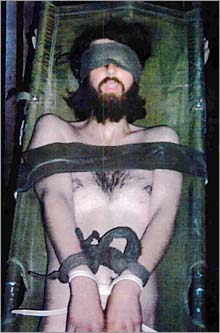
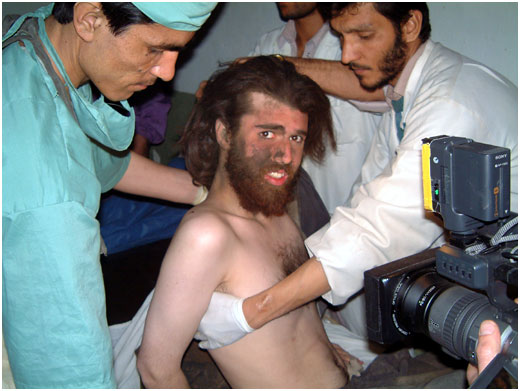
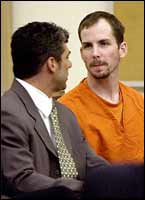
An image of John Walker Lindh, the American Taliban.

In some ways, he's like a lot of 25-year-olds: After years of running from his upbringing and trying to blaze his own trail, he has become studious, stable and settled.

But there's really no other 25-year-old like John Walker Lindh.

He will be forever tagged as the American Taliban, a California kid who converted to Islam and left home to find himself - and joined the radical Taliban to fight in Afghanistan.

Now Lindh is serving a 20-year prison sentence, and is under a court-imposed silence.

But Lindh's family and supporters say he deserves a break, and America needs to take another look at what he really did.

"His story is indeed a story that needs to come out, and needs to be shared with the world," said Shakeel Syed, who served as a religious adviser to Lindh in prison.

In his first-ever account of Lindh's life in a medium-security federal prison in Victorville, Calif., Syed said Lindh is a model inmate who lives as normal a life as possible behind bars - but also is a spiritual beacon to other Muslims there.

"Prison has helped him become a better Muslim," Syed said. "He is a Malcolm X with a softer tone."

Lindh lives with a cellmate, works a prison job and is allowed to mingle with other inmates, Syed said - but he is prohibited from talking about his experiences in Afghanistan, can't see visitors who aren't relatives or lawyers, and isn't allowed to speak Arabic.


Contained ... this above shot of John Walker Lindh shows him bound naked in a container at Camp Rhino, near Kandahar, following his capture in December, say his defence lawyers, who released the photograph


While Lindh was taunted with cries of "Traitor!" when he first came to Victorville, and was once attacked by another inmate, he now faces no threats to his safety and even has gained a measure of respect, Syed said.

"He is an extremely well-liked, well-respected, model inmate in the system by the authorities as well as by the inmates," said Syed, now executive director of the Islamic Shura Council of Southern California. "Some of the inmates have come to sympathize with him because of his special restrictions."

Federal prison officials would not comment on Lindh or release information about him, citing privacy rules.

He burst into the public eye in November 2001, when CIA commandos working with the Northern Alliance, an Afghan group opposed to Taliban rule, found him among wounded and bedraggled Taliban fighters, who soon killed CIA operative Johnny (Mike) Spann.

The image of Lindh, filthy and exhausted, was beamed around the world - shocking the country with his unbelievable journey and stunning his parents, who hadn't heard from him in months.

Lindh had converted to Islam as a teen and traveled to Yemen to study the Koran and Arabic. When his visa expired he went to Pakistan, then sneaked across the border to Afghanistan - where he trained in an Al Qaeda-funded camp and twice met Osama Bin Laden.

Lindh's father, Frank Lindh, said his son was well-meaning but misguided, never taking up arms against America or joining Al Qaeda in its destructive quest.

"In simple terms, this is the story of a decent and honorable young man who became involved in a spiritual quest and became the focus of the grief and anger of an entire nation over an event in which he had no part," Frank Lindh told a San Francisco audience earlier this year.

But in the angry months after Sept. 11, Lindh was held up as a candidate for the death penalty.

Barely 10 months after he was seized on the battlefield, Lindh accepted a plea deal admitting he aided the Taliban - not plotting terror attacks or battling the U.S. He agreed to a 20-year prison term with no opportunity to appeal or challenge the government's restrictions while he's in prison.

Lindh's last public statement came when he was sentenced, where he tried to explain how he ended up in Afghanistan.

"I did not go to fight against America, and I never did," Lindh said. "I understand why so many Americans were angry when I was first discovered in Afghanistan. I realize that many still are, but I hope that with time and understanding, those feelings will change."

His parents have said little since then, but his lawyers are hoping a change in public mood could help him. With few legal options available, they've petitioned President Bush in a long-shot bid to shorten Lindh's sentence.

"I think we all have to realize that the odds are against it," Frank Lindh said in his San Francisco speech. "It is difficult to envision a situation where all those hotheads in Washington can turn around and recognize the kid got a raw deal and should be released."

Legal observers said the sentence was the byproduct of the national mood at the time, and note that many subsequent terror prosecutions in the U.S. have led to much shorter prison terms.

"He became an almost cathartic criminal case for the public," said George Washington University law Prof. Jonathan Turley. "Just as the public emotion was at a fever pitch, John Walker Lindh walked right out of central casting as a vicious traitor who betrayed his country. Upon further examination, he appears to be a confused kid playing a low-level role."

Originally published on April 2, 2006


KEY Words: American Taliban, John Walker Lindh, Books about John Walker Lindh, Google images of John Walker Lindh


Investigating the transformation of John Walker Lindh from a typical American teenager into the most infamous turncoat of our day, Kukis, a former UPI White House correspondent, traces the influences that played a part in Lindh's metamorphosis, from his California childhood to his capture in Mazar-i-Sharif. While unable to interview the young man himself (due, according to the publisher, to Attorney General Ashcroft's gag order) or his parents, the author draws from conversations he had with those who knew Lindh and witnessed his experiences-friends, teachers, lawyers, fellow students, family members and Taliban soldiers-all the way from San Francisco to Afghanistan, Pakistan and Yemen. Despite all the hype surrounding Lindh, Kukis "vowed to keep an open mind" in the research and writing of his biography, and expresses his hope that "understanding Lindh...will help us, as Americans at war, to reflect on ourselves as well as the enemies we face." B&w photos, maps. Copyright 2003 Reed Business Information, Inc.


Mahoney claims that his new book puts not only John Walker Lindh on trial but the entire U.S. government, for what he calls its treasonous double dealings with states that aid terrorists. Part biography of Lindh, part courtroom transcript, part military field report and in large part conjecture, the book, while often muddled and disconnected, raises important questions about the precarious nature of the U.S.'s alliances with Saudi Arabia and Pakistan. The author claims, as have others, that the U.S. enabled the rise of the Taliban by arming the mujahideen fighting the Soviets in Afghanistan in the 1980s. Most readers will find, though, that the charge that this constitutes treason ignores the complexity of the geopolitical landscape. Mahoney's second claim is that, because of its insatiable thirst for oil and profit, the U.S. habitually turns a blind eye to Saudi Arabia's and Pakistan's support of terrorism. The author's main charge, however, is that the Justice Department abruptly stopped Lindh's trial for fear of what might be revealed. This charge ignores what the judge noted: the evidence of Lindh's conspiracy to kill Americans was far from compelling, though Mahoney weakly argues the opposite. While providing much fodder for conspiracy theorists, Mahoney (Sons and Brothers: The Days of Jack and Bobby Kennedy) falls short of making his sweeping indictments stick.
Copyright © Reed Business Information, a division of Reed Elsevier Inc. All rights reserved.

Tuesday, November 20, 2001

Elliot Cohen WW IV (World War 4)


WHAT'S IN A NAME

World War IV
Let's call this conflict what it is.

BY ELIOT A. COHEN
Tuesday, November 20, 2001 12:01 a.m. EST

Political people often dislike calling things by their names. Truth, particularly in wartime, is so unpleasant that we drape it in a veil of evasions, and the right naming of things is far from a simple task.

Take the matter of this war. It is most assuredly something other than the "Afghan War," as the press sometimes calls it. After all, the biggest engagement took place on American soil, and the administration promises to wage the conflict globally, and not, primarily, against Afghans.

The "9/11 War," perhaps? But the war began well before Sept. 11, and its casualties include, at the very least, the dead and wounded in our embassies in Africa, on the USS Cole and, possibly, in Somalia and the Khobar Towers. "Osama bin Laden's War"? There are precedents for this in history (King Philip's War, Pontiac's War, or even The War of Jenkins' Ear), but the war did not begin with bin Laden and will not end with his death, which may come sooner than anyone had anticipated--including, one hopes, the man himself.

A less palatable but more accurate name is World War IV. The Cold War was World War III, which reminds us that not all global conflicts entail the movement of multimillion-man armies, or conventional front lines on a map. The analogy with the Cold War does, however, suggest some key features of that conflict: that it is, in fact, global; that it will involve a mixture of violent and nonviolent efforts; that it will require mobilization of skill, expertise and resources, if not of vast numbers of soldiers; that it may go on for a long time; and that it has ideological roots.

Americans still tiptoe around this last fact. The enemy in this war is not "terrorism"--a distilled essence of evil, conducted by the real-world equivalents of J. K. Rowling's Lord Voldemort, Tolkien's Sauron or C. S. Lewis's White Witch--but militant Islam. The enemy has an ideology, and an hour spent surfing the Web will give the average citizen at least the kind of insights that he might have found during World Wars II and III by reading "Mein Kampf" or the writings of Lenin, Stalin or Mao. Those insights, of course, eluded those in the West who preferred--understandably, but dangerously--to define the problem as something more manageable, such as German resentment about the Versailles Treaty, an exaggerated form of Russian national interest, or peasant resentment of landlords taken a bit too far. In the reported words of one survivor of the Holocaust, when asked what lesson he had taken from his experience of the 1940s, "If someone tells you that he intends to kill you, believe him."

Al Qaeda and its many affiliates consist of Muslim fanatics. They will, no doubt, find almost as many enemies among moderate Muslims as among infidels, and show them, if anything, less mercy. One hopes for a wave of revulsion among Muslims who abhor this rendition of their faith, understand the calamities of all-out war waged to erect a theocratic dystopia, and will fight these movements with no less vigor, and no more reservations, than do Christians, Jews, Hindus and, for that matter, atheists.

Afghanistan constitutes just one front in World War IV, and the battles there just one campaign.
The U.S. is within range of gaining two important objectives there: smashing al Qaeda (including the elimination of its leadership), and teaching the lesson that governments that shelter such organizations will themselves perish. But what next? Three ideas come to mind.

First, if one front in this war is the contest for free and moderate governance in the Muslim world, the U.S. should throw its weight behind pro-Western and anticlerical forces there. The immediate choice lies before the U.S. government in regard to Iran. We can either make tactical accommodations with the regime there in return for modest (or illusory) sharing of intelligence, reduced support for some terrorist groups and the like, or do everything in our power to support a civil society that loathes the mullahs and yearns to overturn their rule. It will be wise, moral and unpopular (among some of our allies) to choose the latter course. The overthrow of the first theocratic revolutionary Muslim state and its replacement by a moderate or secular government, however, would be no less important a victory in this war than the annihilation of bin Laden.

Second, the U.S. should continue to target regimes that sponsor terrorism. Iraq is the obvious candidate, having not only helped al Qaeda, but attacked Americans directly (including an assassination attempt against the first President Bush) and developed weapons of mass destruction. Again, American allies will flinch, and the military may shake its head at the prospect of revisiting the aborted Gulf War victory, but the costs of failing to do so, and the opportunities for success, make it good sense. The Iraqi military is weak, and the consequences of finishing off America's archenemy in the Arab world would reinforce the awe so badly damaged by a decade of cruise missiles flung at empty buildings.

Third, the U.S. must mobilize in earnest. The Afghan achievement is remarkable--within two months to have radically altered the balance of power there, to have effectively destroyed the Taliban state and smashed part of the al Qaeda--is testimony to what the American military and intelligence communities can do when turned on to a problem. But the Taliban were not the hardest case, and the airplanes dropping bombs on the enemy in Kunduz and Kandahar are in some cases older than their pilots, and suffering for lack of spare parts.

The combination of precision weapons, Special Operations forces, and sophisticated intelligence-gathering systems indicates the beginning of a desperately needed "transformation" of the American military. But this will require something more than the $20 billion a year in defense spending increases over the budget now in the offing.

Similarly, the creation of a homeland security office without real powers, the reluctance of the government to open comprehensive, formal inquiries into the disaster of Sept. 11, and the absence of big, imaginative programs--mass scholarships for public health programs, for example, or, more ambitious yet, a really substantial program of scientific research to emancipate the West from dependence upon Persian Gulf oil--tell us that Washington is somewhere between a war footing and business as usual.

It is, of course, early yet, and many of the signs--from the B-52s pounding Taliban front lines to CIA teams scouring the Afghan hills, from enhanced spending on vaccines and the Centers for Disease Control to the creation of military tribunals for foreign terrorists--indicate that the government is truly serious. But much remains to be done, beginning with acknowledging the scope of the task, and acting accordingly. Yet if after the Afghan campaign ends, the government lapses into a covert war of intelligence-gathering, arrests, and the odd explosion in a terrorist training camp, it will be a sign that it would rather avoid calling things by their true name.

Mr. Cohen is professor of strategic studies at the Nitze School of Advanced International Studies, Johns Hopkins University.

Books by Mr. Cohen


Books including contributions by Mr. Cohen


First Sentence:
WE SHALL BEGIN OUR EXPLORATION of military misfortune by looking at the five explanations most commonly offered by historians trying to account for defeat and disaster on the field of battle

amazon quicklinker

Favorites linker

google adds