Good video showing the Bush Administration Talking Points about Iraq and how they changed. Now more than 1 million Iraqs are dead more than 4 thousand US soldiers.
As Donald Rumsfeld said: There are some people who lie and get away with it.
Showing posts with label Donald Rumsfeld. Show all posts
Showing posts with label Donald Rumsfeld. Show all posts
Tuesday, August 26, 2008


Friday, March 21, 2008
The Daily Show Remembers “Iraq: The First Five Years”
Stewart: “Hard to believe folks — five years. And they said it wouldn’t last. No, seriously, they said it wouldn’t last.”
MR. RUSSERT: [D]o you think the American people are prepared for a long, costly, and bloody battle with significant American casualties?
VICE PRES. CHENEY: Well, I don’t think it’s likely to unfold that way, Tim.
RUMSFELD: It could last six days, six weeks. I doubt six months.
Saturday, March 08, 2008
Look it up- It was Clinton who publically called for Rumsfelds resignation
Republican Candidate McCain now claims it was he who made the call for then Secretary of Defense Donald Rumsfeld to resign over failed military strategy.
He lied. Hillary, not Obama or McCain stood at the forefront of ousting Rumsfeld.
It was not Clinton alone Sen. John Kerry called for his resignation and Rep. Charles Rangel, D-N.Y called for his impeachment. ( Note: Joe Lieberman, former Democrat, thought it was a bad idea.)
McCain now admits he did not call for the resignation:
"As he gets closer to the Republican nomination, Sen. John McCain has been trying to balance his unqualified support for the Iraq war by reminding audiences that he was also a tough critic of how it was managed until President Bush finally changed strategies a year ago. In recent weeks, McCain has gone so far as to tell audiences that he was “the only one” who called for Donald H. Rumsfeld’s resignation as defense secretary.
The trick is that he never did, at least not publicly. The senator from Arizona was a tough critic of Rumsfeld and more than once said that he had no confidence in the Pentagon chief in the two years before Bush finally dumped Rumsfeld in November 2006. But even as he was criticizing Rumsfeld, McCain typically stopped short of calling for the Pentagon chief to step down.
While campaigning in Fort Myers, Fla., on Jan. 26, he told a crowd: “In the conflict that we’re in, I’m the only one that said we have to abandon the Rumsfeld strategy — and Rumsfeld — and adopt a new strategy.” Four days later during a debate at the Ronald Reagan Presidential Library in Simi Valley, Calif., aired on CNN, McCain said, “I’m the only one that said that Rumsfeld had to go.”
A McCain spokesman acknowledged this week that that was not correct.
February 9 Washington Post article, the Post reported on February 16 that McCain "overstate[d] his public position on Rumsfeld" and never called for him to resign.
( Note Sen. Obama was not not active in this debate.)
Sen. Clinton: Rumsfeld should resign
Updated: 2006-08-04 09:34
WASHINGTON - Sen. Hillary Rodham Clinton on Thursday called on Defense Secretary Donald H. Rumsfeld to resign, hours after excoriating him at a public hearing over what she called "failed policy" in Iraq.
Senator Hillary Rodham Clinton: "I just don't understand why we can't get new leadership that would give us a fighting chance to turn the situation around before it's too late," the New York Democrat and potential 2008 presidential contender said in an interview with The Associated Press. "I think the president should choose to accept Secretary Rumsfeld's resignation."
"The secretary has lost credibility with the Congress and with the people," she said. "It's time for him to step down and be replaced by someone who can develop an effective strategy and communicate it effectively to the American people and to the world."
Asked about Clinton's comments, Pentagon spokesman Eric Ruff said, "We don't discuss politics."
Clinton had resisted joining the chorus of other Democrats demanding Rumsfeld's ouster. Her remarks Thursday were the harshest assessment yet from the woman considered her party's early front-runner for the 2008 presidential nomination.
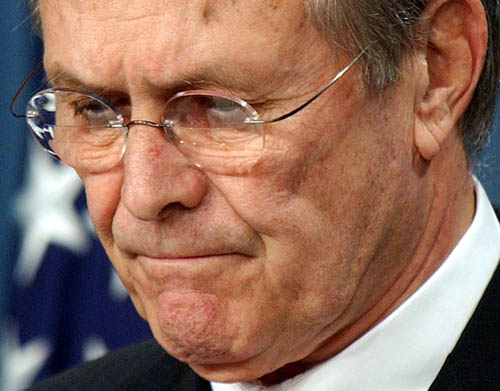
Defense Secretary Donald H. Rumsfeld. [Reuters]
The former first lady has come under attack from some in her own party for voting for the war in 2002 and her current opposition to a deadline for U.S. troop withdrawal.
She criticized Rumsfeld in person earlier Thursday during a Senate Armed Services Committee hearing.
"Under your leadership, there have been numerous errors in judgment that have led us to where we are," she said. "We have a full-fledged insurgency and full-blown sectarian conflict in Iraq."
The defense secretary rejected some of her specific criticisms as simply wrong and said the war against terror will be a drawn-out process. He said he never glossed over the difficulties of the fighting.
"I have never painted a rosy picture," he said. "I've been very measured in my words, and you'd have a dickens of a time trying to find instances where I've been excessively optimistic."
Earlier in the day, the senator wasted no time going after Rumsfeld when he testified in a morning hearing before the Senate Armed Services Committee.
"Under your leadership there have been numerous errors in judgment that have led us to where we are," the New York Democrat said at a Senate Armed Services Committee hearing. "We have a full-fledged insurgency and full-blown sectarian conflict in Iraq."
The defense secretary seemed briefly stunned by the intensity of her attack, exclaiming, "My goodness," before launching into a point-by-point defense.
He rejected some of her specific criticisms as simply wrong and said the war against terror will be a drawn-out process.
"Are there setbacks? Yes," said Rumsfeld. "Is this problem going to get solved in the near term? I think it's going to take some time."
The testy exchange between Clinton and Rumsfeld came after a top general told the panel violence in Iraq is probably as bad as he's ever seen it and the country may be descending into civil war.
"We hear a lot of happy talk and rosy scenarios, but because of the administration's strategic blunders - and frankly the record of incompetence in executing - you are presiding over a failed policy," she said. "Given your track record, Secretary Rumsfeld, why should we believe your assurances now?"
Rumsfeld vehemently denied he'd ever glossed over the difficulties of the fighting in Iraq or elsewhere.
"There's a track record here," countered Clinton. "This is not 2002, 2003, 2004, 2005, when you appeared before this committee and made many comments and presented many assurances that have frankly proven to be unfulfilled."
"Senator, I don't think that's true," Rumsfeld fired back. "I have never painted a rosy picture. I've been very measured in my words and you'd have a dickens of a time trying to find instances where I've been excessively optimistic. I understand this is tough stuff."
At that point, the Republican chairman of the committee, Sen. John Warner of Virginia, came to Rumsfeld's defense, saying his past comments had been balanced.
Clinton still shied away from a demand made by a growing number of Democrats: a deadline for withdrawing troops from Iraq.
The disagreement between the two extended to Afghanistan. The senator specifically faulted Rumsfeld for saying in 2002 that the Taliban was gone, noting that the extremist faction has grown stronger in recent months.
He conceded violence has escalated in Afghanistan, but added, "Does that represent failed policy? I don't know. I would say not."
The defense secretary said he expected the violence there to follow a seasonal pattern and decline as winter approaches.
He lied. Hillary, not Obama or McCain stood at the forefront of ousting Rumsfeld.
It was not Clinton alone Sen. John Kerry called for his resignation and Rep. Charles Rangel, D-N.Y called for his impeachment. ( Note: Joe Lieberman, former Democrat, thought it was a bad idea.)
McCain now admits he did not call for the resignation:
"As he gets closer to the Republican nomination, Sen. John McCain has been trying to balance his unqualified support for the Iraq war by reminding audiences that he was also a tough critic of how it was managed until President Bush finally changed strategies a year ago. In recent weeks, McCain has gone so far as to tell audiences that he was “the only one” who called for Donald H. Rumsfeld’s resignation as defense secretary.
The trick is that he never did, at least not publicly. The senator from Arizona was a tough critic of Rumsfeld and more than once said that he had no confidence in the Pentagon chief in the two years before Bush finally dumped Rumsfeld in November 2006. But even as he was criticizing Rumsfeld, McCain typically stopped short of calling for the Pentagon chief to step down.
While campaigning in Fort Myers, Fla., on Jan. 26, he told a crowd: “In the conflict that we’re in, I’m the only one that said we have to abandon the Rumsfeld strategy — and Rumsfeld — and adopt a new strategy.” Four days later during a debate at the Ronald Reagan Presidential Library in Simi Valley, Calif., aired on CNN, McCain said, “I’m the only one that said that Rumsfeld had to go.”
A McCain spokesman acknowledged this week that that was not correct.
February 9 Washington Post article, the Post reported on February 16 that McCain "overstate[d] his public position on Rumsfeld" and never called for him to resign.
( Note Sen. Obama was not not active in this debate.)
Sen. Clinton: Rumsfeld should resign
Updated: 2006-08-04 09:34
WASHINGTON - Sen. Hillary Rodham Clinton on Thursday called on Defense Secretary Donald H. Rumsfeld to resign, hours after excoriating him at a public hearing over what she called "failed policy" in Iraq.
Senator Hillary Rodham Clinton: "I just don't understand why we can't get new leadership that would give us a fighting chance to turn the situation around before it's too late," the New York Democrat and potential 2008 presidential contender said in an interview with The Associated Press. "I think the president should choose to accept Secretary Rumsfeld's resignation."
"The secretary has lost credibility with the Congress and with the people," she said. "It's time for him to step down and be replaced by someone who can develop an effective strategy and communicate it effectively to the American people and to the world."
Asked about Clinton's comments, Pentagon spokesman Eric Ruff said, "We don't discuss politics."
Clinton had resisted joining the chorus of other Democrats demanding Rumsfeld's ouster. Her remarks Thursday were the harshest assessment yet from the woman considered her party's early front-runner for the 2008 presidential nomination.
Defense Secretary Donald H. Rumsfeld. [Reuters]
The former first lady has come under attack from some in her own party for voting for the war in 2002 and her current opposition to a deadline for U.S. troop withdrawal.
She criticized Rumsfeld in person earlier Thursday during a Senate Armed Services Committee hearing.
"Under your leadership, there have been numerous errors in judgment that have led us to where we are," she said. "We have a full-fledged insurgency and full-blown sectarian conflict in Iraq."
The defense secretary rejected some of her specific criticisms as simply wrong and said the war against terror will be a drawn-out process. He said he never glossed over the difficulties of the fighting.
"I have never painted a rosy picture," he said. "I've been very measured in my words, and you'd have a dickens of a time trying to find instances where I've been excessively optimistic."
Earlier in the day, the senator wasted no time going after Rumsfeld when he testified in a morning hearing before the Senate Armed Services Committee.
"Under your leadership there have been numerous errors in judgment that have led us to where we are," the New York Democrat said at a Senate Armed Services Committee hearing. "We have a full-fledged insurgency and full-blown sectarian conflict in Iraq."
The defense secretary seemed briefly stunned by the intensity of her attack, exclaiming, "My goodness," before launching into a point-by-point defense.
He rejected some of her specific criticisms as simply wrong and said the war against terror will be a drawn-out process.
"Are there setbacks? Yes," said Rumsfeld. "Is this problem going to get solved in the near term? I think it's going to take some time."
The testy exchange between Clinton and Rumsfeld came after a top general told the panel violence in Iraq is probably as bad as he's ever seen it and the country may be descending into civil war.
"We hear a lot of happy talk and rosy scenarios, but because of the administration's strategic blunders - and frankly the record of incompetence in executing - you are presiding over a failed policy," she said. "Given your track record, Secretary Rumsfeld, why should we believe your assurances now?"
Rumsfeld vehemently denied he'd ever glossed over the difficulties of the fighting in Iraq or elsewhere.
"There's a track record here," countered Clinton. "This is not 2002, 2003, 2004, 2005, when you appeared before this committee and made many comments and presented many assurances that have frankly proven to be unfulfilled."
"Senator, I don't think that's true," Rumsfeld fired back. "I have never painted a rosy picture. I've been very measured in my words and you'd have a dickens of a time trying to find instances where I've been excessively optimistic. I understand this is tough stuff."
At that point, the Republican chairman of the committee, Sen. John Warner of Virginia, came to Rumsfeld's defense, saying his past comments had been balanced.
Clinton still shied away from a demand made by a growing number of Democrats: a deadline for withdrawing troops from Iraq.
The disagreement between the two extended to Afghanistan. The senator specifically faulted Rumsfeld for saying in 2002 that the Taliban was gone, noting that the extremist faction has grown stronger in recent months.
He conceded violence has escalated in Afghanistan, but added, "Does that represent failed policy? I don't know. I would say not."
The defense secretary said he expected the violence there to follow a seasonal pattern and decline as winter approaches.
Sunday, October 07, 2007
President Bush on Blackwater (video)
A flashback of Bush dodging a college freshman's question about what laws govern our mercenaries (Blackwater).
The President admits to not knowing, but assures that someone else must know.
This administration has continually sought ways to go outside of the law in programs such as Secret Prisons, Torture, Prisoner Rights and even Domestic Spying,
PREVIOUS POST ABOUT BLACKWATER:
Blackwater manager blamed for 2004 massacre in Fallujah July 9th 2007
US Private mercenaries Mutilated in Fallujia
Video :BLACKWATER the US Secretive Mercenary Firm
Video- Iraq for Sale: The War Profiteers (part 4 of 8)
Please post commnents
The President admits to not knowing, but assures that someone else must know.
This administration has continually sought ways to go outside of the law in programs such as Secret Prisons, Torture, Prisoner Rights and even Domestic Spying,
PREVIOUS POST ABOUT BLACKWATER:
Blackwater manager blamed for 2004 massacre in Fallujah July 9th 2007
US Private mercenaries Mutilated in Fallujia
Video :BLACKWATER the US Secretive Mercenary Firm
Video- Iraq for Sale: The War Profiteers (part 4 of 8)
Please post commnents
Saturday, July 14, 2007
Executive Privlage to conceal the truth about Pat Tillman's Death


Panel Demands Records on Tillman's Death
House Committee Accuses Administration of Withholding Key Documents on Tillman Death
You can just see President Bush asking Vice President Cheney what he should do about this Tillman problem. Cheney smiles and rubs his hands together :" Just say no. Executive privilege.
President Bush:: Heh, Heh, good idea Dick.
And is just what they have done.
Withholding key documents -Why?
Two influential lawmakers investigating how and when the Bush administration learned the circumstances of Pat Tillman's friendly-fire death and how those details were disclosed accused the White House and Pentagon on Friday of withholding key documents and renewed their demand for the material.
The White House and Defense Department have turned over nearly 10,000 pages of papers mostly press clippings but the White House cited "executive branch confidentiality interests" in refusing to provide other documents.
House Oversight Committee Chairman Henry Waxman, D-Calif., and Tom Davis, R-Va., the committee's top-ranking Republican, said Friday the documents were inadequate. They insisted that the Defense Department turn over the additional material by July 25 and asked that the White House do likewise.
Killed April 22, 2004, by friendly (?) fire in Afghanistan.
Tillman, a San Jose native, turned down a lucrative contract with the NFL's Arizona Cardinals to join the Army following the Sept. 11 attacks. He was killed April 22, 2004, by friendly fire in Afghanistan.
Public Lied to at first
Although Pentagon investigators determined quickly that he was killed by his own troops, five weeks passed before the circumstances of his death were made public. During that time, the Army claimed he was killed by enemy fire.
Tillman's family and others have said they believe the erroneous information peddled by the Pentagon was part of a deliberate cover-up that may have reached all the way to President Bush and then-Secretary of Defense Donald H. Rumsfeld. The committee said Friday it had scheduled a second hearing on Tillman's death for Aug. 1, this time to probe what senior Pentagon officials knew and when.
Rumsfeld and Richard Myers, the former chairman of the Joint Chiefs of Staff, were among those the committee invited Friday to appear.
The White House has turned over nearly 1,100 pages of documents and the Defense Department nearly 8,500 pages since the committee requested information from them in April, part of an inquiry into why Tillman's family and the public were misled.
"The document production from the White House sheds virtually no light on these matters," Waxman and Davis wrote to White House counsel Fred Fielding, part of a renewed request for additional papers.
because they implicate executive branch
The committee made public a letter last month in which Fielding said the White House was holding back certain papers "because they implicate executive branch confidentiality interests." He added the White House had blacked out portions of "purely internal e-mails between White House personnel."
The White House's argument for withholding some papers is the same one it used last month as it rejected congressional subpoenas for documents in the firings of eight U.S. attorneys. Executive "confidentiality" is a lesser claim than "executive privilege" more a polite way of declining than a firm refusal and thus still leaves room for negotiation, congressional staffers involved in the matter said.
Fielding added the White House had blacked out portions of "purely internal e-mails between White House personnel."
Waxman and Davis fired back that "these are not appropriate reasons for withholding the documents from the committee." And they charged that the White House had simply held other papers back.
In particular, they expressed doubt that the two documents they'd received on communications between the White House and Pentagon on Tillman's death were the only ones of their kind. One was simply a packet of newspaper clippings.
"Corporal Tillman's death was a major national story," they wrote. "It is not plausible that there were no communications between the Defense Department and the White House about Corporal Tillman's death."
"The committee was fully aware that certain documents were withheld as our letter to them made clear last month along with our offer to discuss possible accommodation that meets the committee's interests while respecting separation of powers principles," Blair Jones, a White House spokesman, said Friday evening. "We continue to offer an opportunity for the committee to move forward in a spirit of accommodation, rather than conflict."
Waxman and Davis complained to Defense Secretary Robert Gates of a "failure to provide a complete production to the committee." For instance, the committee received no documentation on how Rumsfeld learned of Tillman's death.
They said the Pentagon had not produced any papers from, among others, the offices of Gen. John Abizaid, then head of Central Command.
A week after Tillman died, a top general sent a memo to Abizaid warning that it was "highly possible" that Tillman was killed by friendly fire. The memo made clear that the information should be conveyed to the president. The White House said there is no indication that Bush received the warning.
Two days later, the president mentioned Tillman in a speech to the White House correspondents dinner, but he made no reference to how Tillman had died.
A White House spokeswoman did not immediately respond to requests for comment Friday.
Separately, Waxman asked the Republican National Committee for copies of e-mail communications that involved Tillman and White House officials. That request was an outgrowth of the oversight committee's finding last month that 88 White House officials had e-mail accounts with the RNC, and that the administration may have committed extensive violations of a law requiring that certain records be preserved.
Chairman Waxman responds
Today Chairman Waxman and Ranking Minority Member Davis sent a letter to the White House objecting to the withholding of documents related to the death of U.S. Army Corporal Patrick Tillman, who was killed by friendly fire in Afghanistan in 2004. As a result of deficient responses from both the White House and Defense Department, the Committee also announced an August 1 hearing to examine what senior Defense Department officials knew about Corporal Tillman’s death.
Following the Committee’s April 24, 2007, hearing on the Tillman fratricide, the Committee wrote to White House Counsel Fred Fielding seeking “all documents received or generated by any official in the Executive Office of the President” relating to Corporal Tillman’s death. The White House Counsel’s office responded that it would not provide the Committee with documents that “implicate Executive Branch confidentiality interests” and produced only two communications with the officials in the Defense Department, one of which was a package of news clippings. The response of the Defense Department to the Committee’s inquiry was also deficient.
The next date in the battle with the White House : July 25, 2007
In response to the deficiencies in the White House and Defense Department productions, Chairman Waxman and Ranking Member Davis today sent letters to White House Counsel Fred Fielding and Defense Secretary Robert Gates requesting complete document production by July 25, 2007.
Oh, and how about copies of emails wrongly controlled by the Republican National Committee?
Chairman Waxman also wrote the Republican National Committee to request communications about Corporal Tillman’s death by White House officials using e-mail accounts controlled by the RNC.
In addition, the Oversight Committee announced that a hearing will be held on Wednesday, August 1, 2007, to investigate what senior officials at the Defense Department knew about Corporal Tillman’s death.
Copyright © 2007 ABC News Internet Ventures
Other notes about Pat Tillman
Katie Couric's Notebook: Pat Tillman
Pat's brother gives evidence under oath of how they lied when his brother died.
When Bruce Snyder, Pat Tillman’s football coach at Arizona State University, told Pat he planned to redshirt him as a freshman—extending his eligibility for a year but also necessitating an additional year in college—Tillman said, "You can do whatever you want with me, Coach, but in four years, I’m gone. I’ve got things to do with my life."
And Tillman wasn’t kidding. Through sheer drive and determination, he turned an overachieving college career into a long shot at NFL stardom, becoming a late-round pick by the hometown Cardinals in the 1998 draft. Not only did the rookie make it through his first training camp, he eventually earned a starting role and, over time, became one of the league’s top players at his position.
But Tillman’s will to succeed was not confined to the football field. Deeply affected by the horrific events of September 11, 2001, he turned down a $3.6 million contract offer from the Cardinals, quit the NFL and, with his brother Kevin, enlisted in the army for a nation at war. Not just any army unit, either, but the hardcore, hard-as-nails Rangers, training for dangerous special-ops combat that would eventually put him in harm’s way in the sands of Iraq and, later, in the mountainous terrain of Afghanistan.
Real heroes never think of themselves as heroes. They see themselves as ordinary people performing acts any other right-minded person would do if in their shoes. Save the baby from the burning house. Jump into the foxhole and sprawl across the bodies of your buddies, shielding them from the grenade’s flying shrapnel. Bust down the cockpit door of your hijacked jetliner and dive the plane into the ground before it can crash into the U.S. Capitol. True heroes are ordinary people caught up in extraordinary circumstances.
Pat Tillman was just such an American hero, killed in action on April 22, 2004. I’ve Got Things to Do with My Life is the inspirational story of this exceptionally heroic life of victory and valor.
Friday, June 15, 2007
Gen. Pace was pushed out -Democrats thought him incompetent

Defense Secretary Robert Gates went on an unannounced visit to Bagdhad today. Speaking to reporters on the flight to Baghdad, Gates said the military wasn't trying to paint an overly optimistic picture of how the war is going. "It's a very mixed picture," he said. (1)
When Gates arrived he would learn that five more soldiers had just died.
Gates last week made the decision not to seek the reappointment of Gen. Peter Pace as chairman of the joint chiefs of staff. Gates appears to have feared that Pace's long involvement in the Iraq War and his relatively subservient attitude to former SecDef Donald Rumsfeld would turn his reconfirmation hearing into a circus. (2)
Dermocratic Leaders Did Not Approve of Pace
This view of Pace as part of the problem was held by Democratic Leader Harry Reid:
Senate Majority Leader Harry Reid confirmed Thursday that he told liberal bloggers last week that he thinks outgoing Joint Chiefs of Staff Chairman Peter Pace is "incompetent." (1)
Reid Also Doesn't Think Petraeus is Competent
Reid also disparaged Army Gen. David Petraeus, head of Multinational Forces in Iraq."When I was in Iraq, he was responsible for training the Iraqi troops. He told us it was going great. As we've looked back, it didn't go so well," Reid said. "I was a little disappointed, to say the least, today reading USA Today newspaper, where he's saying things are going fine, kids are playing soccer. The truth is, you look at another newspaper and look at a different page of USA Today, the bloodiest three months of the war has been since the surge took place," Reid said.

Tony Snow Calls for an Apology from Reid
Tony Snow told reporters that he hoped what he had read about Reid is "not true, because in a time of war, for a leader of a party that says its supports the military, it seems outrageous to be issuing slanders toward the chairman of the Joint Chiefs and also the man that is responsible for the bulk of military operations in Iraq.
"Indeed, Senator Reid has at some point declared the war lost and also has declared the surge a failure, even though it has not yet been fully enacted," Snow said, adding that Reid should apologize.
Pace Comments on the Situation- He Was Forced Out- He Did Not And Would Not Resign or Retire

WASHINGTON — In his first public comments on the Bush administration's surprise decision to replace him as chairman of the Joint Chiefs of Staff, Marine Gen. Peter Pace disclosed that he had turned down an offer to voluntarily retire rather than be forced out.
To quit in wartime, he said, would be letting down the troops.
Pace, responding to a question from the audience after he spoke at the Joint Forces Staff College in Norfolk, Va., on Thursday evening, said he first heard that his expected nomination for a second two-year term was in jeopardy in mid-May. Defense Secretary Robert Gates on June 8 announced Pace was being replaced.
"One thing that was discussed was whether or not I should just voluntarily retire and take the issue off the table," Pace said, according to a transcript released Friday by his office at the Pentagon.
"I said I could not do that for one very fundamental reason," which is that no soldier or Marine in Iraq should "think _ ever _ that his chairman, whoever that person is, could have stayed in the battle and voluntarily walked off the battlefield.
"That is unacceptable as a leadership thing, in my mind," he added.

Pace, whose current term ends Oct. 1, said he intended to remain on the job until then. Navy Adm. Michael Mullen has been announced as President Bush's choice to succeed Pace, who is the first Marine ever to hold the military's top post.
The decision to drop Pace has fed the political debate in Washington over the Iraq war. On Thursday, Senate Majority Leader Harry Reid caused a stir when he said Pace had failed in his job of providing Congress a candid assessment on the war. Democrats typically have shied from stinging comments about military officers, instead focusing criticism on Bush and administration policies in Iraq.
Asked for comment on Reid's statement, a spokeswoman for Pace, Marine Col. Katie Haddock, said Pace "is focused on his duties as chairman and is not going to respond to press reports on who's saying what. He will let 40 years of service speak for itself."
A Vietnam veteran, Pace indicated in his Norfolk comments that his experience in that war colored his decision not to quit voluntarily.

"The other piece for me personally was that some 40 years ago I left some guys on the battlefield in Vietnam who lost their lives following 2nd Lt. Pace," he said. "And I promised myself then that I will serve this country until I was no longer needed _ that it's not my decision. I need to be told that I'm done.
"I've been told I'm done.
"I will run through the finish line on 1 October, and when I run through the finish line I will have met the mission I set for myself," he said.

Pace was vice chairman of the Joint Chiefs during the run-up to the Iraq war and during the early years of a conflict that has dragged on far longer than the administration foresaw. In October 2005 he succeeded Air Force Gen. Richard Myers as Joint Chiefs chairman, and until recently had largely been spared the war-related criticism that senior civilian officials attracted.
The decision to sideline Pace came as a surprise, since Gates had previously indicated privately that he intended to recommend that the president re-nominate him. In his remarks in Norfolk, Pace confirmed that Gates had told him he preferred to keep him as chairman but in mid-May began to see signs of opposition on Capitol Hill.
When he announced the decision last Friday, Gates said that after consulting with members of the Senate he concluded that sticking with Pace would risk a Senate confirmation struggle focusing on the Iraq War.
"It would be a backward-looking and very contentious process," Gates said. At the same time, he made clear he had made his decision with reluctance, saying he wished it had not been necessary.
"I am no stranger to contentious confirmations, and I do not shrink from them," Gates said. "However, I have decided that at this moment in our history, the nation, our men and women in uniform and General Pace himself would not be well served by a divisive ordeal. ..."

In his remarks in Norfolk, Pace said Gates had accurately portrayed what transpired.
"He brought me in the office and sat me down and said `Pete, this is what's happening. I want to re-nominate you. I want you to know that this is what I'm beginning to hear, this is what I'm going to go do, this is how I'm going to go do it.'"
"He went out and did exactly what he said on television, and exactly what he's been saying in his interviews, which is he went out and pulsed various members of Congress and he heard back from them the things that he said that he heard," Pace said.
At that point, Pace said, he assured Gates that he was willing to go through even a contentious confirmation process.
"I also told him that what he needed to do, in my opinion, was what was best for the institution, and whatever he and the president decided was going to be best for the institution was what Pete Pace was going to do," he said. "Oh and by the way, I can read the Constitution, which says the president gets to nominate and the Senate gets to confirm, or not, and neither one of those two things is going to happen, therefore I'm not staying." (5)
posted by Paul Grant (follower of Basho)
1. Huffington Post http://www.huffingtonpost.com/huff-wires/20070615/iraq/
3. Informed Comment http://www.juancole.com/2007/06/more-than-80-killed-mcclatchy-reviews.html
4. Fox News http://www.foxnews.com/story/0,2933,282632,00.html
5. Huffington Post http://www.huffingtonpost.com/huff-wires/20070615/us-iraq/
------------------------------------------
Thursday, February 01, 2007
Video Documentary part 3 :PNAC/Neocon Crusades - Pin 9/11 on Iraq
1. Cheny convinced Bush to attack Iraq
2. Paul Wolfowitz pushed for regimne change in Iraq constantly
3. The neoconservitives knew that there was no link between 9/11 and Iraq
4. Ricahard Pearl said on news interview that Saddam was responsable for 9/11- when he knew there was no bases for that statement
5. The administration knowinglly lied to the public- well organized and repetitive propoganda similiar to the German Nazi tactics. it was the Nazi Gerbals who said: If you repeat a lie often enough, people swallow it.
6. The administration had a two part plan - A. Get rid of weapons inspectors who keep saying that Iraq has no WMD and B> Find wepons
7. Bush Administration went on a smear campagien against Hans Blix - who angrilly left his post ( read his commnts here)
posted by Paul Grant (follower of Basho)
Sunday, January 28, 2007
Video :BLACKWATER the US Secretive Mercenary Firm
In this post:
1. a two part interview with Jeremy Scahill author of a book on Black Water
2. 'Iraq For Sale' bonus scene: Blackwater
3. A short bio of Blackwater's leader Erik Prince from Wikapedia
4. An interview with Erik Prince
5. Links to a couple of good books about Blackwater
Part Two
'Iraq For Sale' bonus scene: Blackwater
BLACKWATER USA, is the world's most secretive and powerful mercenary firm. Based in the wilderness of North Carolina, it is the fastest-growing private army on the planet with forces capable of carrying out regime change throughout the world. Blackwater protects the top US officials in Iraq and yet we know almost nothing about the firm's quasi-military operations in Iraq, Afghanistan and inside the US. Blackwater was founded by an extreme right-wing fundamentalist Christian mega-millionaire ex- Navy Seal named Erik Prince, the scion of a wealthy conservative family that bankrolls far-right-wing causes, including President Bush.
This civilian reserve force is used by the President without needing Congress' approval. Fred Fielding was Blackwater's lawyer is now Bush's lawyer replacing Harriett Myer. Ken Star the special prosecute in the Clinton's impeachment fiasco is now Blackwater's counsel.

Erik Prince, born in 1969 in Holland, Michigan, is the founder and owner of the military support contractor Blackwater USA. A millionaire and former US Navy SEAL, after high school he briefly enrolled in the Naval Academy before attending and graduating from Hillsdale College. After college, he earned a commission in the Navy and served as a Navy SEAL officer on deployments to Haiti, the Middle East and the Mediterranean, including Bosnia. When his father Edgar Prince unexpectedly died in 1995, he ended his Navy service prematurely. He sold his family's automobile parts company, Prince Corporation, for $1.4 billion and later moved to Virginia Beach and personally financed the formation of Blackwater USA.
Prince is the brother of Betsy DeVos, a former chairman of the Republican Party of Michigan and wife of former Alticor (Amway) president and Gubernatorial candidate Dick DeVos. Prince's first wife died of cancer in 2003, and he has since remarried and has six children. He now runs Prince Group, Blackwater’s parent company, from an office in McLean, Virginia and also serves as a board member of Christian Freedom International, a nonprofit group with a mission of helping "Christians who are persecuted for their faith in Jesus Christ".
Due to its controversial role as an independent, though US-supported, military entity, Erik Prince and Blackwater USA have been the target of several allegations, leading to at least one major court case. Among these allegations are claims of unethical hiring practices and war profiteering.
Q&A: Blackwater's founder on the record
Erik Prince
Erik Prince
The Virginian-Pilot
© July 24, 2006
Erik Prince, the founder of Blackwater USA, is famously media-shy. But the former Navy SEAL agreed to an e-mail interview with The Virginian-Pilot. Here’s the complete text:
Q. Can you tell me a little about your personal history? I know you were a SEAL. When was that? Is that what brought you to the Hampton Roads area? How long did you live in Virginia Beach?
A. I was raised in Holland, Mich. My dad was a very successful entrepreneur. From scratch he started a company that first produced high pressure die-cast machines and grew into a world-class automotive parts supplier in west Michigan. They developed and patented the first lighted car sun visor, developed the car digital compass/thermometer and the programmable garage door opener.
Inside America's
Private Army
Not all their ideas were winners. Things like a sock-drawer light, an automated ham de-boning machine and a propeller driven snowmobile didn’t work out so well for the company. My dad used them as examples of the need for perseverance and determination.
I earned my pilot’s license at 17 and entered the Naval Academy after high school intending to be a Navy pilot. I didn’t like the academy but loved the Navy. This is where I was first exposed to the SEAL teams. I resigned after three semesters at the academy and attended Hillsdale College in Michigan, where I graduated in 1992. I re-entered the Navy through Officer Candidate School and was commissioned a naval officer. I then joined the SEALs, where I served as an officer at SEAL Team 8. I deployed to Haiti, the Middle East and the Mediterranean, including Bosnia.
As I trained all over the world, I realized how difficult it was for units to get the cutting-edge training they needed to ensure success. In a letter home while I was deployed, I outlined the vision that is today Blackwater.
I lived in Virginia Beach for about five years.
Q. Can you tell me a little about the genesis of Blackwater? What was your motivation in starting the company? Did you have any inkling that it would come so far so fast?
A. Just prior to a deployment, my dad unexpectedly died. My family’s business had grown to great success and I left the Navy earlier than I had intended to assist with family matters. I wanted to stay connected to the military so I built a facility to provide a world-class venue for U. S. and friendly foreign military, law enforcement, commercial, and government organizations to prepare to go into harm’s way. Many special operations guys I know had the same thoughts about the need for private advanced training facilities. A few of them joined me when I formed Blackwater. I was in the unusual position after the sale of the family business to self-fund this endeavor.
Q. How do you account for the phenomenal growth of Blackwater and the private security industry? Do you expect this growth to continue?
A. Blackwater's growth is due to a few simple, but important facts: We have always delivered our services complete, correct, and on time, and we continue to attract committed professionals who value service over self and who want to have an immediate positive impact for our customers.
Growth in this industry is not restricted to Iraq alone. Because of the demand, the companies who have continually invested for the long-term will be the companies who are looked at to provide services whenever they are needed. As I said before, when Blackwater got started there was little focus on training and readiness in individual skills.
We have a very long-term view to our work. We see ourselves assisting in the transformation of the DoD into a faster more nimble organization. The private sector has always led innovation in our country. If the government sees some of the things we are doing, and chooses to utilize us or to adopt and adapt some of our innovations in the defense of the nation, then all the better.
Q. Can you discuss the role played by Blackwater and other contractors in the Pentagon’s “total force,” as referenced in the latest Quadrennial Defense Review? What is its significance for Blackwater?
A. The "total force" refers to all resources available to be used in the nation's defense. Blackwater considers itself a partner to the DoD and all government agencies, and we stand ready to provide surge capacity, training, security and operational services in various areas at their request. We are honored to contribute in some small way.
American history details the contributions of private contractors in the development of our Nation. Examples include the Jamestown, Plymouth, and Massachusetts Bay colonies; all started as private investment endeavors whose security was provided by PMCs. Across the street from the White House is Lafayette Park; on its four corners stand statues of Lafayette, Von Steuben, Rochambeau, and Kosciusko. All were foreign professional military officers that came here to help build and develop the capacity of the Continental Army. The base of one of the statues bears the inscription: “He gave military training and discipline to the citizen soldiers who achieved the independence of the United States.” Lewis and Clark’s expedition to explore the American West consisted of some active duty soldiers but their “Corps of Discovery” crew also consisted of what would now be considered contractors.
Q. What are the economics of this industry? How is it cost-effective for the government to outsource these functions?
A. Blackwater and the private sector are able rapidly to tailor a custom solution to solve the customer’s problem. Our ability to quickly react with a right-sized solution whose entire cost is only associated with the duration of the contract is cost-effective because there are no subsequent carrying costs like salary, medical care, retirement, etc.
My family’s business was automotive supply, one of the most efficient and globally competitive in the world. You wake up in the morning having to drive efficiency throughout the organization or you will be driven under. We strive for that level efficiency in what we do today. In very competitive industries, the purchasing/contract officers understand your business as well as you do. The government can ensure good value for the taxpayer by pushing that level of competence and accountability to its purchasing agents and contracting officers too.
Q. There have been calls for more regulation of this industry. Do you agree that any further regulation is needed? If so, what could you support?
A. Given the sensational tone of the media coverage our industry receives, it is understandable that there are calls for more regulation. We certainly agree that our industry should be accountable and transparent, but we should carefully analyze the domestic and international regulations that already exist so that further conversations can be had from a common foundation of accurate information. There are already many tools at the disposal of purchasing agents, government contracting officers and law enforcement officials to ensure proper behavior of PMC’s. For example, early privateers (the forbearers of the U.S. Navy) would post a significant performance bond to receive their Letter of Marque. We fully support high standards with high enforcement that drive unethical, immoral players from our industry.
Q. Some contractors have been involved in financial or abuse scandals. How can that kind of thing be avoided?
A. Those companies or individuals who disregard the moral, ethical, and legal high ground are not long for this industry. Closely working together with contracting agencies, contracting officers, and policy makers can only reduce the opportunities for financial and other abuses. The key to success is leadership and balance; strong corporate governance, and operational and "field” leadership at all levels carries the day always. We want to reduce opportunities for abuse without constraining the flexibility that makes our industry so valuable.
1. a two part interview with Jeremy Scahill author of a book on Black Water
2. 'Iraq For Sale' bonus scene: Blackwater
3. A short bio of Blackwater's leader Erik Prince from Wikapedia
4. An interview with Erik Prince
5. Links to a couple of good books about Blackwater
Part Two
'Iraq For Sale' bonus scene: Blackwater
BLACKWATER USA, is the world's most secretive and powerful mercenary firm. Based in the wilderness of North Carolina, it is the fastest-growing private army on the planet with forces capable of carrying out regime change throughout the world. Blackwater protects the top US officials in Iraq and yet we know almost nothing about the firm's quasi-military operations in Iraq, Afghanistan and inside the US. Blackwater was founded by an extreme right-wing fundamentalist Christian mega-millionaire ex- Navy Seal named Erik Prince, the scion of a wealthy conservative family that bankrolls far-right-wing causes, including President Bush.
This civilian reserve force is used by the President without needing Congress' approval. Fred Fielding was Blackwater's lawyer is now Bush's lawyer replacing Harriett Myer. Ken Star the special prosecute in the Clinton's impeachment fiasco is now Blackwater's counsel.

Erik Prince, born in 1969 in Holland, Michigan, is the founder and owner of the military support contractor Blackwater USA. A millionaire and former US Navy SEAL, after high school he briefly enrolled in the Naval Academy before attending and graduating from Hillsdale College. After college, he earned a commission in the Navy and served as a Navy SEAL officer on deployments to Haiti, the Middle East and the Mediterranean, including Bosnia. When his father Edgar Prince unexpectedly died in 1995, he ended his Navy service prematurely. He sold his family's automobile parts company, Prince Corporation, for $1.4 billion and later moved to Virginia Beach and personally financed the formation of Blackwater USA.
Prince is the brother of Betsy DeVos, a former chairman of the Republican Party of Michigan and wife of former Alticor (Amway) president and Gubernatorial candidate Dick DeVos. Prince's first wife died of cancer in 2003, and he has since remarried and has six children. He now runs Prince Group, Blackwater’s parent company, from an office in McLean, Virginia and also serves as a board member of Christian Freedom International, a nonprofit group with a mission of helping "Christians who are persecuted for their faith in Jesus Christ".
Due to its controversial role as an independent, though US-supported, military entity, Erik Prince and Blackwater USA have been the target of several allegations, leading to at least one major court case. Among these allegations are claims of unethical hiring practices and war profiteering.
Q&A: Blackwater's founder on the record
Erik Prince
Erik Prince
The Virginian-Pilot
© July 24, 2006
Erik Prince, the founder of Blackwater USA, is famously media-shy. But the former Navy SEAL agreed to an e-mail interview with The Virginian-Pilot. Here’s the complete text:
Q. Can you tell me a little about your personal history? I know you were a SEAL. When was that? Is that what brought you to the Hampton Roads area? How long did you live in Virginia Beach?
A. I was raised in Holland, Mich. My dad was a very successful entrepreneur. From scratch he started a company that first produced high pressure die-cast machines and grew into a world-class automotive parts supplier in west Michigan. They developed and patented the first lighted car sun visor, developed the car digital compass/thermometer and the programmable garage door opener.
Inside America's
Private Army
Not all their ideas were winners. Things like a sock-drawer light, an automated ham de-boning machine and a propeller driven snowmobile didn’t work out so well for the company. My dad used them as examples of the need for perseverance and determination.
I earned my pilot’s license at 17 and entered the Naval Academy after high school intending to be a Navy pilot. I didn’t like the academy but loved the Navy. This is where I was first exposed to the SEAL teams. I resigned after three semesters at the academy and attended Hillsdale College in Michigan, where I graduated in 1992. I re-entered the Navy through Officer Candidate School and was commissioned a naval officer. I then joined the SEALs, where I served as an officer at SEAL Team 8. I deployed to Haiti, the Middle East and the Mediterranean, including Bosnia.
As I trained all over the world, I realized how difficult it was for units to get the cutting-edge training they needed to ensure success. In a letter home while I was deployed, I outlined the vision that is today Blackwater.
I lived in Virginia Beach for about five years.
Q. Can you tell me a little about the genesis of Blackwater? What was your motivation in starting the company? Did you have any inkling that it would come so far so fast?
A. Just prior to a deployment, my dad unexpectedly died. My family’s business had grown to great success and I left the Navy earlier than I had intended to assist with family matters. I wanted to stay connected to the military so I built a facility to provide a world-class venue for U. S. and friendly foreign military, law enforcement, commercial, and government organizations to prepare to go into harm’s way. Many special operations guys I know had the same thoughts about the need for private advanced training facilities. A few of them joined me when I formed Blackwater. I was in the unusual position after the sale of the family business to self-fund this endeavor.
Q. How do you account for the phenomenal growth of Blackwater and the private security industry? Do you expect this growth to continue?
A. Blackwater's growth is due to a few simple, but important facts: We have always delivered our services complete, correct, and on time, and we continue to attract committed professionals who value service over self and who want to have an immediate positive impact for our customers.
Growth in this industry is not restricted to Iraq alone. Because of the demand, the companies who have continually invested for the long-term will be the companies who are looked at to provide services whenever they are needed. As I said before, when Blackwater got started there was little focus on training and readiness in individual skills.
We have a very long-term view to our work. We see ourselves assisting in the transformation of the DoD into a faster more nimble organization. The private sector has always led innovation in our country. If the government sees some of the things we are doing, and chooses to utilize us or to adopt and adapt some of our innovations in the defense of the nation, then all the better.
Q. Can you discuss the role played by Blackwater and other contractors in the Pentagon’s “total force,” as referenced in the latest Quadrennial Defense Review? What is its significance for Blackwater?
A. The "total force" refers to all resources available to be used in the nation's defense. Blackwater considers itself a partner to the DoD and all government agencies, and we stand ready to provide surge capacity, training, security and operational services in various areas at their request. We are honored to contribute in some small way.
American history details the contributions of private contractors in the development of our Nation. Examples include the Jamestown, Plymouth, and Massachusetts Bay colonies; all started as private investment endeavors whose security was provided by PMCs. Across the street from the White House is Lafayette Park; on its four corners stand statues of Lafayette, Von Steuben, Rochambeau, and Kosciusko. All were foreign professional military officers that came here to help build and develop the capacity of the Continental Army. The base of one of the statues bears the inscription: “He gave military training and discipline to the citizen soldiers who achieved the independence of the United States.” Lewis and Clark’s expedition to explore the American West consisted of some active duty soldiers but their “Corps of Discovery” crew also consisted of what would now be considered contractors.
Q. What are the economics of this industry? How is it cost-effective for the government to outsource these functions?
A. Blackwater and the private sector are able rapidly to tailor a custom solution to solve the customer’s problem. Our ability to quickly react with a right-sized solution whose entire cost is only associated with the duration of the contract is cost-effective because there are no subsequent carrying costs like salary, medical care, retirement, etc.
My family’s business was automotive supply, one of the most efficient and globally competitive in the world. You wake up in the morning having to drive efficiency throughout the organization or you will be driven under. We strive for that level efficiency in what we do today. In very competitive industries, the purchasing/contract officers understand your business as well as you do. The government can ensure good value for the taxpayer by pushing that level of competence and accountability to its purchasing agents and contracting officers too.
Q. There have been calls for more regulation of this industry. Do you agree that any further regulation is needed? If so, what could you support?
A. Given the sensational tone of the media coverage our industry receives, it is understandable that there are calls for more regulation. We certainly agree that our industry should be accountable and transparent, but we should carefully analyze the domestic and international regulations that already exist so that further conversations can be had from a common foundation of accurate information. There are already many tools at the disposal of purchasing agents, government contracting officers and law enforcement officials to ensure proper behavior of PMC’s. For example, early privateers (the forbearers of the U.S. Navy) would post a significant performance bond to receive their Letter of Marque. We fully support high standards with high enforcement that drive unethical, immoral players from our industry.
Q. Some contractors have been involved in financial or abuse scandals. How can that kind of thing be avoided?
A. Those companies or individuals who disregard the moral, ethical, and legal high ground are not long for this industry. Closely working together with contracting agencies, contracting officers, and policy makers can only reduce the opportunities for financial and other abuses. The key to success is leadership and balance; strong corporate governance, and operational and "field” leadership at all levels carries the day always. We want to reduce opportunities for abuse without constraining the flexibility that makes our industry so valuable.
Saturday, January 06, 2007
Saturday, December 02, 2006
Rumsfeld’s Memo of Options for Iraq War - New York Times
Rumsfeld’s Memo of Options for Iraq War
Following is the text of a classified Nov. 6 memorandum that Defense Secretary Donald H. Rumsfeld sent to the White House suggesting new options in Iraq. The memorandum was sent one day before the midterm Congressional elections and two days before Mr. Rumsfeld resigned.
Nov. 6, 2006
SUBJECT: Iraq — Illustrative New Courses of Action
The situation in Iraq has been evolving, and U.S. forces have adjusted, over time, from major combat operations to counterterrorism, to counterinsurgency, to dealing with death squads and sectarian violence. In my view it is time for a major adjustment. Clearly, what U.S. forces are currently doing in Iraq is not working well enough or fast enough. Following is a range of options:
ILLUSTRATIVE OPTIONS
Above the Line: (Many of these options could and, in a number of cases, should be done in combination with others)
¶Publicly announce a set of benchmarks agreed to by the Iraqi Government and the U.S. — political, economic and security goals — to chart a path ahead for the Iraqi government and Iraqi people (to get them moving) and for the U.S. public (to reassure them that progress can and is being made).
¶Significantly increase U.S. trainers and embeds, and transfer more U.S. equipment to Iraqi Security forces (ISF), to further accelerate their capabilities by refocusing the assignment of some significant portion of the U.S. troops currently in Iraq.
¶Initiate a reverse embeds program, like the Korean Katusas, by putting one or more Iraqi soldiers with every U.S. and possibly Coalition squad, to improve our units’ language capabilities and cultural awareness and to give the Iraqis experience and training with professional U.S. troops.
¶Aggressively beef up the Iraqi MOD and MOI, and other Iraqi ministries critical to the success of the ISF — the Iraqi Ministries of Finance, Planning, Health, Criminal Justice, Prisons, etc. — by reaching out to U.S. military retirees and Reserve/National Guard volunteers (i.e., give up on trying to get other USG Departments to do it.)
¶Conduct an accelerated draw-down of U.S. bases. We have already reduced from 110 to 55 bases. Plan to get down to 10 to 15 bases by April 2007, and to 5 bases by July 2007.
¶Retain high-end SOF capability and necessary support structure to target Al Qaeda, death squads, and Iranians in Iraq, while drawing down all other Coalition forces, except those necessary to provide certain key enablers for the ISF.
¶Initiate an approach where U.S. forces provide security only for those provinces or cities that openly request U.S. help and that actively cooperate, with the stipulation being that unless they cooperate fully, U.S. forces would leave their province.
¶Stop rewarding bad behavior, as was done in Fallujah when they pushed in reconstruction funds, and start rewarding good behavior. Put our reconstruction efforts in those parts of Iraq that are behaving, and invest and create havens of opportunity to reward them for their good behavior. As the old saying goes, “If you want more of something, reward it; if you want less of something, penalize it.” No more reconstruction assistance in areas where there is violence.
¶Position substantial U.S. forces near the Iranian and Syrian borders to reduce infiltration and, importantly, reduce Iranian influence on the Iraqi Government.
¶Withdraw U.S. forces from vulnerable positions — cities, patrolling, etc. — and move U.S. forces to a Quick Reaction Force (QRF) status, operating from within Iraq and Kuwait, to be available when Iraqi security forces need assistance.
¶Begin modest withdrawals of U.S. and Coalition forces (start “taking our hand off the bicycle seat”), so Iraqis know they have to pull up their socks, step up and take responsibility for their country.
¶Provide money to key political and religious leaders (as Saddam Hussein did), to get them to help us get through this difficult period.
¶Initiate a massive program for unemployed youth. It would have to be run by U.S. forces, since no other organization could do it.
¶Announce that whatever new approach the U.S. decides on, the U.S. is doing so on a trial basis. This will give us the ability to readjust and move to another course, if necessary, and therefore not “lose.”
¶Recast the U.S. military mission and the U.S. goals (how we talk about them) — go minimalist.
Below the Line (less attractive options):
¶Continue on the current path.
¶Move a large fraction of all U.S. Forces into Baghdad to attempt to control it.
¶Increase Brigade Combat Teams and U.S. forces in Iraq substantially.
¶Set a firm withdrawal date to leave. Declare that with Saddam gone and Iraq a sovereign nation, the Iraqi people can govern themselves. Tell Iran and Syria to stay out.
¶Assist in accelerating an aggressive federalism plan, moving towards three separate states — Sunni, Shia, and Kurd.
¶Try a Dayton-like process.
________________
Sunday, September 17, 2006
THE ARCHITECTS OF WAR: WHERE ARE THEY NOW?
THE ARCHITECTS OF WAR: WHERE ARE THEY NOW?
Click here to comment on this report.
President Bush has not fired any of the architects of the Iraq war. In fact, a review of the key planners of the conflict reveals that they have been rewarded – not blamed – for their incompetence.
PAUL WOLFOWITZ

Role In Going To War: Wolfowitz said the U.S. would be greeted as liberators, that Iraqi oil money for pay for the reconstruction, and that Gen. Eric Shinseki’s estimate that several hundred thousand troops would be needed was “wildly off the mark.” [Washington Post, 12/8/05]
Where He Is Now: Bush promoted Wolfowitz to head the World Bank in March 2005. [Washington Post, 3/17/05]
Key Quote: “We are dealing with a country that can really finance its own reconstruction and relatively soon.” [Wolfowitz, 3/27/03]
DOUGLAS FEITH

Role In Going To War: As Undersecretary of Defense for Policy, Feith spearheaded two secretive groups at the Pentagon — the Counter Terrorism Evaluation Group and the Office of Special Plans — that were instrumental in drawing up documents that explained the supposed ties between Saddam and al Qaeda. The groups were “created in order to find evidence of what Wolfowitz and his boss, Defense Secretary Donald Rumsfeld, believed to be true.” Colin Powell referred to Feith’s operation as the Gestapo. In Bob Woodward’s Plan of Attack, former CentCom Commander Gen. Tommy Franks called Feith the “f***ing stupidest guy on the face of the earth.” [LAT, 1/27/05; NYT, 4/28/04; New Yorker, 5/12/03; Plan of Attack, p.281]
Where He Is Now: Feith voluntarily resigned from the Defense Department shortly after Bush’s reelection. He is co-chairman of a project at Harvard University’s John F. Kennedy School of Government to write an academic book on how to fight terrorism. Feith’s secretive groups at the Pentagon are under investigation by the Pentagon and the Senate Intelligence Committee for intelligence failures. [Washington Post, 1/27/05, 11/18/05; Washington Times, 3/3/06]
Key Quote: “I am not asserting to you that I know that the answer is — we did it right. What I am saying is it’s an extremely complex judgment to know whether the course that we chose with its pros and cons was more sensible.” [Washington Post, 7/13/05]
STEPHEN HADLEY

Role In Going To War: As then-Deputy National Security Advisor, Hadley disregarded memos from the CIA and a personal phone call from Director George Tenet warning that references to Iraq’s pursuit of uranium be dropped from Bush’s speeches. The false information ended up in Bush’s 2003 State of the Union address. [Washington Post, 7/23/03]
Where He Is Now: On January 26, 2005, Stephen Hadley was promoted to National Security Advisor. [White House bio]
Key Quote: “I should have recalled at the time of the State of the Union speech that there was controversy associated with the uranium issue. … And it is now clear to me that I failed in that responsibility in connection with the inclusion of these 16 words in the speech that he gave on the 28th of January.” [Hadley, 7/22/03]
RICHARD PERLE

Role In Going To War: Richard Perle, the so-called “Prince of Darkness,” was the chairman of Defense Policy Board during the run-up to the Iraq war. He suggested Iraq had a hand in 9-11. In 1996, he authored “Clean Break,” a paper that was co-signed by Douglas Feith, David Wurmser, and others that argued for regime change in Iraq. Shortly after the war began, Perle resigned from the Board because he came under fire for having relationships with businesses that stood to profit from the war. [Guardian, 9/3/02, 3/28/03; AFP, 8/9/02]
Where He Is Now: Currently, Perle is a resident fellow at the American Enterprise Institute where he specializes in national security and defense issues. He has been investigated for ethical violations concerning war profiteering and other conflicts of interest. [Washington Post, 9/1/04]
Key Quote: “And a year from now, I’ll be very surprised if there is not some grand square in Baghdad that is named after President Bush. There is no doubt that, with the exception of a very small number of people close to a vicious regime, the people of Iraq have been liberated and they understand that they’ve been liberated. And it is getting easier every day for Iraqis to express that sense of liberation.” [Perle, 9/22/03]
ELLIOT ABRAMS

Role In Going To War: Abrams was one of the defendants in the Iran-Contra Affair, and he pled guilty to two misdemeanor counts of withholding information from Congress. He was appointed Special Assistant to the President and Senior Director on the National Security Council for Near East and North African Affairs during Bush’s first term, where he served as Bush’s chief advisor on the Middle East. His name surfaced as part of the investigation into who leaked the name of a undercover CIA operative Valerie Plame. [Washington Post, 5/27/03, 2/3/05]
Where He Is Now: Abrams was promoted to deputy national security adviser in February of 2005. [Slate, 2/17/05]
Key Quote: “We recognize that military action in Iraq, if necessary, will have adverse humanitarian consequences. We have been planning over the last several months, across all relevant agencies, to limit any such consequences and provide relief quickly.” [CNN, 2/25/03]
DAVID WURMSER

Role In Going To War: At the time of the war, Wurmser was a special assistant to John Bolton in the State Department. Wurmser has long advocated the belief that both Syria and Iraq represented threats to the stability of the Middle East. In early 2001, Wurmser had issued a call for air strikes against Iraq and Syria. Along with Perle, he is considered a main author of “Clean Break.” [Asia Times, 4/17/03; Guardian, 9/3/02]
Where He Is Now: Wurmser was promoted to Principal Deputy Assistant to the Vice President for National Security Affairs; he is in charge of coordinating Middle East strategy. His name has been associated with the Plame Affair and with an FBI investigation into the passing of classified information to Chalabi and AIPAC. [Raw Story, 10/19/05; Washington Post, 9/4/04]
Key Quote: “Syria, Iran, Iraq, the PLO and Sudan are playing a skillful game, but have consistently worked to undermine US interests and influence in the region for years, and certainly will continue to do so now, even if they momentarily, out of fear, seem more forthcoming.” [Washington Post, 9/24/01]
ANDREW NATSIOS

Role In Going To War: Shortly after the invasion of Iraq, Andrew Natsios, then the Administrator of the U.S. Agency for International Development, went on Nightline and claimed that the U.S. contribution to the rebuilding of Iraq would be just $1.7 billion. When it became quickly apparent that Natsios’ prediction would fall woefully short of reality, the government came under fire for scrubbing his comments from the USAID Web site. [Washington Post, 12/18/03; ABC News, 4/23/03]
Where He Is Now: Natsios stepped down as the head of USAID in January and is currently teaching at Georgetown University’s Edmund A. Walsh’s School of Foreign Service as a Distinguished Professor in the Practice of Diplomacy and Advisor on International Development. [AP, 2/20/06; Georgetown, 12/2/05]
Key Quote: “[T]he American part of this will be $1.7 billion. We have no plans for any further-on funding for this.” [Nightline, 4/23/03]
DAN BARTLETT

Role In Going To War: Dan Bartlett was the White House Communications Director at the time of the war and was a mouthpiece in hyping the Iraq threat. Bartlett was also a regular participant in the weekly meetings of the White House Iraq Group (WHIG). The main purpose of the group was the systematic coordination of the “marketing” of going to war with Iraq as well as selling the war here at home. [Washington Post, 8/10/03]
Where He Is Now: Bartlett was promoted to Counselor to the President on January 5, 2005, and is responsible for the formulation of policy and implementation of the President’s agenda. [White House]
Key Quote: “President Bush understands that the need to disarm Saddam Hussein is necessary. He has made that case to the United Nations Security Council. He’s made that case to the United States Congress. The entire world rallied behind this resolution that gives him one last chance. He has that chance, but time is running out.” [CNN, 1/26/03]
MITCH DANIELS

Role In Going To War: Mitch Daniels was the director of the Office of Management and Budget from January 2001 through June of 2003. In this capacity, he was responsible for releasing the initial budget estimates for the Iraq War which he pegged at $50 to $60 billion. The estimated cost of the war, including the full economic ramifications, is approaching $1 trillion. [MSNBC, 3/17/06]
Where He Is Now: In 2004, Daniels was elected Governor of Indiana. [USA Today, 11/3/04]
Key Quote: Mitch Daniels had said the war would be an “affordable endeavor” and rejected an estimate by the chief White House economic adviser that the war would cost between $100 billion and $200 billion as “very, very high.” [Christian Science Monitor, 1/10/06]
GEORGE TENET

Role In Going To War: As CIA Director, Tenet was responsible for gathering information on Iraq and the potential threat posted by Saddam Hussein. According to author Bob Woodward, Tenet told President Bush before the war that there was a “slam dunk case” that Saddam possessed weapons of mass destruction. Tenet remained publicly silent while the Bush administration made pre-war statements on Iraq’s supposed nuclear program and ties to al Qaeda that were contrary to the CIA’s judgments. Tenet issued a statement in July 2003, drafted by Karl Rove and Scooter Libby, taking responsibility for Bush’s false statements in his State of the Union address. [CNN, 4/19/04; NYT, 7/22/05]
Where He Is Now: Tenet voluntarily resigned from the administration on June 3, 2004. He was later awarded a Presidential Medal of Freedom. [Washington Post, 6/3/04]
Key Quote: “It’s a slam dunk case.” [CNN, 4/19/04]
COLIN POWELL

Role In Going To War: Despite stating in Feb. 2001 that Saddam had not developed “any significant capability with respect to weapons of mass destruction,” Powell made the case in front of the United Nations for a United States-led invasion of Iraq, stating that, “There can be no doubt that Saddam Hussein has biological weapons and the capability to rapidly produce more, many more. And he has the ability to dispense these lethal poisons and diseases in ways that can cause massive death and destruction.” [Powell, 2/5/03; Powell, 2/24/01]
Where He Is Now: Shortly after Bush won reelection in 2004, Powell resigned from the administration. Powell now sits on numerous corporate boards. He is poised to succeed Henry Kissinger in May as Chairman of the Eisenhower Fellowship Program at the City College of New York. In September 2005, Powell said of his U.N. speech that it was a “blot” on his record. He went on to say, “It will always be a part of my record. It was painful. It’s painful now.” [ABC News, 9/9/05]
Key Quote: “‘You are going to be the proud owner of 25 million people,’ he told the president. ‘You will own all their hopes, aspirations, and problems. You’ll own it all.’ Privately, Powell and Deputy Secretary of State Richard Armitage called this the Pottery Barn rule: You break it, you own it.” [Bob Woodward, Plan of Attack]
DONALD RUMSFELD

Role In Going To War: Prior to the war, Rumsfeld repeatedly suggested the war in Iraq would be short and swift. He said, “The Gulf War in the 1990s lasted five days on the ground. I can’t tell you if the use of force in Iraq today would last five days, or five weeks, or five months, but it certainly isn’t going to last any longer than that.” He also said, “It is unknowable how long that conflict will last. It could last six days, six weeks. I doubt six months.” [Rumsfeld, 11/14/02; USA Today, 4/1/03]
Where He Is Now: Despite increased calls for his resignation, Donald Rumsfeld continues to be the most vocal supporter of staying the course in Iraq. Recently, he claimed that an early U.S. pullout would be the equivalent of leaving Germany in the hands of Nazis. [Bill Kristol, Washington Post, 12/15/04; Reuters, 3/19/06]
Key Quote: “You go to war with the Army you have. They’re not the Army you might want or wish to have at a later time.” [CNN, 12/9/04]
CONDOLEEZZA RICE

Role In Going To War: As National Security Adviser, Rice disregarded at least two CIA memos and a personal phone call from Director George Tenet stating that the evidence behind Iraq’s supposed uranium acquisition was weak. She urged the necessity of war because “we don’t want the smoking gun to be a mushroom cloud.” [Washington Post, 7/27/03; CNN, 9/8/02]
Where She Is Now: In December of 2004, Condoleezza Rice was promoted to Secretary of State and is being widely-mentioned as a possible presidential candidate. [ABC News, 11/16/04]
Key Quote: “We did not know at the time – maybe someone knew down in the bowels of the agency – but no one in our circles knew that there were doubts and suspicions that this might be a forgery. Of course it was information that was mistaken.” [Meet the Press, 6/8/03]
DICK CHENEY

Role In Going To War: Among a host of false pre-war statements, Cheney claimed that Iraq may have had a role in 9/11, stating that it was “pretty well confirmed” that 9/11 hijacker Mohammed Atta met with Iraqi intelligence officials. Cheney also claimed that Saddam was “in fact reconstituting his nuclear program” and that the U.S. would be “greeted as liberators.” [Meet the Press, 12/9/01, 3/16/03]
Where He Is Now: Cheney earned another four years in power when Bush won re-election in 2004. Despite recent calls from conservatives calling for him to be replaced, Cheney has said, “I’ve now been elected to a second term; I’ll serve out my term.” [CBS Face the Nation, 3/19/06]
Key Quote: “I think they’re in the last throes, if you will, of the insurgency.” [Larry King Live, 6/20/05]
GEORGE W. BUSH

Role In Going To War: Emphasizing Saddam Hussein’s supposed stockpile of weapons of mass destruction, supposed ties to al Qaeda, and supposed nuclear weapons program, Bush led the effort to build public support for an invasion of Iraq. [State of the Union, 1/28/03]
Where He Is Now: In November 2004, Bush won re-election. Since that time, popular support for the war and the President have reached a low point. [Washington Post, 3/7/06]
Key Quote: “Facing clear evidence of peril, we cannot wait for the final proof — the smoking gun — that could come in the form of a mushroom cloud.” [Bush, 10/7/02]
Wednesday, August 30, 2006
Rumsfeld's speech to American Legion National Convention

In this post we have
1.Keith Olbermann Smacking Down Senile Donald Rumsfeld for the speech to the American Legion
2. Text of that speech.
Address at the 88th Annual American Legion National Convention
As Delivered by Secretary of Defense Donald H. Rumsfeld, Salt Lake City, Utah, Tuesday, August 29, 2006
Thank you so very much. I appreciate that a great deal, that warm welcome. Earlier, a few minutes ago, I had a chance say hello to Senator Bennett and Senator Hatch, both of whom have provided such fine representation for this state and strong support for the Department of Defense and for the men and women in uniform. Members of the congressional delegation, I believe, are here -- Rob Bishop and Christopher Smith. We thank you for being here. The mayor, Mr. Corroon -- thank you. Distinguished guests.
Michael Peterson, if I could sing, I'd sing just like that. (Laughter.) That is very nice. (Applause.)
And to the spirit of youth, young folks, I had a chance before I came him to watch their presentations on television. We appreciate your thoughtfulness and your service.
To the Spirit of Service Awardees, congratulations. It is impressive to note what you're doing while you serve our country in uniform.
My special thanks to you, Tom [American Legion Commander Tom Bock], for your service to the military, to our veterans and to our country. It was a pleasure to meet your wonderful family over there; your son who's flown Chinooks, I guess, in Iraq, is following your proud tradition of military service.
Certainly, our country is grateful to all of you who have children, relatives, serving in our nation's military. They're in our thoughts and prayers, and please tell them that we appreciate all they do for our country.
I also want to thank each of you, members of the American Legion, for the love and the support that you provide for our troops every day. It is important, and it is deeply appreciated.
No one is more proud of these young people than their Commander-in-Chief, and I know that President Bush is looking forward to being with you later this week. It's a privilege to work with a president who is determined to protect our flag. (Applause.) We are fortunate to have a leader of strong resolve at a time of war.
Through all the challenges, he remains the same man who stood atop the rubble in Manhattan with a bullhorn vowing to fight back. The leader who told a grieving nation that we will never forget what was lost. And the President who has worked every day to fulfill his vow to protect the American people and to bring the enemy to justice or to bring justice to the enemy.
Our nation is so fortunate to have the American Legion standing up for all of those who are serving our country at this time of testing.
About a year ago, I participated in the dedication of the World War II Memorial in Washington. My father had served in the Pacific on a carrier during that war. When I looked out in the audience I could see a great many American Legion caps, not surprising, and it was a reminder of the millions who sacrificed for our country, so many of whom did not come home.
And it was also a reminder of all that the American Legionnaires do for our servicemen and servicewomen. Indeed, through nearly nine decades of service, the American Legion continues to find ways to undertake new initiatives that embody the motto: “For God and Country.”
The Department of Defense is proud to be your partner in the Heroes to Hometowns program, which is helping severely wounded veterans with job searches, with their homes, and with other activities to aid in their transition to civilian life.
Your partnership with the America Supports You program helps communities, organizations, and individuals across this nation express their appreciation to our troops and to their families. You can find it at: americasupportsyou.mil, and see all of the things that the compassionate and generous American people are doing; schools, corporations, villages, helping the families and helping the troops.
And on a personal note, I want to commend the American Legion for its sponsorship of the Boy Scouts. I know there are places where Scouting is kind of put down. Well, I was a proud Cub Scout; a Boy Scout; an Explorer Scout; an Eagle Scout; and a Distinguished Eagle Scout; and the Scouts represent, in my view, some of the very best qualities of our country, and they certainly merit our support. (Applause.)
The American Legion -- actually the members of the American Legion -- have achieved a great deal since its founding in the months following World War I, when those small number of folks got together in a hotel room in Europe looking for a way to help some of their fellow veterans who would be coming home soon.
That year -- 1919 -- turned out to be one of the pivotal junctures in modern history with the signing of the Treaty of Versailles, the creation of the League of Nations, a treaty and an organization intended to make future wars unnecessary and obsolete. Indeed, 1919 was the beginning of a period where, over time, a very different set of views would come to dominate public discourse and thinking in the West.
Over the next decades, a sentiment took root that contended that if only the growing threats that had begun to emerge in Europe and Asia could be accommodated, then the carnage and the destruction of then-recent memory of World War I could be avoided.
It was a time when a certain amount of cynicism and moral confusion set in among Western democracies. When those who warned about a coming crisis, the rise of fascism and nazism, they were ridiculed or ignored. Indeed, in the decades before World War II, a great many argued that the fascist threat was exaggerated or that it was someone else's problem. Some nations tried to negotiate a separate peace, even as the enemy made its deadly ambitions crystal clear. It was, as Winston Churchill observed, a bit like feeding a crocodile, hoping it would eat you last.
There was a strange innocence about the world. Someone recently recalled one U.S. senator's reaction in September of 1939 upon hearing that Hitler had invaded Poland to start World War II. He exclaimed:
“Lord, if only I had talked to Hitler, all of this might have been avoided!”
I recount that history because once again we face similar challenges in efforts to confront the rising threat of a new type of fascism. Today -- another enemy, a different kind of enemy -- has made clear its intentions with attacks in places like New York and Washington, D.C., Bali, London, Madrid, Moscow and so many other places. But some seem not to have learned history's lessons.
We need to consider the following questions, I would submit:
* With the growing lethality and the increasing availability of weapons, can we truly afford to believe that somehow, some way, vicious extremists can be appeased?
* Can folks really continue to think that free countries can negotiate a separate peace with terrorists?
* Can we afford the luxury of pretending that the threats today are simply law enforcement problems, like robbing a bank or stealing a car; rather than threats of a fundamentally different nature requiring fundamentally different approaches?
* And can we really afford to return to the destructive view that America, not the enemy, but America, is the source of the world's troubles?
These are central questions of our time, and we must face them honestly.
We hear every day of new plans, new efforts to murder Americans and other free people. Indeed, the plot that was discovered in London that would have killed hundreds -- possibly thousands -- of innocent men, women and children on aircraft flying from London to the United States should remind us that this enemy is serious, lethal, and relentless.
But this is still not well recognized or fully understood. It seems that in some quarters there's more of a focus on dividing our country than acting with unity against the gathering threats.
It's a strange time:
* When a database search of America's leading newspapers turns up literally 10 times as many mentions of one of the soldiers who has been punished for misconduct -- 10 times more -- than the mentions of Sergeant First Class Paul Ray Smith, the first recipient of the Medal of Honor in the Global War on Terror;
* Or when a senior editor at Newsweek disparagingly refers to the brave volunteers in our armed forces -- the Army, the Navy, the Air Force, the Marines, the Coast Guard -- as a "mercenary army;"
* When the former head of CNN accuses the American military of deliberately targeting journalists; and the once CNN Baghdad bureau chief finally admits that as bureau chief in Baghdad, he concealed reports of Saddam Hussein's crimes when he was in charge there so that CNN could keep on reporting selective news;
* And it's a time when Amnesty International refers to the military facility at Guantanamo Bay -- which holds terrorists who have vowed to kill Americans and which is arguably the best run and most scrutinized detention facility in the history of warfare -- as "the gulag of our times." It’s inexcusable. (Applause.)
Those who know the truth need to speak out against these kinds of myths and distortions that are being told about our troops and about our country. America is not what's wrong with the world. (Applause.)
The struggle we are in -- the consequences are too severe -- the struggle too important to have the luxury of returning to that old mentality of “Blame America First.”
One of the most important things the American Legion has done is not only to serve and assist and advocate, as you have done so superbly for so much of the past century, but also to educate and to speak the truth about our country and about the men and women in the military.
Not so long ago, an exhibit -- Enola Gay at the Smithsonian during the 1990s -- seemed to try to rewrite the history of World War II by portraying the United States as somewhat of an aggressor. Fortunately, the American Legion was there to lead the effort to set the record straight. (Applause.)
Your watchdog role is particularly important today in a war that is to a great extent fought in the media on a global stage, a role to not allow the distortions and myths be repeated without challenge so that at the least the second or third draft of history will be more accurate than the first quick allegations we see.
You know from experience personally that in every war there have been mistakes, setbacks, and casualties. War is, as Clemenceau said, “a series of catastrophes that result in victory.”
And in every army, there are occasional bad actors, the ones who dominate the headlines today, who don't live up to the standards of the oath and of our country. But you also know that they are a very, very small percentage of the literally hundreds of thousands of honorable men and women in all theaters in this struggle who are serving our country with humanity, with decency, with professionalism, and with courage in the face of continuous provocation. (Applause.)
And that is important in any long struggle or long war, where any kind of moral or intellectual confusion about who and what is right or wrong, can weaken the ability of free societies to persevere.
Our enemies know this well. They frequently invoke the names of Beirut or Somalia -- places they see as examples of American retreat and American weakness. And as we've seen -- even this month -- in Lebanon, they design attacks and manipulate the media to try to demoralize public opinion. They doctor photographs of casualties. They use civilians as human shields. And then they try to provoke an outcry when civilians are killed in their midst, which of course was their intent.
The good news is that most Americans, though understandably influenced by what they see and read, have good inner gyroscopes. They have good center of gravity. So, I'm confident that over time they will evaluate and reflect on what is happening in this struggle and come to wise conclusions about it.
Iraq, a country that was brutalized by a cruel and dangerous dictatorship, is now traveling the slow, difficult, bumpy, uncertain path to a secure new future under a representative government that will be at peace with its neighbors, rather than a threat to their own people, to their neighbors, or to the world.
As the nature of the threat and the conflict in Iraq has changed over these past several years, so have the tactics and the deployments. But while military tactics have changed and adapted to the realities on the ground -- as they must -- the strategy has not changed, which is to empower the Iraqi people to be able to defend, and govern, and rebuild their own country.
The extremists themselves call Iraq the “epicenter” in the War on Terror. And our troops know how important their mission is.
A soldier who recently volunteered for a second tour in Iraq captured the feeling of many of his peers. In an e-mail to some friends, he wrote the following, and I quote:
“I ask that you never take advantage of the liberties guaranteed by the shedding of free blood, never take for granted the freedoms granted by our Constitution. For those liberties would be merely ink on paper were it not for the sacrifice of generations of Americans who heard the call of duty and responded heart, mind and soul with ‘Yes, I will.’”
Some day that young man very likely will be a member of the American Legion attending a convention like this. I certainly hope so. And I hope he does that and that we all have a chance to meet. And one day a future speaker may reflect back on the time of historic choice, remembering the questions raised as to our country's courage, and dedication, and willingness to persevere in this fight until we prevail.
The question is not whether we can win; it's whether we have the will to persevere to win. I'm convinced that Americans do have that determination and that we have learned the lessons of history, of the folly of trying to turn a blind eye to danger. These are lessons you know well, lessons that your heroism has helped to teach to generations of Americans.
May God bless each of you. May God bless the men and women in uniform, and their families. And may God continue to bless our wonderful country.
Thank you very much. (Applause.)
Wednesday, May 03, 2006
Subscribe to:
Posts (Atom)


 Posts
Posts


