 What is the Bush Doctrine.
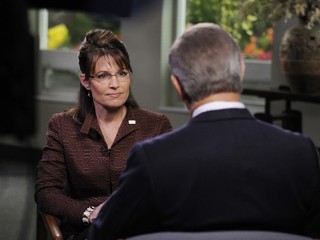
In an interview with Charles Gibson, Republican Vice Presidential hopeful Alaska Gov. Sarah Palin was asked if she agreed with the Bush Doctrine.

To which she responded: "In what respect, Charlie?"
To which she was informed: "... that we have the right of anticipatory self-defense."
Was Gibson's description right in his definition of the Bush Doctrine?

Charles Krauthammer wrote in an op-ed piece in the Washington Post
"There is no single meaning of the Bush Doctrine. In fact, there have been four distinct meanings, each one succeeding another over the eight years"
And Mr. Krauthhammer claims his authority on the subject:
"I know something about the subject because, as the Wikipedia entry on the Bush Doctrine notes, I was the first to use the term. In the cover essay of the June 4, 2001, issue of the Weekly Standard entitled, "The Bush Doctrine: ABM, Kyoto, and the New American Unilateralism," I suggested that the Bush administration policies of unilaterally withdrawing from the ABM treaty and rejecting the Kyoto protocol, together with others, amounted to a radical change in foreign policy that should be called the Bush Doctrine."
Unilateralism ("one+side-ism") is any doctrine or agenda that supports one-sided action. Such action may be in disregard for other parties, or as an expression of a commitment toward a direction which other parties may find agreeable.And though Bush spoke of forming a multinational military to attack Iraq, his position was not backed by the UN Security Council, and was in divergence to it's rules.
Who defines the Bush Doctrine?
If we leave it to history we will see that in addition to Bush's dropping from treaties, that his doctrin included:
1. The United States had the right to treat countries that harbor or give aid to terrorist groups as terrorists themselves, which was used to justify the invasion of Afghanistan.[1]
2, The policy of preventive war, which held that the United States should depose foreign regimes that represented a supposed threat to the security of the United States, even if that threat was not immediate (used to justify the invasion of Iraq).
3. The belief that terrorist groups could not be treated according to the same rules as ordinary states.
Using an analogy from games theory, he said terrorist groups were not "repetitive players" who had a mutual interest in upholding the acknowledged rules of the international system (as states do); they themselves would not be inhibited in any way by the prohibition on the use of force in international law. Terrorists are more like criminals acting on a global scale, and therefore should be treated according to the "logic of police action". The police can act before a crime has actually taken place; similarly there would be a case for taking action against terrorists who had acquired a dirty bomb, even before there was concrete evidence that they were planning to detonate it imminently.4. A willingness to pursue U.S. military interests in a unilateral way, inernational concensus is not required - but would be sought.
5. And a policy of supporting democracy around the world, especially in the Middle East. Putting democracy and human rights promotion higher on the U.S. foreign policy agenda.
One political officer at every U.S. embassy in the Middle East has democracy-promotion efforts as part of his or her portfolio. Through vehicles such as the National Democratic Institute and its Republican counterpart, the International Republican Institute, the administration now funds pro-democracy initiatives throughout the Middle East. http://www.motherjones.com/washington_dispatch/2008/01/freedom-fighters.html
Freedom AgendaThe fifth point lsisted above, of the Bush Doctrine has also been called Bush's Freedom Agenda. Some belive that this is the `lasting legacy', that President Bush wishes to be remembered by.
Charles Krauthammer writes:
"..the most sweeping formulation of the Bush approach to foreign policy and the one that most clearly and distinctively defines the Bush years: the idea that the fundamental mission of American foreign policy is to spread democracy throughout the world. It was most dramatically enunciated in Bush's second inaugural address: "The survival of liberty in our land increasingly depends on the success of liberty in other lands. The best hope for peace in our world is the expansion of freedom in all the world."
This declaration of a sweeping, universal American freedom agenda was consciously meant to echo John Kennedy's pledge in his inaugural address that the United States "shall pay any price, bear any burden, meet any hardship, support any friend, oppose any foe, in order to assure the survival and the success of liberty." It draws also from the Truman doctrine of March 1947 and from Wilson's 14 points."

The Sad TruthThe sad truth is that the Bush Presidency has left the Unted States trillions of dollars in debt, in two ongoing wars with a military bogged down and needing significant influx of money and soldiers, with a country in economic trouble, a budget debt of 50 Billion, a very low standing in world opinion, and a much less stable middle East then when his term began.
Bush has had his accomplishments - giving tax breaks to the rich and allowing oil companies to reap record profits as gas prices have almost doubled. He has brought a corporation called Haliburton back from financial problems, and has moved towards the use of private military firms such as Blackwater who are above the law, secret prisons around the world, promoted the use of torture and decrease of civil rights not just of non- American's, but of US citizens.
The Freedom Agenda was just rhetoricalFor example:
1. At the United Nations lectern this week, President Bush hailed the spread of democracy. "From Beirut to Baghdad," he said, "people are making the choice for freedom." Yet even as he spoke, tanks were rolling through the streets of Bangkok as a military coup toppled the elected leader of Thailand, who at that moment was in New York for the U.N. session.
Bush made no mention of the dramatic events on Tuesday and left New York yesterday without ever seeing the deposed prime minister, much less offering any public support for a onetime strong ally of the United States. The president's spokesman later provided a strikingly mild response only after being asked by a reporter, pronouncing the White House "disappointed" by the coup
2.Bush strongly supported Gen. Pervez Musharraf, the Pakistani president who took power in a military coup.

3.. Bush supporte Kazakhstan's president, Nursultan Nazarbayev, despite the suppression of opposition parties, newspapers and human rights groups in the oil-rich Central Asian republic.
4. The administration has likewise embraced autocratic leaders in such disparate places as Azerbaijan and Ethiopia while generally tempering criticism of anti-democratic policies in Russia and China. Even in the Middle East, Bush has treaded lightly in nudging allies such as Egypt and Saudi Arabia to reform.
http://www.washingtonpost.com/wp-dyn/content/article/2006/09/20/AR2006092001696.html





 Posts
Posts


