Army wives get phone death threats from Iraq
By Sean Rayment, Defence Correspondent
Wives and family members of soldiers fighting in Iraq have received telephone calls, believed to include death threats, from insurgents, according to military documents seen by The Sunday Telegraph.
The "nuisance" calls have been made with increasing frequency over the past few weeks after insurgents managed to obtain home numbers from soldiers' mobile telephones.
The growing number of calls has led to an investigation by the Royal Military Police, which has issued a warning to all soldiers in Iraq to take great care when using mobile telephones to call home.
The extent of the problem emerged in a restricted Army document issued to soldiers of the London Regiment, a Territorial Army unit, which has soldiers from its ranks serving in Iraq.
The document warns soldiers preparing to take part in operations that insurgents in southern Iraq have managed to obtain the home telephone numbers of soldiers by using electronic intercept devices to hack into mobile phone systems.
It is understood that the threats range from claims that a husband or son is dead or will be killed fighting in Iraq, to verbal abuse. Many of those who have received calls say that they were made by people with a poor command of English or with a Middle Eastern accent.
The military document states that there have been "many instances in the last weeks of relatives and friends of personnel serving abroad on operations getting nuisance phone calls" from Iraq.
It adds: "Investigations indicate that the 'callers' of these nuisance calls have acquired the numbers from personnel using their own mobiles to phone. This is fairly easy using today's technology. It makes no difference whether the mobile is of UK origin or sourced abroad.
The MoD is keen to establish the extent of these nuisance calls, to determine whether there is a pattern to them. All ranks are to be aware of the possibility of receiving nuisance calls if using mobiles to phone home."
Since the start of the war in Iraq, a number of high profile soldiers are believed to have received death threats from opponents of the war.
Cpl Mark Byles, who won the Military Cross in 2004 after leading members of the 1st Bn of the Princess of Wales's Royal Regiment in a bayonet charge, received a death threat after his story appeared in the press. Abu Baker Mansha was later sentenced to eight years imprisonment for plotting to kill the soldier.
The Ministry of Defence confirmed that families of soldiers serving in Iraq had received "nuisance calls", including people calling the homes of soldiers from Iraq then hanging up.
The spokesman said: "We would not describe this as sinister. We have no evidence of anyone receiving any death threats."
That was it. I found it odd that he DID NOT say "Yeah, I should talk to her parents." Also, in aftermath I now REALLY see that he was only concerned for himself.
Wednesday, June 28, 2006


G.I. Says Song About Killing Iraqis a Joke (vdeo & Lyrics)
A Marine corporal who sang in a homemade video about killing members of an Iraqi family said Wednesday that the song was a joke and was not intended to offend anyone.
Cpl. Joshua Belile, 23, said the video was his way of "blowing off steam to a bunch of Marines and soldiers."
"It doesn't take a whole lot of common sense to realize it was a joke," he said.
In "Hadji Girl," a four-minute video circulated on the Internet, Belile tells a cheering audience about a Marine who falls in love with an Iraqi woman and goes home with her. Family members shoot the woman and then confront him with automatic weapons, prompting him to retaliate.
Belile's performance was filmed while he was stationed in Iraq and was posted anonymously on the YouTube Web site, but was later removed. Belile learned of the posting after returning from his deployment in March. He is now assigned to Light/Attack Helicopter Squadron 167 at Marine Corps Air Station New River, adjacent to Camp Lejeune.
"I'm a very nonpolitical person. I know that sounds very strange coming from a Marine," Belile told The Associated Press in a telephone interview. "I know about me and my little world. I write music and I sing music. I never intended to hurt anyone's feelings."
Marine Corps officials said Tuesday that Belile had not violated military law. He could face administrative action, which can include informal counseling, they said.
Belile said in a statement Tuesday that he plans to release a professionally recorded version of the song within a few weeks.
The Council on American-Islamic Relations, which brought Belile's video to the attention of the Pentagon, cautioned against a release, spokesman Ibrahim Hooper said Wednesday.
"It's a free country, but I don't know that it's the wisest choice. I would hope he would seek the advice of levelheaded friends and family and just put this sordid episode to a rest," Hooper said.
Belile has said the video was not related to allegations that Marines killed two dozen unarmed civilians last year in Haditha, Iraq.
Lyrics:
The Marine Can Sing Too.
Lyrics;
We were out in the sands of Iraq
And we were under attack
Well I didn't know where to go
First thing that I could see
Was everybody's favorite Burger King
So I threw open the door and I hit the floor
Then suddenly to my surprise
I looked up and I saw her eyes
I knew it was love at first sight
And she said "Durka Durka Mohammed Jihad"
"Shurpa Shurpa Bach Allah"
Hajji Girl I can't understand what you say
And she said "Durka Durka Mohammed Jihad"
"Shurpa Shurpa Bach Allah"
Hajji Girl I love you anyway
Then she said she wanted me to see
She wanted me to come meet her family
But I couldn't figure out how to say no
CAUSE I DON'T SPEAK ARABIC SO.....
She took me down an old dirt trail
And pulled up to a side shanty
Threw open the door and hit the floor
Cause her brother and her father shouted
"Durka durka Mohammed jihad"
"Shurpa Shurpa Bach Allah"
They pulled out their AK's so I could see
And they said "Durka Durka Mohammed Jihad"
"Shurpa Shurpa Bach Allah"
So I grabbed her little sister and put her in front of me!
As the bullets began to fly
The blood sprayed from between her eyes
And then I laughed maniacally
Then I jumped behind the TV
And I locked and loaded my M16
I blew those mother fuckers to eternity
And I said "Durka Durka Mohammed Jihad"
"Shurpa Shurpa Bach Allah"
Should've known they were fuckin' with a Marine
Cpl. Joshua Belile, 23, said the video was his way of "blowing off steam to a bunch of Marines and soldiers."
"It doesn't take a whole lot of common sense to realize it was a joke," he said.
In "Hadji Girl," a four-minute video circulated on the Internet, Belile tells a cheering audience about a Marine who falls in love with an Iraqi woman and goes home with her. Family members shoot the woman and then confront him with automatic weapons, prompting him to retaliate.
Belile's performance was filmed while he was stationed in Iraq and was posted anonymously on the YouTube Web site, but was later removed. Belile learned of the posting after returning from his deployment in March. He is now assigned to Light/Attack Helicopter Squadron 167 at Marine Corps Air Station New River, adjacent to Camp Lejeune.
"I'm a very nonpolitical person. I know that sounds very strange coming from a Marine," Belile told The Associated Press in a telephone interview. "I know about me and my little world. I write music and I sing music. I never intended to hurt anyone's feelings."
Marine Corps officials said Tuesday that Belile had not violated military law. He could face administrative action, which can include informal counseling, they said.
Belile said in a statement Tuesday that he plans to release a professionally recorded version of the song within a few weeks.
The Council on American-Islamic Relations, which brought Belile's video to the attention of the Pentagon, cautioned against a release, spokesman Ibrahim Hooper said Wednesday.
"It's a free country, but I don't know that it's the wisest choice. I would hope he would seek the advice of levelheaded friends and family and just put this sordid episode to a rest," Hooper said.
Belile has said the video was not related to allegations that Marines killed two dozen unarmed civilians last year in Haditha, Iraq.
Lyrics:
The Marine Can Sing Too.
Lyrics;
We were out in the sands of Iraq
And we were under attack
Well I didn't know where to go
First thing that I could see
Was everybody's favorite Burger King
So I threw open the door and I hit the floor
Then suddenly to my surprise
I looked up and I saw her eyes
I knew it was love at first sight
And she said "Durka Durka Mohammed Jihad"
"Shurpa Shurpa Bach Allah"
Hajji Girl I can't understand what you say
And she said "Durka Durka Mohammed Jihad"
"Shurpa Shurpa Bach Allah"
Hajji Girl I love you anyway
Then she said she wanted me to see
She wanted me to come meet her family
But I couldn't figure out how to say no
CAUSE I DON'T SPEAK ARABIC SO.....
She took me down an old dirt trail
And pulled up to a side shanty
Threw open the door and hit the floor
Cause her brother and her father shouted
"Durka durka Mohammed jihad"
"Shurpa Shurpa Bach Allah"
They pulled out their AK's so I could see
And they said "Durka Durka Mohammed Jihad"
"Shurpa Shurpa Bach Allah"
So I grabbed her little sister and put her in front of me!
As the bullets began to fly
The blood sprayed from between her eyes
And then I laughed maniacally
Then I jumped behind the TV
And I locked and loaded my M16
I blew those mother fuckers to eternity
And I said "Durka Durka Mohammed Jihad"
"Shurpa Shurpa Bach Allah"
Should've known they were fuckin' with a Marine
Thursday, June 15, 2006

Tuesday, June 06, 2006
Looking at empty Boots
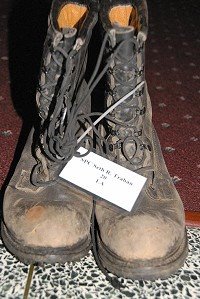
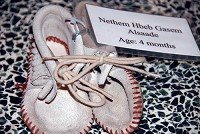 Combat boots, Iraqi shoes form an emotional exhibit
Pat Whitney
Courier Staff Writer
Hanover College custodian Anna Denton looked through lines of combat boots at the Eyes Wide Open exhibit on display at the college this week.
“My friend’s son’s boots are here somewhere,” she said, checking the tags tied to boot strings.
It was a sad and anxious search, she added, not only because her friend lost her son, but also because Denton’s son is in Iraq.
The exhibit is part of a larger national exhibit that has been touring cities throughout the country. Locally, 300 pairs of empty boots and Iraqi civilian shoes will challenge students and others within the community who visit the exhibit to take a closer look at the human cost of war.
At the Hanover College exhibit, combat boots represent National Guard soldiers who have fallen in the Iraq War. Dozens of civilian shoes, also part of the exhibit, memorialize Iraqi civilian casualties.
“The exhibit displays the pain caused by war in a very special way,” said freshman Emily Leatherbury, a member of People for Peace who brought the exhibit to Hanover College after being moved by the exhibit when it was in Louisville.
Leatherbury pointed out that many students, including herself, have not experienced war or its pain.
“The Open exhibit brings the pain of war down to a level we can all understand,” she said. “The exhibit makes the death of the soldiers and civilians more personal, because their shoes are something they wear every day. To see the shoes stand without the person makes a powerful statement about what war does to people.”
The exhibit can be viewed at Lynn Hall from 3-7 p.m. today and from noon to 6 p.m. Saturday and Sunday.
The local Eyes Wide Open exhibit coincides with an exhibit at the National Mall in Washington, D.C., where the balance of the 3,000 boots and shoes that make up the national exhibit are on display.
The Washington exhibit will also feature the unveiling of a new memorial creating a space to reflect the overwhelming enormity of the loss of Iraqi lives. Through words and pictures, visitors to the Washington exhibit will be asked to imagine what life would be like if this war were happening on U.S. soil.
At today’s Eyes Wide Open Advocacy Day celebration in Washington, the American Friends Service Committee and Friends Committee on National Legislation will be sponsoring training and encouraging people to share their experiences with the human cost of war with their Congressional representatives.
“I do not think it (the exhibit) will necessarily change local opinion on the war,” Leatherbury said. “But I do believe it will force people to recognize the tragedy so many have encountered because of the war in Iraq and war itself. I think after seeing the exhibit, people will look on war with more of an understanding and nearness — rather than feeling separated or disconnected.”
Monday, May 29, 2006
Just peace
 We need to stop.
Just stop.
Stop for a moment...
Before anybody
Says or does anything
That may hurt anyone else.
We need to be silent.
Just silent.
Silent for a moment...
Before we forever lose
The blessing of songs
That grow in our hearts.
We need to notice.
Just notice.
Notice for a moment...
Before the future slips away
Into ashes and dust of humility.
Stop, be silent, and notice...
In so many ways, we are the same.
Our differences are unique treasures.
We have, we are, a mosaic of gifts
To nurture, to offer, to accept.
We need to be.
Just be.
Be for a moment...
Kind and gentle, innocent and trusting,
Like children and lambs,
Never judging or vengeful
Like the judging and vengeful.
And now, let us pray,
Differently, yet together,
Before there is no earth, no life,
No chance for peace.
Sometimes the most important messages come from the most unlikely places. Mattie J.T. Stepanek, a 13-year-old boy, made a difference before he died with his Heartsongs poetry. He continues to impact the world through Just Peace. This poet, best-selling author, peace activist, and prominent voice for the Muscular Dystrophy Association fervently believed in and promoted world peace not just as a concept, but as a reality.
Mattie was working on Just Peace with Jimmy Carter when he died in June 2004. His mother, Jeni, who edited the material and wrote a preface for the book is publishing it at her son's request. Just Peace explores Mattie's concept of the world and all people as a unique mosaic of gifts. War and injustice shatter the mosaic, which can only be made whole again by planning and actively pursuing peace. The young visionary's essays, poetry, and photographs appear throughout the book. Jimmy Carter has written a special foreword and forthword for the book.
Just as important to the book and enlightening to the reader are Mattie's many correspondences. Central to these are his personal e-mails to and from former president Jimmy Carter, Mattie's peace "hero" and role model. The Nobel Peace Prize winner met Mattie, considered him an angel, messenger, and hero in his own right, and was genuinely affected by Mattie's passion and drive. Just Peace is an intimate portrait of a president, a young man of hope, and peace itself.
A portion of the proceeds from Just Peace will be donated to the MDA Mattie Fund designated for medical research to help find treatments and cures for childhood neuromuscular diseases.

 In his eulogy, Former President Jimmy Carter told the congregation that throughout his long and varied public life, which has included shaking millions of hands, traveling to more than 120 countries and knowing "kings and queens, presidents and prime ministers," Mattie was "the most extraordinary person" he has ever known.
BREITBART.COM - Emotional Bush says US must finish military campaign in Iraq
| Emotional Bush says US must finish military campaign in Iraq May 29 1:44 PM US/Eastern  Email this story Email this story |  |
President George W. Bush again vowed to complete US military missions around the world as the United States honoured its war dead with the American toll in Iraq closing on 2,500.
Tears welled in the US president's eyes as he gave his latest annual speech at Arlington National Cemetery, just a few days after admitting that he had some regrets about the Iraq conflict and that it had caused "consternation" in America.

"I'm in awe of the men and women who sacrifice for the freedom of the United States of America," Bush said to loud applause from an audience that included Defence Secretary Donald Rumsfeld and US military chiefs.
"Our nation mourns the loss of our men and women in uniform. We will honour them by completing the mission for which they gave their lives, by defeating the terrorists, by advancing the cause of liberty and by laying the foundation of peace for a generation of young Americans," Bush added.
The US death toll in Iraq is now about 2,470 and has increased by more than 800 since the president's last Memorial Day wreath-laying at Arlington Cemetery, in the Washington suburbs. Almost 300 US soldiers have died in Afghanistan.
There are the remains of about 296,000 US soldiers, mainly from the two World Wars and the Vietnam and Korean conflicts, at Arlington.
"In this place where valor sleeps, we are reminded why America has always gone to war reluctantly, because we know the costs of war," said Bush.
"We have seen those costs in the war on terror we fight today. These grounds are the final resting place for more than 270 men and women who have given their lives in freedom's cause since the attacks of September 11, 2001."
The Iraq war is becoming increasingly unpopular and has become a major drag on the president's approval ratings which now hover around 30 percent. Polls indicate an overwhelming majority of Americans oppose the war.
On Saturday, Bush compared the "war against terror" to the Cold War struggle against communism.
But last week, after a summit with war ally Prime Minister Tony Blair of Britain, Bush spoke of "setbacks and missteps" in the Iraq campaign, said that the Abu Ghraib prison scandal had been the biggest mistake in Iraq and that he regretted some of his rhetoric in the war on terror, such as his "Bring 'em on" taunt to Iraqi insurgents.
He called it the "kind of tough talk that sent the wrong signal to people."
.Tears welled in the US president's eyes as he gave his latest annual speech at Arlington National Cemetery, just a few days after admitting that he had some regrets about the Iraq conflict and that it had caused 'consternation' in America.
'I'm in awe of the men and women who sacrifice for the freedom of the United States of America,' Bush said to loud applause from an audience that included Defence Secretary Donald Rumsfeld and US military chiefs.
'Our nation mourns the loss of our men and women in uniform. We will honour them by completing the mission for which they gave their lives, by defeating the terrorists, by advancing the cause of liberty and by laying the foundation of peace for a generation of young Americans,' Bush added.
The US death toll in Iraq is now about 2,470 and has increased by more than 800 since the president's last Memorial Day wreath-laying at Arlington Cemetery, in the Washington suburbs. Almost 300 US soldiers have died in Afghanistan.
There"
Sunday, May 28, 2006
| Coalition War Dead | |
| At least 2703 Coalition forces have been killed in Operation Iraqi Freedom. | |
Tuesday, May 23, 2006
Nobel literature laureate Guenter Grass slammed the United States

Nobel laureate Grass slams U.S. for 'systematic' and 'merciless' crimes
(AP) - BERLIN-German Nobel literature laureate Guenter Grass slammed the United States Tuesday for what he described as "crimes" and other actions that only encourage terrorism and strengthen dictatorial regimes.
Speaking at the opening of the 72nd International PEN congress in Berlin, Grass sharply criticized the United States over the war in Iraq.
"The war that they wanted and that ignored the laws of the civilized world encourages terror and has no end," said Grass, 78. He added that "the crimes of the U.S.A. ... are systematic, constant, infamous and merciless."
He also criticized the U.S. administration for its approach to countries such as Syria, North Korea and Iran, describing it as "a policy that could not be dumber or more dangerous."
"Dictatorships - and there is no shortage of choice - are labeled rogue states, which as a rule strengthens the countries that are boastfully threatened with military strikes," Grass said.
Grass, a prominent left-wing figure in Germany, is respected as the voice of the post-World War II generation who has untiringly warned his compatriots to remain vigilant against racism and war. He also has long been a critic of U.S. policy.
The German playwright and novelist was awarded the Nobel Prize for literature in 1999.
His comments were greeted with a standing ovation.
Thursday, May 18, 2006
"Caught the scene on video which was obtained by Time magazine"

Did Marines killed Iraqis 'in cold blood' ?
Citing ongoing investigation, Marines mum
From Jamie McIntyre
CNN
WASHINGTON (CNN) -- A decorated Marine colonel turned anti-war congressman said Wednesday that Marines killed at least 30 innocent Iraqi civilians "in cold blood" in Haditha in November, suggesting the attack is twice as bad as originally reported.
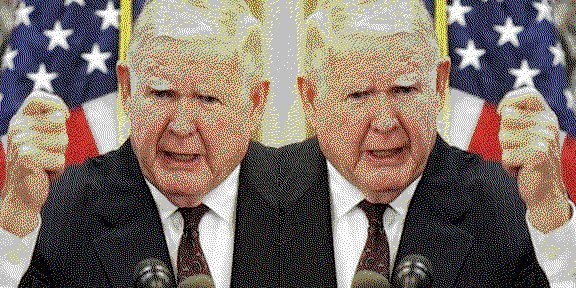
Rep. John Murtha, D-Pennsylvania, told reporters Wednesday that he got his information from U.S. commanders, who said the investigation will show that the Marines deliberately killed the civilians.
The U.S. Marine Corps has declined to comment on the report, which initially stated that 15 were killed.
"There was no firefight. There was no IED that killed these innocent people. Our troops overreacted because of the pressure on them, and they killed innocent civilians in cold blood," Murtha said. (Watch Murtha level accusations against the Marines -- 1:58)
Murtha, who was decorated for his service in Vietnam, said the death toll may be more than twice as high as originally reported.

"They actually went into the houses and killed women and children," the congressman said.
Citing an ongoing investigation, the Marine Corps said, "Any comment at this time would be inappropriate and could undermine the investigatory and possible legal process."
The Iraqi civilians were killed while troops from the 3rd Battalion, 1st Marines were looking for insurgents who planted a roadside bomb that killed a member of their unit.
At first, the Marines said the civilians were killed by a roadside bomb. Later, they suggested the victims may have been caught in a firefight.
An Iraqi human rights group, Hammurabi Human Rights Association, caught the scene on video, which was obtained by Time magazine. A criminal investigation ensued.
Time Warner is the parent company of Time magazine and CNN.
Last month, the battalion commander and two company commanders were relieved of their commands and reassigned to staff jobs at Camp Pendleton in California.
Sources close to the investigation said it is too soon to say whether anyone will face criminal charges, but key aspects of the original Marine account have not checked out.

Murtha supported the invasion of Iraq in 2003, but last November, he distanced himself from the Bush administration and called for the withdrawal of U.S. troops because of what he called "a flawed policy wrapped in illusion."
| Find this article at: http://www.cnn.com/2006/WORLD/meast/05/18/murtha.marines/index.html?section=cnn_topstories |
Wednesday, May 10, 2006
George Roehl Jr. was 21
Boston.com -- MANCHESTER, N.H. --A 21-year-old soldier described as a father figure to his four younger siblings was killed Monday in Iraq by a roadside bomb.

"It's every mother's worst nightmare, to come home and find the Army standing in your driveway," she said Tuesday. "As soon as you see it you know what it is. They're not here to tell you anything good."
She said her son, whom she last talked with about three weeks ago, was concerned about whether he would make it home.
"He said, 'Mom, they shoot at me every day.' ... He knew what he was getting into and he paid the ultimate sacrifice to fight for somebody else's freedom," she said.
He joined the military about a year ago, following in the footsteps of his father, grandfather and a cousin, family members said. His sister Sarah had tried to talk him out of it.
"I was like, `Don't go,'" she said. "Is it really worth it?"
The family said Roehl was one of two soldiers killed during a patrol outside Baghdad.
Sunday, May 07, 2006
Wednesday, May 03, 2006
Video: Iraq for Sale: The War Profiteers (part 1 of 8)
Iraq for Sale: The War Profiteers (part 1 of 8)
Iraq for Sale: The War Profiteers (part 6 of 8)
"Their are a lot of soldiers who are going to come home, not with bullets in their chest but with pathogens in their blood."
Media Matters - Mission Accomplished: A look back at the media's fawning coverage of Bush's premature declaration of victory in Iraq

On May 1, 2003, President Bush landed on the aircraft carrier USS Abraham Lincoln aboard an S-3B Viking jet, emerged from the aircraft in full flight gear, and proceeded to 'press[] flesh,' as The Washington Post put it, as he shook hands and hugged crew members in front of the cameras. Later that day, Bush delivered a nationally televised speech from the deck of the Abraham Lincoln in which he declared that '[m]ajor combat operations in Iraq have ended,' all the while standing under a banner reading: 'Mission Accomplished.' Despite lingering questions over the continued violence in Iraq, the failure to locate weapons of mass destruction, and the whereabouts of Saddam Hussein, as well as evidence that Bush may have shirked his responsibilities in the Texas Air National Guard (TANG) during the Vietnam War, the print and televised media fawned over Bush's 'grand entrance' and the image of Bush as the 'jet pilot' and the 'Fighter Dog.'"
Monday, April 17, 2006
Neil Young- speaks and sings his mind
Neil Young on CNN - April 18th 2006
Protest music is back with Neil Young's 2006 release, 'Living With War', featuring many great songs/ideas including this one, "Let's Impeach The President".
Protest music is back with Neil Young's 2006 release, 'Living With War', featuring many great songs/ideas including this one, "Let's Impeach The President".
Saturday, April 15, 2006
What Rumsfeld knew
By Michael Scherer and Mark Benjamin

Apr. 14, 2006 | Secretary of Defense Donald Rumsfeld was personally involved in the late 2002 interrogation of a high-value al-Qaida detainee known in intelligence circles as "the 20th hijacker." He also communicated weekly with the man in charge of the interrogation, Maj. Gen. Geoffrey Miller, the controversial commander of the Guantánamo Bay detention center.
During the same period, detainee Mohammed al-Kahtani suffered from what Army investigators have called "degrading and abusive" treatment by soldiers who were following the interrogation plan Rumsfeld had approved. Kahtani was forced to stand naked in front of a female interrogator, was accused of being a homosexual, and was forced to wear women's underwear and to perform "dog tricks" on a leash. He received 18-to-20-hour interrogations during 48 of 54 days.
Little more than two years later, during an investigation into the mistreatment of prisoners at Guantánamo, Rumsfeld expressed puzzlement at the notion that his policies had caused the abuse. "He was going, 'My God, you know, did I authorize putting a bra and underwear on this guy's head?'" recalled Lt. Gen. Randall M. Schmidt, an investigator who interviewed Rumsfeld twice in early 2005.
These disclosures are contained in a Dec. 20, 2005, Army inspector general's report on Miller's conduct, which was obtained this week by Salon through the Freedom of Information Act. The 391-page document -- which has long passages blacked out by the government -- concludes that Miller should not be punished for his oversight role in detainee operations, a fact that was reported last month by Time magazine. But the never-before-released full report also includes the transcripts of interviews with high-ranking military officials that shed new light on the role that Rumsfeld and Miller played in the harsh treatment of Kahtani, who had met with Osama bin Laden on several occasions and received terrorist training in al-Qaida camps.
In a sworn statement to the inspector general, Schmidt described Rumsfeld as "personally involved" in the interrogation and said that the defense secretary was "talking weekly" with Miller. Schmidt said he concluded that Rumsfeld did not specifically prescribe the more "creative" interrogation methods used on Kahtani. But he added that the open-ended policies Rumsfeld approved, and that the apparent lack of supervision of day-to-day interrogations permitted the abusive conduct to take place. "Where is the throttle on this stuff?" asked Schmidt, an Air Force fighter pilot, who said in his interview under oath with the inspector general that he had concerns about the length and repetition of the harsh interrogation methods. "There were no limits."

Schmidt also saw close parallels between the interrogations at Guantánamo, and the photographic evidence of abuse at Abu Ghraib prison in Iraq. "Just for the lack of a camera, it would sure look like Abu Ghraib," Schmidt told the inspector general, in the interview that was conducted in August 2005. At the direction of Pentagon officials, Miller led a mission to Iraq in August 2003 to review detainee operations at Abu Ghraib -- a visit that critics say precipitated the abuse of prisoners there.
In April 2005, Schmidt completed his report on detainee abuse at Guantánamo, which he co-authored with Brig. Gen. John T. Furlow. They recommended that Miller be "admonished" and "held accountable" for the alleged abuse of Kahtani. But that recommendation was rejected by Gen. Bantz J. Craddock, the current head of the Southern Command, who said Miller had not violated any law or policy.
On Dec. 2, 2002, Rumsfeld approved 16 harsher interrogation strategies for use against Kahtani, including the use of forced nudity, stress positions and the removal of religious items. In public statements, however, Rumsfeld has maintained that none of the policies at Guantánamo led to "inhumane" treatment of detainees. Jeffrey Gordon, a Pentagon spokesman, told Salon Thursday that Kahtani was an al-Qaida terrorist who provided a "treasure trove" of still-classified information during his interrogation. "Al-Kahtani's interrogation was guided by a very detailed plan, conducted by trained professionals in a controlled environment, and with active supervision and oversight," Gordon said in an e-mail statement. "Nothing was done randomly."
Miller -- who has invoked his right against self-incrimination in courts-martial of Abu Ghraib soldiers -- said that he did not know all the details of Kahtani's interrogation. But Schmidt told the inspector general that he found that claim "hard to believe" in light of Miller's knowledge of Rumsfeld's continuing interest in Kahtani. "The secretary of defense is personally involved in the interrogation of one person, and the entire General Counsel system of all the departments of the military," Schmidt said. "There is just not a too-busy alibi there for that."
The harsh interrogation of Kahtani came to an abrupt end in mid-January 2003. Gen. James T. Hill, Craddock's predecessor as the head of Southern Command, recalled in his interview with the inspector general that he received a call from Rumsfeld on a January weekend asking about the progress of Kahtani's interrogation. "Someone had come to him and suggested that it needed to be looked at," Hill said of Rumsfeld. "He said, 'What do you think?' And I said, 'Why don't [you] let me call General Miller.'"
According to Hill's account of that call, Miller advised that the harsh interrogation of Kahtani should continue, using the techniques Rumsfeld had previously approved. "We think we're right on the verge of making a breakthrough," Hill remembered Miller saying. Hill said he called Rumsfeld back with the news. "The secretary said, 'Fine,'" Hill remembered.

Nonetheless, several days later Rumsfeld revoked the harsher interrogation methods, apparently responding to military lawyers who had raised concerns that they may constitute cruel and unusual punishment or torture.
"My attitude on that was, 'Great!'" said Hill. The general recalled thinking about Rumsfeld and the decision to halt the harsh interrogation, "All I'm trying to do is what you want us to do in the first place and doing it the right way."
The harsher methods were not approved again.
-- By Michael Scherer and Mark Benjamin

Apr. 14, 2006 | Secretary of Defense Donald Rumsfeld was personally involved in the late 2002 interrogation of a high-value al-Qaida detainee known in intelligence circles as "the 20th hijacker." He also communicated weekly with the man in charge of the interrogation, Maj. Gen. Geoffrey Miller, the controversial commander of the Guantánamo Bay detention center.
During the same period, detainee Mohammed al-Kahtani suffered from what Army investigators have called "degrading and abusive" treatment by soldiers who were following the interrogation plan Rumsfeld had approved. Kahtani was forced to stand naked in front of a female interrogator, was accused of being a homosexual, and was forced to wear women's underwear and to perform "dog tricks" on a leash. He received 18-to-20-hour interrogations during 48 of 54 days.
Little more than two years later, during an investigation into the mistreatment of prisoners at Guantánamo, Rumsfeld expressed puzzlement at the notion that his policies had caused the abuse. "He was going, 'My God, you know, did I authorize putting a bra and underwear on this guy's head?'" recalled Lt. Gen. Randall M. Schmidt, an investigator who interviewed Rumsfeld twice in early 2005.
These disclosures are contained in a Dec. 20, 2005, Army inspector general's report on Miller's conduct, which was obtained this week by Salon through the Freedom of Information Act. The 391-page document -- which has long passages blacked out by the government -- concludes that Miller should not be punished for his oversight role in detainee operations, a fact that was reported last month by Time magazine. But the never-before-released full report also includes the transcripts of interviews with high-ranking military officials that shed new light on the role that Rumsfeld and Miller played in the harsh treatment of Kahtani, who had met with Osama bin Laden on several occasions and received terrorist training in al-Qaida camps.
In a sworn statement to the inspector general, Schmidt described Rumsfeld as "personally involved" in the interrogation and said that the defense secretary was "talking weekly" with Miller. Schmidt said he concluded that Rumsfeld did not specifically prescribe the more "creative" interrogation methods used on Kahtani. But he added that the open-ended policies Rumsfeld approved, and that the apparent lack of supervision of day-to-day interrogations permitted the abusive conduct to take place. "Where is the throttle on this stuff?" asked Schmidt, an Air Force fighter pilot, who said in his interview under oath with the inspector general that he had concerns about the length and repetition of the harsh interrogation methods. "There were no limits."
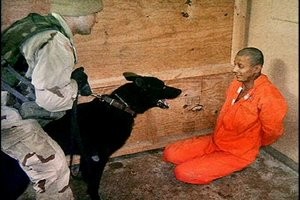
Schmidt also saw close parallels between the interrogations at Guantánamo, and the photographic evidence of abuse at Abu Ghraib prison in Iraq. "Just for the lack of a camera, it would sure look like Abu Ghraib," Schmidt told the inspector general, in the interview that was conducted in August 2005. At the direction of Pentagon officials, Miller led a mission to Iraq in August 2003 to review detainee operations at Abu Ghraib -- a visit that critics say precipitated the abuse of prisoners there.
In April 2005, Schmidt completed his report on detainee abuse at Guantánamo, which he co-authored with Brig. Gen. John T. Furlow. They recommended that Miller be "admonished" and "held accountable" for the alleged abuse of Kahtani. But that recommendation was rejected by Gen. Bantz J. Craddock, the current head of the Southern Command, who said Miller had not violated any law or policy.
On Dec. 2, 2002, Rumsfeld approved 16 harsher interrogation strategies for use against Kahtani, including the use of forced nudity, stress positions and the removal of religious items. In public statements, however, Rumsfeld has maintained that none of the policies at Guantánamo led to "inhumane" treatment of detainees. Jeffrey Gordon, a Pentagon spokesman, told Salon Thursday that Kahtani was an al-Qaida terrorist who provided a "treasure trove" of still-classified information during his interrogation. "Al-Kahtani's interrogation was guided by a very detailed plan, conducted by trained professionals in a controlled environment, and with active supervision and oversight," Gordon said in an e-mail statement. "Nothing was done randomly."
Miller -- who has invoked his right against self-incrimination in courts-martial of Abu Ghraib soldiers -- said that he did not know all the details of Kahtani's interrogation. But Schmidt told the inspector general that he found that claim "hard to believe" in light of Miller's knowledge of Rumsfeld's continuing interest in Kahtani. "The secretary of defense is personally involved in the interrogation of one person, and the entire General Counsel system of all the departments of the military," Schmidt said. "There is just not a too-busy alibi there for that."
The harsh interrogation of Kahtani came to an abrupt end in mid-January 2003. Gen. James T. Hill, Craddock's predecessor as the head of Southern Command, recalled in his interview with the inspector general that he received a call from Rumsfeld on a January weekend asking about the progress of Kahtani's interrogation. "Someone had come to him and suggested that it needed to be looked at," Hill said of Rumsfeld. "He said, 'What do you think?' And I said, 'Why don't [you] let me call General Miller.'"
According to Hill's account of that call, Miller advised that the harsh interrogation of Kahtani should continue, using the techniques Rumsfeld had previously approved. "We think we're right on the verge of making a breakthrough," Hill remembered Miller saying. Hill said he called Rumsfeld back with the news. "The secretary said, 'Fine,'" Hill remembered.

Nonetheless, several days later Rumsfeld revoked the harsher interrogation methods, apparently responding to military lawyers who had raised concerns that they may constitute cruel and unusual punishment or torture.
"My attitude on that was, 'Great!'" said Hill. The general recalled thinking about Rumsfeld and the decision to halt the harsh interrogation, "All I'm trying to do is what you want us to do in the first place and doing it the right way."
The harsher methods were not approved again.
-- By Michael Scherer and Mark Benjamin
Monday, April 03, 2006
Wasted Money & Broken Promises
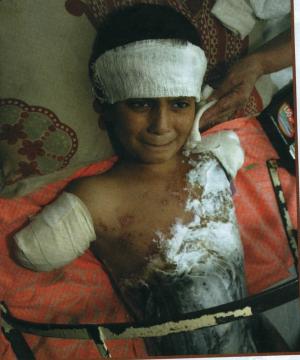 Not considering the health care needs the U.S. invasion Caused
"U.S. Plan to Build Iraq Clinics Falters
Contractor Will Try to Finish 20 of 142 Sites
By Ellen Knickmeyer
Washington Post Foreign Service
Monday, April 3, 2006; A01
BAGHDAD -- A reconstruction contract for the building of 142 primary health centers across Iraq is running out of money, after two years and roughly $200 million, with no more than 20 clinics now expected to be completed, the U.S. Army Corps of Engineers says.

The contract, awarded to U.S. construction giant Parsons Inc. in the flush, early days of reconstruction in Iraq, was expected to lay the foundation of a modern health care system for the country, putting quality medical care within reach of all Iraqis.

Parsons, according to the Corps, will walk away from more than 120 clinics that on average are two-thirds finished. Auditors say the project serves as a warning for other U.S. reconstruction efforts due to be completed this year.
Coming with little public warning, the 86 percent shortfall of completions dismayed the World Health Organization's representative for Iraq. "That's not good. That's shocking," Naeema al-Gasseer said by telephone from Cairo. "We're not sending the right message here. That's affecting people's expectations and people's trust, I must say."
By the end of 2006, the $18.4 billion that Washington has allocated for Iraq's reconstruction runs out. All remaining projects in the U.S. reconstruction program, including electricity, water, sewer, health care and the justice system, are due for completion. As a result, the next nine months are crunchtime for the easy-term contracts that were awarded to American contractors early on, before surging violence drove up security costs and idled workers.
Stuart Bowen, the top U.S. auditor for reconstruction, warned in a telephone interview from Washington that other reconstruction efforts may fall short like that of Parsons. "I've been consumed for a year with the fear we would run out of money to finish projects," said Bowen, the inspector general for reconstruction in Iraq.
The reconstruction campaign in Iraq is the largest such American undertaking since World War II. The rebuilding efforts have remained a point of pride for American troops and leaders as they struggle with an insurgency and now Shiite Muslim militias and escalating sectarian conflict.
The Corps of Engineers says the campaign so far has renovated or built 3,000 schools, upgraded 13 hospitals and created hundreds of border forts and police stations. Major projects this summer, the Corps says, should noticeably improve electricity and other basic services, which have fallen below prewar levels despite the billions of dollars that the United States already has expended toward reconstruction here.
Violence for which the United States failed to plan has consumed up to half the $18.4 billion through higher costs to guard project sites and workers and through direct shifts of billions of dollars to build Iraq's police and military.
In January, Bowen's office calculated the American reconstruction effort would be able to finish only 300 of 425 promised electricity projects and 49 of 136 water and sanitation projects.
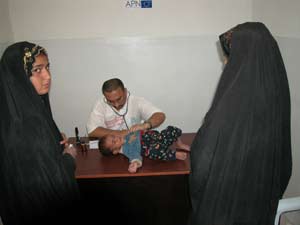
U.S. authorities say they made a special effort to preserve the more than $700 million of work for Iraq's health care system, which had fallen into decay after two decades of war and international sanctions.
Doctors in Baghdad's hospitals still cite dirty water as one of the major killers of infants. The city's hospitals place medically troubled newborns two to an incubator, when incubators work at all.
Early in the occupation, U.S. officials mapped out the construction of 300 primary-care clinics, said Gasseer, the WHO official. In addition to spreading basic health care beyond the major cities into small towns, the clinics were meant to provide training for Iraq's medical professionals. "Overall, they were considered vital," she said.
In April 2004, the project was awarded to Parsons Inc. of Pasadena, Calif., a leading construction firm in domestic and international markets. McCoy, the Corps of Engineers commander, said Parsons has been awarded about $1 billion in reconstruction projects in Iraq.
Like much U.S. government work in 2003 and 2004, the contract was awarded on terms known as "cost-plus," Parsons said, meaning that the company could bill the government for its actual cost, rather than a cost agreed to at the start, and add a profit margin. The deal was also classified as "design-build," in which the contractor oversees the project from design to completion.
These terms, among the most generous possible for contractors, were meant to encourage companies to undertake projects in a dangerous environment and complete them quickly.
McCoy said Parsons subcontracted the clinics to four main Iraqi companies, which often hired local firms to do the actual construction, creating several tiers of overhead costs.
Starting in 2004, the need for security sent costs soaring. Insurgent attacks forced companies to organize mini-militias to guard employees and sites; work often was idled when sites were judged to be too dangerous. Western contractors often were reduced to monitoring work sites by photographs, Parsons officials said.
"Security degenerated from the beginning. The expectations on the part of Parsons and the U.S. government was we would have a very benign construction environment, like building a clinic in Falls Church," said Earnest Robbins, senior vice president for the international division of Parsons in Fairfax, Va. Difficulty choosing sites for the clinics also delayed work, Robbins said.
Faced with a growing insurgency, U.S. authorities in 2004 took funding away from many projects to put it into building up Iraqi security forces.
"During that period, very little actual project work, dirt-turning, was being done," Bowen said. At the same time, "we were paying large overhead for contractors to remain in-country." Overhead has consumed 40 percent to 50 percent of the clinic project's budget, McCoy said.
In 2005, plans were scaled back to build 142 primary clinics by December of that year, an extended deadline. By December, however, only four had been completed, reconstruction officials said. Two more were finished weeks later. With the money almost all gone, the Corps of Engineers and Parsons reached what both sides described as a negotiated settlement under which Parsons would try to finish 14 more clinics by early April and then leave the project.
The agreement stipulated that the contract was terminated by consensus, not for cause, the Corps and Parsons said.
Both said the Corps had wanted to cancel the contract outright, and McCoy rejected the reasons that Parsons put forward for the slow progress.
"In the time they completed 45 projects, I completed 500 projects," he said. Parsons has a number of other contracts in Baghdad, from oil-facility upgrades to border forts to prisons. "The fact is it is hard, but there are companies over here that are doing it."

© 2006 The Washington Post Company
Sunday, April 02, 2006
Follow up -What ever happened to the American Taliban?
| An exclusive look at Lindh's life behind bars
| ||||
|
| ||||
But there's really no other 25-year-old like John Walker Lindh. He will be forever tagged as the American Taliban, a California kid who converted to Islam and left home to find himself - and joined the radical Taliban to fight in Afghanistan. Now Lindh is serving a 20-year prison sentence, and is under a court-imposed silence. But Lindh's family and supporters say he deserves a break, and America needs to take another look at what he really did. |

 "His story is indeed a story that needs to come out, and needs to be shared with the world," said Shakeel Syed, who served as a religious adviser to Lindh in prison.
In his first-ever account of Lindh's life in a medium-security federal prison in Victorville, Calif., Syed said Lindh is a model inmate who lives as normal a life as possible behind bars - but also is a spiritual beacon to other Muslims there.
"Prison has helped him become a better Muslim," Syed said. "He is a Malcolm X with a softer tone."
Lindh lives with a cellmate, works a prison job and is allowed to mingle with other inmates, Syed said - but he is prohibited from talking about his experiences in Afghanistan, can't see visitors who aren't relatives or lawyers, and isn't allowed to speak Arabic.
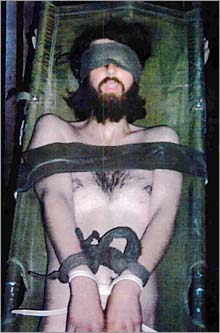
Contained ... this above shot of John Walker Lindh shows him bound naked in a container at Camp Rhino, near Kandahar, following his capture in December, say his defence lawyers, who released the photograph
While Lindh was taunted with cries of "Traitor!" when he first came to Victorville, and was once attacked by another inmate, he now faces no threats to his safety and even has gained a measure of respect, Syed said.
"He is an extremely well-liked, well-respected, model inmate in the system by the authorities as well as by the inmates," said Syed, now executive director of the Islamic Shura Council of Southern California. "Some of the inmates have come to sympathize with him because of his special restrictions."
Federal prison officials would not comment on Lindh or release information about him, citing privacy rules.
He burst into the public eye in November 2001, when CIA commandos working with the Northern Alliance, an Afghan group opposed to Taliban rule, found him among wounded and bedraggled Taliban fighters, who soon killed CIA operative Johnny (Mike) Spann.
The image of Lindh, filthy and exhausted, was beamed around the world - shocking the country with his unbelievable journey and stunning his parents, who hadn't heard from him in months.
Lindh had converted to Islam as a teen and traveled to Yemen to study the Koran and Arabic. When his visa expired he went to Pakistan, then sneaked across the border to Afghanistan - where he trained in an Al Qaeda-funded camp and twice met Osama Bin Laden.
Lindh's father, Frank Lindh, said his son was well-meaning but misguided, never taking up arms against America or joining Al Qaeda in its destructive quest.
"In simple terms, this is the story of a decent and honorable young man who became involved in a spiritual quest and became the focus of the grief and anger of an entire nation over an event in which he had no part," Frank Lindh told a San Francisco audience earlier this year.
But in the angry months after Sept. 11, Lindh was held up as a candidate for the death penalty.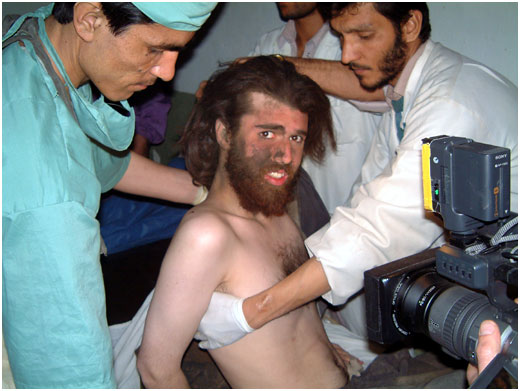
Barely 10 months after he was seized on the battlefield, Lindh accepted a plea deal admitting he aided the Taliban - not plotting terror attacks or battling the U.S. He agreed to a 20-year prison term with no opportunity to appeal or challenge the government's restrictions while he's in prison.
Lindh's last public statement came when he was sentenced, where he tried to explain how he ended up in Afghanistan.
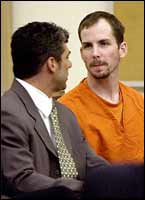
"I did not go to fight against America, and I never did," Lindh said. "I understand why so many Americans were angry when I was first discovered in Afghanistan. I realize that many still are, but I hope that with time and understanding, those feelings will change."
His parents have said little since then, but his lawyers are hoping a change in public mood could help him. With few legal options available, they've petitioned President Bush in a long-shot bid to shorten Lindh's sentence.
"I think we all have to realize that the odds are against it," Frank Lindh said in his San Francisco speech. "It is difficult to envision a situation where all those hotheads in Washington can turn around and recognize the kid got a raw deal and should be released."
Legal observers said the sentence was the byproduct of the national mood at the time, and note that many subsequent terror prosecutions in the U.S. have led to much shorter prison terms.
"He became an almost cathartic criminal case for the public," said George Washington University law Prof. Jonathan Turley. "Just as the public emotion was at a fever pitch, John Walker Lindh walked right out of central casting as a vicious traitor who betrayed his country. Upon further examination, he appears to be a confused kid playing a low-level role."
Originally published on April 2, 2006
KEY Words: American Taliban, John Walker Lindh, Books about John Walker Lindh, Google images of John Walker Lindh
Investigating the transformation of John Walker Lindh from a typical American teenager into the most infamous turncoat of our day, Kukis, a former UPI White House correspondent, traces the influences that played a part in Lindh's metamorphosis, from his California childhood to his capture in Mazar-i-Sharif. While unable to interview the young man himself (due, according to the publisher, to Attorney General Ashcroft's gag order) or his parents, the author draws from conversations he had with those who knew Lindh and witnessed his experiences-friends, teachers, lawyers, fellow students, family members and Taliban soldiers-all the way from San Francisco to Afghanistan, Pakistan and Yemen. Despite all the hype surrounding Lindh, Kukis "vowed to keep an open mind" in the research and writing of his biography, and expresses his hope that "understanding Lindh...will help us, as Americans at war, to reflect on ourselves as well as the enemies we face." B&w photos, maps. Copyright 2003 Reed Business Information, Inc.
Mahoney claims that his new book puts not only John Walker Lindh on trial but the entire U.S. government, for what he calls its treasonous double dealings with states that aid terrorists. Part biography of Lindh, part courtroom transcript, part military field report and in large part conjecture, the book, while often muddled and disconnected, raises important questions about the precarious nature of the U.S.'s alliances with Saudi Arabia and Pakistan. The author claims, as have others, that the U.S. enabled the rise of the Taliban by arming the mujahideen fighting the Soviets in Afghanistan in the 1980s. Most readers will find, though, that the charge that this constitutes treason ignores the complexity of the geopolitical landscape. Mahoney's second claim is that, because of its insatiable thirst for oil and profit, the U.S. habitually turns a blind eye to Saudi Arabia's and Pakistan's support of terrorism. The author's main charge, however, is that the Justice Department abruptly stopped Lindh's trial for fear of what might be revealed. This charge ignores what the judge noted: the evidence of Lindh's conspiracy to kill Americans was far from compelling, though Mahoney weakly argues the opposite. While providing much fodder for conspiracy theorists, Mahoney (Sons and Brothers: The Days of Jack and Bobby Kennedy) falls short of making his sweeping indictments stick.
Copyright © Reed Business Information, a division of Reed Elsevier Inc. All rights reserved.
Sunday, March 26, 2006
Americans share blame for war
March 26, 2006
Americans share blame for war, speaker says

That was one of the messages during the Iraqi Women Speak Out Tour, an anti-war event that drew hundreds of attendees to the Veterans Memorial Building.
"When you look at the lead-up to the war in Iraq, I blame President Bush, I blame Congress, I blame the media," said Scott Ritter, a former Marine, former United Nations chief weapons inspector for Iraq and contributor to the book "Neo-Conned Again!," a compilation of condemnations of the Iraq War. "But I'm not cutting any slack for the American people."
Americans, he said, have grown accustomed to a lifestyle they cannot sustain. Many Americans have failed to engage, he said, making the American government more of an oligarchy than a representative democracy.
"As a nation, we are mute, we are silent," Ritter thundered.
The event was part of a tour organized by San Francisco international human rights organization Global Exchange that is sending Iraqi women to speaking engagements across the country to talk about their experiences and the U.S. invasion.
But the Iraqi woman scheduled to speak at the Santa Cruz event, Faiza Al-Araji, could not make it because of exhaustion, said Medea Benjamin, founding director of Global Exchange.
Four Iraqi women are participating in the project, speaking at events, colleges, houses of worship and other places, giving local newspaper interviews and speaking on radio shows.Al-Araji, said Benjamin, has mostly been sent to traditionally conservative parts of the country.
"We've found that people are hungry for information no matter where they are," said Benjamin.
Al-Araji, said Benjamin, maintains that Iraqis are capable of stopping civil war if the U.S. troops would leave. Others say their main hope is that their children will come home alive from school each day.
Such information was one of the things Jay Johnson, of Santa Cruz, came to hear.
"I'm interested in the war, and I want to learn any more information I can get about it," he said, "particularly the women's issues."
That search for information also drew Dina Scoppettoni of Aptos.
"I'm wanting to find out the truth, I guess, or a little more of it," she said.
Also speaking at the event was Ray McGovern, a former U.S. Army captain and a former CIA analyst. McGovern detailed how President Bush sidestepped the Geneva Conventions, leading to "our publicly acknowledged policy of torturing people.
"We've all heard it was a couple of bad apples at the bottom, but I have documentation that it was bad apples at the top of the barrel," said McGovern, producing a memorandum signed by President Bush that requires "that the detainees be treated humanely and, to the extent appropriate and consistent with military necessity, in a manner consistent with the principles of Geneva."
"That's a loophole you can drive a Mack truck through," said McGovern.
The organizers urged attendees to act by sending a postcard to Rep. Sam Farr, D-Carmel, urging him to cut off funds for the war by signing Massachusetts Rep. James P. McGovern's End the War in Iraq Act of 2005.
Americans share blame for war, speaker says - By Gwen Mickelson - Sentinel staff writer - March 26, 2006
Americans share blame for war, speaker says
By Gwen MickelsonSANTA CRUZ — The American people share the blame for the war in Iraq.
That was one of the messages during the Iraqi Women Speak Out Tour, an anti-war event that drew hundreds of attendees to the Veterans Memorial Building.
"When you look at the lead-up to the war in Iraq, I blame President Bush, I blame Congress, I blame the media," said Scott Ritter, a former Marine, former United Nations chief weapons inspector for Iraq and contributor to the book "Neo-Conned Again!," a compilation of condemnations of the Iraq War. "But I'm not cutting any slack for the American people."
Americans, he said, have grown accustomed to a lifestyle they cannot sustain. Many Americans have failed to engage, he said, making the American government more of an oligarchy than a representative democracy.
"As a nation, we are mute, we are silent," Ritter thundered.
The event was part of a tour organized by San Francisco international human rights organization Global Exchange that is sending Iraqi women to speaking engagements across the country to talk about their experiences and the U.S. invasion.
But the Iraqi woman scheduled to speak at the Santa Cruz event, Faiza Al-Araji, could not make it because of exhaustion, said Medea Benjamin, founding director of Global Exchange.
Four Iraqi women are participating in the project, speaking at events, colleges, houses of worship and other places, giving local newspaper interviews and speaking on radio shows.
Al-Araji, said Benjamin, has mostly been sent to traditionally conservative parts of the country.
"We've found that people are hungry for information no matter where they are," said Benjamin.
Al-Araji, said Benjamin, maintains that Iraqis are capable of stopping civil war if the U.S. troops would leave. Others say their main hope is that their children will come home alive from school each day.
Such information was one of the things Jay Johnson, of Santa Cruz, came to hear.
"I'm interested in the war, and I want to learn any more information I can get about it," he said, "particularly the women's issues."
That search for information also drew Dina Scoppettoni of Aptos.
"I'm wanting to find out the truth, I guess, or a little more of it," she said.
Also speaking at the event was Ray McGovern, a former U.S. Army captain and a former CIA analyst. McGovern detailed how President Bush sidestepped the Geneva Conventions, leading to "our publicly acknowledged policy of torturing people.
"We've all heard it was a couple of bad apples at the bottom, but I have documentation that it was bad apples at the top of the barrel," said McGovern, producing a memorandum signed by President Bush that requires "that the detainees be treated humanely and, to the extent appropriate and consistent with military necessity, in a manner consistent with the principles of Geneva."
"That's a loophole you can drive a Mack truck through," said McGovern.
The organizers urged attendees to act by sending a postcard to Rep. Sam Farr, D-Carmel, urging him to cut off funds for the war by signing Massachusetts Rep. James P. McGovern's End the War in Iraq Act of 2005.
Friday, March 24, 2006
Will Bush let this man be killed for becomming a Christian? Don't we finance this country?

In a television image broadcast on Wednesday,
Abdul Rahman was shown in a Kabul court with a Bible.
New York Times Letter to the Editor:
To the Editor:
What a sad irony it is that a Christian convert in Afghanistan managed to survive the rule of the Taliban but is in danger of not surviving the rule of a democratically elected, American-supported government.
What this case proves is just how hollow the rhetoric about 50 million people "liberated" in the Middle East really is.
Perhaps those who are eager to spread American-style democracy around the world will now realize that freedom is as much about the culture and customs of a society as it is about the spectacle of heavily guarded elections and purple-stained fingers.
Alan Rusk
Trenton, March 23, 2006
The Story:
KABUL, Afghanistan, March 23 — The judge presiding over the prosecution of an Afghan man facing death for converting from Islam to Christianity said Thursday that he would resist any interference, despite mounting international condemnation.
To Afghan prosecutors, the case appears equally clear cut. One described Mr. Rahman as a "microbe," said conversion is illegal under Islamic law, and requested the death penalty.
If he is convicted, Mr. Rahman will be able to appeal his sentence to two higher courts. Maulavi Zada, the judge overseeing the case, said Thursday that the next court session would be held in several days. It was unclear whether Mr. Rahman would present any defense. To date, no lawyer in Kabul has been willing to represent him.
Moderate Afghan officials are eager to quietly dispose of the case, but the vocal criticism from American and Western officials makes that more difficult, according to Mr. Rubin. One possible compromise would involve the court's declaring Mr. Rahman mentally ill and allowing him to leave the country.
Tuesday, March 21, 2006
Print Story: Bush Defends Decisions on Iraq War on Yahoo! News
Bush Defends Decisions on Iraq War
By TERENCE HUNT, AP White House Correspondent 7 minutes ago
President Bush said Tuesday the decision about when to withdraw all U.S. troops from Iraq will fall to future presidents and Iraqi leaders, suggesting that U.S. involvement will continue at least through 2008.
Acknowledging the public's growing unease with the war — and election-year skittishness among fellow Republicans — the president nonetheless vowed to keep U.S. soldiers in the fight.
"If I didn't believe we could succeed, I wouldn't be there. I wouldn't put those kids there," Bush declared.
He also stood by embattled Secretary of Defense Donald H. Rumsfeld.
"I don't believe he should resign. He's done a fine job. Every war plan looks good on paper until you meet the enemy," he said.
In his second full-blown news conference of the year, Bush sought to ease his political problems by addressing them directly.
"Nobody likes war. It creates a sense of uncertainty in the country," he said. "War creates trauma." He acknowledged that Republicans are worried about their political standing in November.
"There's a certain unease as you head into an election year," Bush said during a wide-ranging news conference that lasted nearly an hour.
More than 2,300 Americans have died in three years of war in Iraq. Polls show the public's support of the war and Bush himself have dramatically declined in recent months, jeopardizing the political goodwill he carried out of the 2004 re-election victory.
"I'd say I'm spending that capital on the war," Bush quipped.
When asked about his failed Social Security plan, he simply said: "I didn't get done." But the president defiantly defended his warrantless eavesdropping program, and baited Democrats who suggest that he broke the law.
Calling a censure resolution "needless partisanship," Bush challenged Democrats to go into the November midterm elections in opposition to eavesdropping on suspected terrorists. "They ought to stand up and say, `The tools we're using to protect the American people should not be used,'" Bush said.
The news conference marked a new push by Bush to confront doubts about his strategy in Iraq. A day earlier, he acknowledged to a sometimes skeptical audience that there was dwindling support for his Iraq policy and that he understood why people were disheartened.
"The terrorists haven't given up. They're tough-minded. They like to kill," he said Tuesday. "There will be more tough fighting ahead."
Later in the news conference, Bush was asked whether there would come a day when no U.S. forces are in Iraq.
"That, of course, is an objective. And that will be decided by future presidents and future governments of Iraq," he said.
Asked if that meant it won't happen on his watch, the president said, "You mean a complete withdrawal? That's a timetable. I can only tell you that I will make decisions on force levels based upon what the commanders on the ground say."
The president said he did not agree with former interim Iraqi Prime Minister Ayad Allawi, who told the British Broadcasting Corporation Sunday, "If this is not civil war, then God knows what civil war is."
Bush said others inside and outside Iraq think the nation has stopped short of civil war. "There are other voices coming out of Iraq, by the way, other than Mr. Allawi, who I know by the way — like. A good fellow."
"We all recognized that there is violence, that there is sectarian violence. But the way I look at the situation is, the Iraqis looked and decided not to go into civil war."
Nearly four out of five Americans, including 70 percent of Republicans, believe civil war will break out in Iraq, according to a recent AP-Ipsos poll.
Bush said he's confident of victory in Iraq. "I'm optimistic we'll succeed. If not, I'd pull our troops out," he said, warning that abandoning the nation would be a dangerous mistake.
"So failure in Iraq, which isn't going to happen, would send all kinds of terrible signals to an enemy that wants to hurt us and people who are desperate to change the condition in the broader Middle East," Bush said.
He said he agreed to U.S. talks with Iran to underscore his point that Tehran's attempts to spread sectarian violence or provide support to Iraqi insurgents was unacceptable to the United States.
His opening remarks were designed to steel Americans for more fighting in Iraq and put an optimistic spin on the state of the U.S. economy.
"Productivity is strong. Inflation is contained. Household net worth is at an all-time high," Bush said, crediting his administration's policies.
On Iraq, Bush bristled at a suggestion that he had wanted to wage war against that country since early in his presidency.
"I didn't want war. To assume I wanted war is just flat wrong ... with all due respect," he told a reporter. "No president wants war." To those who say otherwise, "it's simply not true," Bush said.
Asked about former supporters who now oppose him and the war, Bush said he's trying to win them over by "talking realistically to people" about the war and its importance to the nation.
"I can understand how Americans are worried about whether or not we can win," Bush said, adding that most Americans want victory "but they're concerned about whether or not we can win."
Bush scoffed at a question suggesting he should reshuffle or shake up his White House staff to help raise his sagging poll standings. But he did hint that he might bring in an experienced Washington insider to work with a disgruntled Congress.
"I'm not going to announce it right now," Bush said, adding that he's satisfied with the staff he's surrounded himself with.
Monday, March 20, 2006
Angelo A. Zawaydeh
Angelo A. Zawaydeh | |||
| |||


Some troops headed back to Iraq are mentally ill | The San Diego Union-Tribune

The psychotropic drugs are a bow to a little-discussed truth fraught with implications: Mentally ill service mem-bers are being returned to combat.
The redeployments are legal, and the service members are often eager to go. But veterans groups, lawmakers and mental-health professionals fear that the practice lacks adequate civilian oversight. They also worry that such redeployments are becoming more frequent as multiple combat tours become the norm and traumatized service members are retained out of loyalty or wartime pressures to maintain troop numbers.
Sen. Barbara Boxer hopes to address the controversy through the Department of Defense Task Force on Mental Health, which is expected to start work next month. The California Democrat wrote the legislation that created the panel. She wants the task force to examine deployment policies and the quality and availability of mental-health care for the military.
“We've also heard reports that doctors are being encouraged not to identify mental-health illness in our troops. I am asking for a lot of answers,” Boxer said during a March 8 telephone interview. “If people are suffering from mental-health problems, they should not be sent on the battlefield.”
Stress reduces a person's chances of functioning well in combat, said Frank M. Ochberg, a psychiatrist for 40 years and a founding member of the International Society for Traumatic Stress Studies.
“I have not seen anything that says this is a good thing to use these drugs in high-stress situations. But if you are going to be going (into combat) anyway, you are better off on the meds,” said Ochberg, a former consultant to the Secret Service and the National Security Council. “I would hope that those with major depression would not be sent.”
About 25,000 Marines and sailors based in San Diego County are undergoing a major combat rotation that began in January. Their deployments are expected to last seven months.
Officials from the Defense Department and Camp Pendleton, where some units have been to Iraq three times, said they don't track personnel deployed while taking mental-health medication or the number diagnosed with mental illness.
But medical officers for the Army and Marine Corps acknowledge that medicated service members – and those suffering combat-induced psychological problems – are returning to war. And anecdotal evidence, bolstered by the government's own studies, suggest that the number could be significant.
A 2004 Army report found that up to 17 percent of combat-seasoned infantrymen experienced major depression, anxiety or post-traumatic stress disorder after one combat tour to Iraq. Less than 40 percent of them had sought mental-health care.
A Pentagon survey released last month found that 35 percent of the troops returning from Iraq had received psychological counseling during their first year home.
That survey echoed statistics collected by the San Diego Veterans Affairs Healthcare System. The system has found that about 33 percent of Iraq and Afghanistan veterans suffer from schizophrenia, depression and post-traumatic stress disorder.
The various studies apparently didn't consider the effects of multiple combat tours, though psychiatrists agree that the greater people's exposure to combat, generally the higher their risk of suffering mental illness.
More than 435,000 U.S. personnel have served in Iraq and Afghanistan combined. It is unclear how many have served in that region more than once.
Joe Costello, a mental-health counselor at the Vista Veterans Center, said emotionally scarred troops are routinely redeployed and that most want to go back to the war zone.
“I see it every day,” said Costello, who mainly treats reservists.
Buttressing the idea that large numbers of service members are medicated, more than 200,000 prescriptions for the most common types of antidepressants were written in the past 14 months for service members and their families, said Sydney Hickey, a spokeswoman for the National Military Family Association.
Hicks said a Defense Department official gave her the information during a December briefing. She said the official did not distinguish between prescriptions for the troops and those for their family members.
In addition, the Defense Department has not provided prescription totals for such antidepressants from before and after the United States invaded Iraq in 2003.
The prescriptions were for selective serotonin reuptake inhibitors, commonly called SSRIs. These drugs are used to treat depression, anxiety disorders, some personality disorders and post-traumatic stress disorder. They include brand names such as Paxil, Cymbalta and Wellbutrin.
The antidepressants work by elevating the level of the neurotransmitter serotonin. Researchers believe that low serotonin levels in the brain could be a biological cause of depression and certain anxiety disorders.
Mental-health care for service members and the Defense Department's efforts to keep the mentally ill in uniform are becoming national issues, said Steve Robinson, director of the National Gulf War Resource Center in Silver Spring, Md.
Robinson said three Army doctors have told him about being pressured by their commanders not to identify mental conditions that would prevent personnel from being deployed.
“They are being told to diagnose combat-stress reaction instead of PTSD,” he said. “That does two things: It keeps the troops deployable and it makes it hard for them to collect disability claims once they get out of the military.”
Robinson contends that the Pentagon is trying to control its spending on mental-health disabilities.
Between 1999 and 2004, disability payments to veterans with post-traumatic stress disorder rose to $4.3 billion from $1.7 billion nationwide, according to a report by the Department of Veterans Affairs' inspector general.
Overall, service members' mental health is a hot-button subject because it goes to the cost of the war in dollars and lives, said Joy Ilem, an assistant national legislative director for the organization Disabled American Veterans.
“The (Department of Veterans Affairs) is very worried about the political implications of PTSD and other mental issues arising from the war,” Ilem said. “They are talking about early outreach and treatment, but they are really trying to tamp down the discussion.”
Cmdr. Paul S. Hammer deals with such issues daily.
Hammer, a psychiatrist, is responsible for the Marine Corps' mental-health programs during this deployment rotation. He confirmed that Marines with post-traumatic stress disorder and combat stress are returning to Iraq, though he would not say how many.
Hammer said deciding who is deployed is often anguishing.
Sometimes he has to tell Marine commanders that personnel they had counted on will not be deploying. In other instances, he said, “We'll hold some guy's feet to the fire and say, 'This is what you signed up for, and you have to go.' ”
Marines are “amazingly resilient,” Hammer added. “You've got people exposed to incredible violence, but they do entirely well.”
It's the tough calls that worry Adrian Atizado, a legislative director for Disabled American Veterans.
“Currently, the services will deploy a service member if the person is medically stable and it is determined that the deployment won't aggravate (his) condition,” Atizado said. “How does one gauge that?
“This a gray area; this is asking a medical provider to make a decision based on the future. The medical providers are human beings. I have no doubt that they are looking out for the best interest of the service members, but they are under pressure to check off on their deployment.”
Ultimately, much is unknown about the rates of post-traumatic stress disorder among Iraq veterans, especially those who have been through more than one combat tour, said Matt Friedman, executive director of the U.S. Department of Veterans Affairs National Center for PTSD in White River Junction, Vt.
Friedman said that with time, “one of the things we are going to find out is how well people function who might have been on medication (during combat). This is a very important question and has all kinds of implications.
“But remember, they are all volunteers. This isn't Vietnam, where people were drafted and sent to fight. Think of the ethical questions that would arise from sending draftees back to war on medications.”
Saturday, March 18, 2006
Dirty Water: KBR Negligence Threatens Troops
 Halliburton has become the slumlord of Iraq.
At the end of this artical thier is a video from the film Iraq for sale that touches on the water incident.
Paul Rieckhoff
Negligence Threatens Troops
"KBR had exposed the entire camp to water twice as contaminated as raw water from the Euphrates River. KBR was apparently taking the waste water... which should have been dumped back in the river, and using that as the non-potable water supply. Such problems had been happening for more than a year... No trained water treatment specialist could claim that the water was fit for human use."
That's from Senate testimony of a former Halliburton employee, Ben Carter, a water purification specialist. He's talking about water purification at Camp Ar Ramadi, home to thousands of US Troops in Iraq. Ben Carter tried to sound the alarm back in March of 2005, telling his higher-ups at KBR that they were leaving the water supply "vulnerable to contamination from dust, insects, rodents, or even enemy attack," but KBR wasn't interested in admitting the severity of the problem to the Troops who had been affected.

Today, an AP story shows that the problem wasn't just at Camp Ar Ramadi. KBR allowed dangerously polluted water to reach US Troops throughout Iraq. Wil Granger, one of the KBR whistleblowers, says, "This event should be considered a 'near miss' as the consequences of these actions could have been very severe resulting in mass sickness or death."
And people did get sick. Ben Carter was diagnosed with an "unidentified organism" in his digestive tract, and some Troops have complained of stomach problems, as well. From Marissa Sousa, Iraq veteran:
"The whole time I was in Iraq I had extreme gastrointestinal problems, that the medics had no idea what it was and the medications they gave never worked. I wasn't until I left Iraq that the bigger 'problems' diminished and I was left with occasional cramping and indigestion. I feel that if I had known earlier, this could have been prevented and I could have taken measures that I didn't have to use because I was being taken care of, such as hand sanitizer instead of soap and luke warm water at the DFAC. All of this would make the average person upset at this news, but to me and possibly others that served in Iraq, this is nothing new. If it isn't one thing it is another. Crappy armor, crappy water. Halliburton has become the slumlord of Iraq."
KBR and the DOD claim that the water supply is now safe. But for months, the American public paid KBR to provide our Troops with safe water, and KBR didn't hold up their end of the contract. IAVA's new Follow the Money Project, lead by chief investigator Dina Rasor, will be following this money to see how this could happen and who is responsible.
But we are the most concerned about the troops. If you're an Iraq veteran and you think you were affected by this problem, send an email to info@iava.org.
Subscribe to:
Posts (Atom)


 Posts
Posts


