Saturday, October 15, 2011


Wednesday, November 04, 2009
Vallery Plame Story update: Cheney lied to the FBI
The FBI has released its report of thier interview with former VP Dick Cheny about the outing of a CIA opprative. The former Vice President’s memory failed him 72 times during a 3 hour interview by the FBI concerning the Plame leak case.
Thursday, October 01, 2009


Tuesday, September 22, 2009
Cpl. Cody Daniel Richardson, 22, strangles wife

NC Marine charged with murder in wife's death
Tuesday, September 22, 2009
CAMP LEJEUNE, N.C. — A Camp Lejeune Marine charged with first-degree murder in the death of his wife had confessed to the killing in a 911 call, police said Tuesday.
Cpl. Cody Daniel Richardson, 22, of Carroll, N.H., was charged in the death of his 21-year-old wife, Jessy, Jacksonville police said. He was held under a $1 million bond in the Onslow County jail.
Police Say Marine Left Wife in Apartment for 1-2 Days after Slaying
Chief Michael Yaniero told a news conference that Richardson confessed to a 911 operator that he strangled his wife, but an autopsy will be performed to determine the cause of death.
Yaniero said officers went to the couple's apartment on Monday and found the Marine officer outside and the woman's body inside.
Authorities said the couple had an argument that resulted in her death and it appeared the woman had been dead for up to two days.
Jessy Richardson graduated from Kingswood Regional High School in 2006. Cody Richardson also attended the school but didn't graduate there. Those who knew the two said they were shocked by the murder charge.

Richardson was being held at the Onslow County Jail.
Camp Lejeune officials said Richardson is assigned to the 2nd Marine Regiment, 2nd Marine Division at Camp Lejeune. He entered the Marine Corps in August 2006 and was promoted to corporal on May 1, 2008.
He deployed to Iraq in November 2007 and returned in May 2008. He is a decorated Marine and has been awarded the Iraqi Campaign Medal and National Defense Service and Global War on Terrorism service medals.
Sara Lauer, the mother of the victim, said she doesn't want her daughter's husband to serve any time if he is found responsible. She said that he needs help and will have to live what he's done.
Richardson is the latest Camp Lejeune Marine charged in a domestic violence case.

Cesar Laurean, a former Marines corporal, is charged with first-degree murder in the death of Lance Cpl. Maria Lauterbach, whose charred remains were found in his backyard in January 2008.
Authorities have charged military personnel in the deaths of three other women in North Carolina.
Army Sgt. Richard Smith has been accused of hiring a man to kill his wife, Sgt. Christina Smith. Army Sgt. Edgar Patino has been charged with killing Spc. Megan Touma, who was pregnant. And Marine Cpl. John Wimunc has been charged in the death of his wife, Army 2nd Lt. Holley Wimunc.
US troops develop Male Breast Cancer from bad water

The Few, The Proud, The Forgotten
Camp Lejeune Residents Blame Breast Cancer on the Water
For three decades, dry-cleaning chemicals and industrial solvents laced the water used by local Marines and their families. Mike Partain and at least 19 others developed male breast cancer.
One night in April 2007, as Mike Partain hugged his wife before going to bed, she felt a small lump above his right nipple. A mammogram led to a diagnosis of male breast cancer. Six days later, the 41-year-old insurance adjuster had a mastectomy.
Over the last two years, Partain has compiled a list of 19 others diagnosed with male breast cancer who once lived on the base.
For three decades -- from the 1950s to the mid-1980s -- the water supply used by hundreds of thousands of Marines and their families was laced with chemicals from an off-base dry-cleaning company and industrial solvents used to clean military equipment.
A 1974 base order required safe disposal of solvents and warned that improper handling could cause drinking water contamination. Yet solvents were dumped or buried near base wells for years.
Military officials acknowledge that they were told as early as 1981 that potentially dangerous "volatile organic compounds" had been detected in the drinking water.
In men, breast cancer is rare. About 1,900 cases are expected to be diagnosed in the U.S. this year, compared with 192,000 cases in women, the American Cancer Society says.
Establishing a link between chemical exposure and a specific cancer cluster is difficult. But Partain and the others from Camp Lejeune say their illnesses are more than mere coincidence.
Partain said there was no history of breast cancer in his family, and that a test for a gene linked to the disease was negative. Only two of the other 19 survivors -- 18 former Marines and the son of a Marine -- have family histories of female breast cancer, Partain said.
The website lists 484 people who lived or worked at Camp Lejeune and say they have been diagnosed with cancer or other illnesses. More than 1,600 former base residents have filed claims against the federal government, seeking $34 billion total in damages.
The military, Partain contends, knew details of the contamination earlier than it has admitted.
A 1980 report by a scientist working for the Army who tested base tap water warned officials that the "water is highly contaminated," Partain said. A 1981 follow-up report said that more tests had shown the water to be tainted "with other chlorinated hydrocarbons (solvents)!"
In 1982, a chemist with a private lab hired by the Corps provided the base commander with a report showing "contamination by trichloroethylene and tetrachloroethylene" in well fields supplying two Camp Lejeune water systems. "We called the situation to the attention of Camp Lejeune personnel," the chemist wrote, adding that his findings had important public health implications.
Trichloroethylene (TCE) is a colorless solvent often used to clean grease from machinery. Tetrachloroethylene (PCE) is commonly used in dry cleaning. Both chemicals are now "reasonably anticipated to be human carcinogens," according to the Health and Human Services Department's National Toxicology Program. But in 1982 they were not subject to regulation.
In April 1985, the base commander sent letters informing residents that "minute (trace) amounts of several organic chemicals" had been detected in wells. It gave no indication that the chemicals could be dangerous. That spring, one of 10 contaminated wells was reopened for use on four days to help alleviate a water shortage.
A 2004 fact-finding panel set up by the Corps concluded that base officials had acted properly and that the drinking water was "consistent with general . . . industry practices" at the time. However, the panel found that officials did not attempt to evaluate health risks for dangerous chemicals, and that a Navy technical advisory unit had failed to provide the Corps with the expertise needed to understand health dangers.
In 2005, Justice Department and Environmental Protection Agency investigations found no criminal conduct by Corps officials.
The Marine Corps waited until 1999 -- 14 years after closing the contaminated wells -- to begin notifying former base residents. That effort was part of a federal health study aimed at children conceived or born at the base during the contamination years.
Only in 2008 did the Corps undertake a more widespread effort to notify former Marines and family members who had lived in an affected housing area during the time in question. An online health registry now contains more than 135,000 names.
Congress required the notification after being lobbied by Jerry Ensminger, a former Marine drill instructor who blames the 1985 leukemia death of his daughter Janey, 9, on contaminated water.
Ensminger has fought to hold the Corps accountable, researching military documents and confronting officials. He learned that the water was tainted while watching a local TV report in 1997.
"I trained more than 2,000 Marines on our Marine Corps values," Ensminger said. "Now the Marine Corps leadership refuses to honor those values."
Partain said he had no idea his drinking water had been laced with probable carcinogens until he heard about congressional testimony by Ensminger in 2007.
Peter Devereaux, 47, a former Marine who served at Camp Lejeune from 1980 to 1982, was diagnosed with breast cancer in January 2008 and had a mastectomy. He said he did not know about the contamination until Partain contacted him last year.
"The Marine Corps refuses to acknowledge what they did to people who served their country," Devereaux said. "It sickens me."
Last month, Sen. Richard M. Burr (R-N.C.) introduced a bill that would require the government to cover healthcare costs for Marines and family members who were exposed to the contaminated water.
Sunday, July 12, 2009
Video News: Cheney's secret CIA work being Revealed
Former US Vice-President Dick Cheney gave direct orders to the CIA to conceal an intelligence program from Congress, US media reports say.
Remember the accusations by Seymour Hersh (reported here on Iraq War News & History - here
Will the US investigate?
Remember the accusations by Seymour Hersh (reported here on Iraq War News & History - here
Will the US investigate?
Saturday, July 11, 2009
Update: Obama to look into Aphganistan Dasht-e-Leili massacre.
Note: Do not expect much deep digging by the Obama Administration on this re-revelation of the problematic mass killing in Afghanistan, more likely more cover-up. Sad.
Obama orders probe of alleged Afghan mass killings
WASHINGTON, July 13 (Xinhua) -- U.S. President Barack Obama said he has ordered an investigation into allegations that the former Bush administration failed to probe into alleged killings of hundreds of Taliban prisoners by a CIA-backed Afghan warlord.
"The indications that this had not been properly investigated just recently was brought to my attention," he said during an interview to be broadcast on CNN later Monday.
"So what I've asked my national security team to do is to collect the facts for me that are known, and we'll probably make a decision in terms of how to approach it once we have all of the facts gathered up," the president said.
The inquiry stems from the deaths of at least 1,000 Taliban prisoners who had surrendered to the U.S.-backed Afghan Northern Alliance in late 2001.
At the time, the prisoners were in the custody of Abdul Rashid Dostum, a prominent Afghan warlord supported by the U.S. Central Intelligence Agency, or CIA.
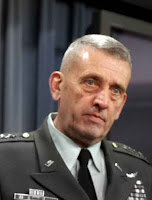 Revelations of the killings first surfaced in a 2002 Newsweek report, prompting U.S. General Tommy Franks, who led the invasion of Afghanistan, to request an investigation. (Franks was the U.S. general leading the attack on the Taliban in Afghanistan in response to the 11 September 2001 attacks on the World Trade Center and The Pentagon. He also led the 2003 invasion of Iraq and the overthrow of Saddam Hussein.)
However, according to recent U.S. media reports, the former Bush administration had repeatedly discouraged efforts to investigate the case.
Previously:
President Obama's refusal to open up comprehensive investigations into war crimes becomes a criminal act by purposefully covering up criminal activity. The US should be `out in front' investigating past actions of the previous Administration, rather than allowing other countries and groups to expose US atrocities. Recently outside investigations of a massacre in Afghanistan uncovered the Bush Administrations impediment of US investigations.
Physicians for Human Rights (PHR)have sued for the release of government documents, in hopes to uncover more information about an Alleged Massacre of Up to 2,000 Prisoners in Afghanistan.
in the wake of a major New York Times story with new evidence that the Bush Administration impeded at least three federal investigations into alleged war crimes in Afghanistan in 2002.
PHR is calling for the Department of Justice to investigate why the Bush Administration impeded an FBI criminal probe of the alleged Dasht-e-Leili massacre.
Suffocated in Container Trucks
According to US government documents obtained by PHR, as many as 2,000 surrendered Taliban fighters were reportedly suffocated in container trucks by Afghan forces operating jointly with the US in November 2001. The bodies were reportedly buried in mass graves in the Dasht-e-Leili desert near Sheberghan, Afghanistan. Notorious Afghan warlord General Abdul Rashid Dostum, who was reportedly on the CIA payroll, is allegedly responsible for the massacre.
General Abdul Rashid Dostum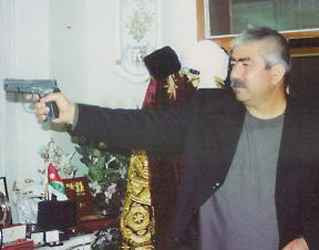 General Abdul Rashid Dostum (born 1954) is the Deputy Defense Minister of Afghanistan and an Uzbek warlord. As the leader of Afghanistan's minority Uzbek community, he is a controversial figure who has often changed sides in Afghanistan's complex web of shifting alliances.
In 1996, following the rise of the Taliban and their capture of Herat and Kabul, Dostum realigned himself with Rabbani against the Taliban. Along with General Mohammed Fahim and Ismail Khan, Dostum was one of three factional leaders that comprised the Northern Alliance. While much of the rest of Afghanistan was in ruins, his stronghold of Mazar-e-Sharif - a city of around two million people - was thriving.General Dostum grew rich, but his rule was harsh. He is reported to have frequently ordered public executions of criminals, who were usually crushed to death under tanks. It is claimed that he financed his army with profits from the opium trade. At the height of his power in 1997 - at the age of 43 - he controlled a kind of mini-state in northern Afghanistan.
The Taliban's capture of Mr. Dostum's fortress and airfield in Mazar-e-Sharif in 1997 forced him into exile in Uzbekistan and Iran. In 1998, he fled to Turkey. He returned in 2000 to join the Northern Alliance, seeking to avenge himself on the Taliban. He found that opportunity in 2001, when he drove the Taliban from power on the heels of a U.S.-led bombing campaign. The leader of the second largest party in the anti-Taliban Northern Alliance, General Dostum directed the campaign to recapture Mazar-e-Sharif - the town he once ruled. Dostum then consolidated his power base in the north, strengthening his hold on an area which covered six provinces with a population of around five million.
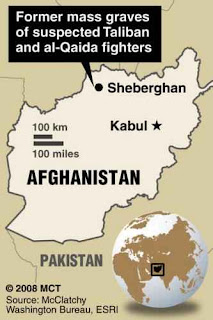 Karzai appointed him as a special adviser on security and military affairs, with effective control over security affairs in the northern Afghan provinces of Balkh, Jowzjan, Sar-e Pol, Samangan, and Faryab. Today he runs parts of the country's north as his own fiefdom, nominally serving as a deputy defense minister to the national government in Kabul but operating almost totally independent of the government. Dostum's force of some 20,000 militia fighters is composed mostly of ethnic Uzbeks who are members of his political group, Junbish-e Melli. Within his areas of control, he encourages women to live and work freely, as well as music, sports, alcohol, and allows for people of other religions.
In November of 2002, the United Nations began an investigation of alleged human rights abuses by Dostum. Witnesses claimed that Dostum jailed and tortured witnesses to prevent them from testifying in a war crimes case. Dostum is also under suspicion for the events of the Dasht-i-Leili massacre.
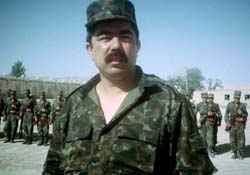
In March of 2003, he established a North Zone of Afghanistan, against the wishes of interim president Hamid Karzai. On May 20, 2003, Dostum signed an agreement to no longer serve as Karzai's special envoy for the northern regions.
Forces loyal to Dostum continue to clash with forces loyal to Tajik General Atta Mohammed.
General Dostum has run unsuccessfully against Afghan President Hamid Karzai in the country's presidential election.
The Attorney General of Afghanistan, Abdul Jabar Sabet suggests that Dostum is such a powerful commander in northern Afghanistan that, in the current security environment, he might be above prosecution. "Anyone who commits a criminal act must be brought to justice," Sabit says. "But in reality, I must admit that there will be some difficulties. In this war situation, in many cases, it is difficult for us to implement the law."
Sabit says that "because of the war there is no law, and you cannot implement the law in the south of the country or in many districts -- even in those places where the rule of law does exist, sometimes we cannot enforce the law over some people."
Afghan political analyst Fazel Rahman Oria sums it up this way: “Dostum is putting pressure on the government. He wants to show people that the government is subject to him. And, indeed, this is true".
Physicians for Human Rights, which shared the 1997 Nobel Peace Prize, first documented the existence of the alleged mass grave in Afghanistan in January 2002 and since then:
Advocated for witnesses to be protected, the mass grave site to be secured, and for a full and impartial investigation; Conducted preliminary forensic investigations -- including exposing 15 remains and conducting three autopsies -- under UN auspices at Dasht-e-Leili; Successfully sued for compliance with a PHR Freedom of Information Act (FOIA) request for the release of US government documents that reveal US intelligence knowledge of the magnitude of the alleged crime and awareness of the execution and torture of witnesses to the incidents;Helped identify the US chain of command likely responsible for impeding federal investigations into the alleged massacre;
Discovered and reported on alleged tampering of the site; and
Requested satellite image analysis by the American Association for the Advancement of Science (AAAS) that appears to demonstrate that tampering occurred soon after PHR filed its FOIA request in June 2006.
"Physicians for Human Rights went to investigate inhumane conditions at a prison in northern Afghanistan, but what we found was much worse," stated Susannah Sirkin, PHR Deputy Director. "Our researchers documented an apparent mass grave site with reportedly thousands of bodies of captured prisoners who were suffocated to death in trucks. That was 2002; seven years later, we still seek answers about what exactly happened and who was involved."
Senior Bush Administration officials impeded investigations by the FBI and the State Department, and the Defense Department apparently never conducted a full inquiry, the New York Times reports in the story for the July 11 print edition by Pulitzer Prize winning reporter James Risen.
"The Bush Administration's disregard for the rule of law and the Geneva Conventions led to torture of prisoners in Guantanamo and many other secret places," noted Nathaniel Raymond, PHR's lead researcher on Dasht-e-Leili.
Obama Must Open Investigations
"Contrary to the legal opinions of the previous Department of Justice, the principles of the Geneva Conventions are non-negotiable, as is their enforcement. President Obama must open a full and transparent criminal probe and prosecute any US officials found to have broken the law."
"The State Department's statement to the New York Times that suspected war crimes should be thoroughly investigated indicates a move towards full accountability," added Raymond. "We stand ready to aid the US government in investigating this massacre. It is time for the cover-up to end."
Sirkin added, "President Obama must set a different course by signaling publicly that in all of its operations anywhere in the world, the US and its allies will respect the Geneva Conventions and safeguard the rights of prisoners of war, as well as all captured combatants and detainees to be treated humanely."
PHR reiterated its call on the Government of Afghanistan, which has jurisdiction over the alleged mass grave site, to:
Secure the area with the assistance of ISAF (International Security Assistance Force-Afghanistan);Protect witnesses to the initial incident and the ensuing tampering; and
Ensure a full investigation of remaining evidence at the site, including the tracing of the substantial amount of soil that appears to have been removed in 2006.
"Gravesites have been tampered with, evidence has been destroyed, and witnesses have been tortured and killed," stressed Sirkin. "The Dasht-e-Leili mass grave site must finally be secured, all surviving witnesses must be protected, and the Government of Afghanistan, in coordination with the UN and NATO (North Atlantic Treaty Organization), must at last allow a full investigation to go forward."
Physicians for Human Rights (PHR) shared the 1997 Nobel Peace Prize. PHR was founded in 1986 on the idea that health professionals, with their specialized skills, ethical commitments, and credible voices, are uniquely positioned to investigate the health consequences of human rights violations and work to stop them. PHR mobilizes health professionals to advance health, dignity and justice and promotes the right to health for all. PHR has documented the systematic use of psychological and physical torture by US personnel against detainees held at Guantanamo Bay, Abu Ghraib, Bagram airbase and elsewhere.
PHR's International Forensic Program (IFP) has conducted forensic assessments and investigations of human rights abuses, crimes against humanity and genocide in many countries. IFP is dedicated to providing independent forensic expertise to document and collect evidence of human rights violations and of violations of international humanitarian law. Since the 1980s, PHR has mobilized forensic scientists and other experts worldwide to respond to inquiries by governments, organizations, families and individuals.
Reference Articles:
http://news.prnewswire.com/DisplayReleaseContent.aspx?ACCT=104&STORY=/www/story/07-10-2009/0005058098&EDATE=
http://news.xinhuanet.com/english/2009-07/13/content_11703350.htm
Obama orders probe of alleged Afghan mass killings
WASHINGTON, July 13 (Xinhua) -- U.S. President Barack Obama said he has ordered an investigation into allegations that the former Bush administration failed to probe into alleged killings of hundreds of Taliban prisoners by a CIA-backed Afghan warlord.
"The indications that this had not been properly investigated just recently was brought to my attention," he said during an interview to be broadcast on CNN later Monday.
"So what I've asked my national security team to do is to collect the facts for me that are known, and we'll probably make a decision in terms of how to approach it once we have all of the facts gathered up," the president said.
The inquiry stems from the deaths of at least 1,000 Taliban prisoners who had surrendered to the U.S.-backed Afghan Northern Alliance in late 2001.
At the time, the prisoners were in the custody of Abdul Rashid Dostum, a prominent Afghan warlord supported by the U.S. Central Intelligence Agency, or CIA.
 Revelations of the killings first surfaced in a 2002 Newsweek report, prompting U.S. General Tommy Franks, who led the invasion of Afghanistan, to request an investigation. (Franks was the U.S. general leading the attack on the Taliban in Afghanistan in response to the 11 September 2001 attacks on the World Trade Center and The Pentagon. He also led the 2003 invasion of Iraq and the overthrow of Saddam Hussein.)
However, according to recent U.S. media reports, the former Bush administration had repeatedly discouraged efforts to investigate the case.
Previously:
President Obama's refusal to open up comprehensive investigations into war crimes becomes a criminal act by purposefully covering up criminal activity. The US should be `out in front' investigating past actions of the previous Administration, rather than allowing other countries and groups to expose US atrocities. Recently outside investigations of a massacre in Afghanistan uncovered the Bush Administrations impediment of US investigations.
Physicians for Human Rights (PHR)have sued for the release of government documents, in hopes to uncover more information about an Alleged Massacre of Up to 2,000 Prisoners in Afghanistan.
in the wake of a major New York Times story with new evidence that the Bush Administration impeded at least three federal investigations into alleged war crimes in Afghanistan in 2002.
PHR is calling for the Department of Justice to investigate why the Bush Administration impeded an FBI criminal probe of the alleged Dasht-e-Leili massacre.
Suffocated in Container Trucks
According to US government documents obtained by PHR, as many as 2,000 surrendered Taliban fighters were reportedly suffocated in container trucks by Afghan forces operating jointly with the US in November 2001. The bodies were reportedly buried in mass graves in the Dasht-e-Leili desert near Sheberghan, Afghanistan. Notorious Afghan warlord General Abdul Rashid Dostum, who was reportedly on the CIA payroll, is allegedly responsible for the massacre.
General Abdul Rashid Dostum
 General Abdul Rashid Dostum (born 1954) is the Deputy Defense Minister of Afghanistan and an Uzbek warlord. As the leader of Afghanistan's minority Uzbek community, he is a controversial figure who has often changed sides in Afghanistan's complex web of shifting alliances.
In 1996, following the rise of the Taliban and their capture of Herat and Kabul, Dostum realigned himself with Rabbani against the Taliban. Along with General Mohammed Fahim and Ismail Khan, Dostum was one of three factional leaders that comprised the Northern Alliance. While much of the rest of Afghanistan was in ruins, his stronghold of Mazar-e-Sharif - a city of around two million people - was thriving.General Dostum grew rich, but his rule was harsh. He is reported to have frequently ordered public executions of criminals, who were usually crushed to death under tanks. It is claimed that he financed his army with profits from the opium trade. At the height of his power in 1997 - at the age of 43 - he controlled a kind of mini-state in northern Afghanistan.
The Taliban's capture of Mr. Dostum's fortress and airfield in Mazar-e-Sharif in 1997 forced him into exile in Uzbekistan and Iran. In 1998, he fled to Turkey. He returned in 2000 to join the Northern Alliance, seeking to avenge himself on the Taliban. He found that opportunity in 2001, when he drove the Taliban from power on the heels of a U.S.-led bombing campaign. The leader of the second largest party in the anti-Taliban Northern Alliance, General Dostum directed the campaign to recapture Mazar-e-Sharif - the town he once ruled. Dostum then consolidated his power base in the north, strengthening his hold on an area which covered six provinces with a population of around five million.
 Karzai appointed him as a special adviser on security and military affairs, with effective control over security affairs in the northern Afghan provinces of Balkh, Jowzjan, Sar-e Pol, Samangan, and Faryab. Today he runs parts of the country's north as his own fiefdom, nominally serving as a deputy defense minister to the national government in Kabul but operating almost totally independent of the government. Dostum's force of some 20,000 militia fighters is composed mostly of ethnic Uzbeks who are members of his political group, Junbish-e Melli. Within his areas of control, he encourages women to live and work freely, as well as music, sports, alcohol, and allows for people of other religions.
In November of 2002, the United Nations began an investigation of alleged human rights abuses by Dostum. Witnesses claimed that Dostum jailed and tortured witnesses to prevent them from testifying in a war crimes case. Dostum is also under suspicion for the events of the Dasht-i-Leili massacre.

In March of 2003, he established a North Zone of Afghanistan, against the wishes of interim president Hamid Karzai. On May 20, 2003, Dostum signed an agreement to no longer serve as Karzai's special envoy for the northern regions.
Forces loyal to Dostum continue to clash with forces loyal to Tajik General Atta Mohammed.
General Dostum has run unsuccessfully against Afghan President Hamid Karzai in the country's presidential election.
The Attorney General of Afghanistan, Abdul Jabar Sabet suggests that Dostum is such a powerful commander in northern Afghanistan that, in the current security environment, he might be above prosecution. "Anyone who commits a criminal act must be brought to justice," Sabit says. "But in reality, I must admit that there will be some difficulties. In this war situation, in many cases, it is difficult for us to implement the law."
Sabit says that "because of the war there is no law, and you cannot implement the law in the south of the country or in many districts -- even in those places where the rule of law does exist, sometimes we cannot enforce the law over some people."
Afghan political analyst Fazel Rahman Oria sums it up this way: “Dostum is putting pressure on the government. He wants to show people that the government is subject to him. And, indeed, this is true".
Physicians for Human Rights, which shared the 1997 Nobel Peace Prize, first documented the existence of the alleged mass grave in Afghanistan in January 2002 and since then:
Advocated for witnesses to be protected, the mass grave site to be secured, and for a full and impartial investigation; Conducted preliminary forensic investigations -- including exposing 15 remains and conducting three autopsies -- under UN auspices at Dasht-e-Leili; Successfully sued for compliance with a PHR Freedom of Information Act (FOIA) request for the release of US government documents that reveal US intelligence knowledge of the magnitude of the alleged crime and awareness of the execution and torture of witnesses to the incidents;Helped identify the US chain of command likely responsible for impeding federal investigations into the alleged massacre;
Discovered and reported on alleged tampering of the site; and
Requested satellite image analysis by the American Association for the Advancement of Science (AAAS) that appears to demonstrate that tampering occurred soon after PHR filed its FOIA request in June 2006.
"Physicians for Human Rights went to investigate inhumane conditions at a prison in northern Afghanistan, but what we found was much worse," stated Susannah Sirkin, PHR Deputy Director. "Our researchers documented an apparent mass grave site with reportedly thousands of bodies of captured prisoners who were suffocated to death in trucks. That was 2002; seven years later, we still seek answers about what exactly happened and who was involved."
Senior Bush Administration officials impeded investigations by the FBI and the State Department, and the Defense Department apparently never conducted a full inquiry, the New York Times reports in the story for the July 11 print edition by Pulitzer Prize winning reporter James Risen.
"The Bush Administration's disregard for the rule of law and the Geneva Conventions led to torture of prisoners in Guantanamo and many other secret places," noted Nathaniel Raymond, PHR's lead researcher on Dasht-e-Leili.
Obama Must Open Investigations
"Contrary to the legal opinions of the previous Department of Justice, the principles of the Geneva Conventions are non-negotiable, as is their enforcement. President Obama must open a full and transparent criminal probe and prosecute any US officials found to have broken the law."
"The State Department's statement to the New York Times that suspected war crimes should be thoroughly investigated indicates a move towards full accountability," added Raymond. "We stand ready to aid the US government in investigating this massacre. It is time for the cover-up to end."
Sirkin added, "President Obama must set a different course by signaling publicly that in all of its operations anywhere in the world, the US and its allies will respect the Geneva Conventions and safeguard the rights of prisoners of war, as well as all captured combatants and detainees to be treated humanely."
PHR reiterated its call on the Government of Afghanistan, which has jurisdiction over the alleged mass grave site, to:
Secure the area with the assistance of ISAF (International Security Assistance Force-Afghanistan);Protect witnesses to the initial incident and the ensuing tampering; and
Ensure a full investigation of remaining evidence at the site, including the tracing of the substantial amount of soil that appears to have been removed in 2006.
"Gravesites have been tampered with, evidence has been destroyed, and witnesses have been tortured and killed," stressed Sirkin. "The Dasht-e-Leili mass grave site must finally be secured, all surviving witnesses must be protected, and the Government of Afghanistan, in coordination with the UN and NATO (North Atlantic Treaty Organization), must at last allow a full investigation to go forward."
Physicians for Human Rights (PHR) shared the 1997 Nobel Peace Prize. PHR was founded in 1986 on the idea that health professionals, with their specialized skills, ethical commitments, and credible voices, are uniquely positioned to investigate the health consequences of human rights violations and work to stop them. PHR mobilizes health professionals to advance health, dignity and justice and promotes the right to health for all. PHR has documented the systematic use of psychological and physical torture by US personnel against detainees held at Guantanamo Bay, Abu Ghraib, Bagram airbase and elsewhere.
PHR's International Forensic Program (IFP) has conducted forensic assessments and investigations of human rights abuses, crimes against humanity and genocide in many countries. IFP is dedicated to providing independent forensic expertise to document and collect evidence of human rights violations and of violations of international humanitarian law. Since the 1980s, PHR has mobilized forensic scientists and other experts worldwide to respond to inquiries by governments, organizations, families and individuals.
Reference Articles:
http://news.prnewswire.com/DisplayReleaseContent.aspx?ACCT=104&STORY=/www/story/07-10-2009/0005058098&EDATE=
http://news.xinhuanet.com/english/2009-07/13/content_11703350.htm
Monday, June 15, 2009
Prison commander apologizes for 'our nation,' military

The Washington post today reports Maj. Gen. Geoffrey Miller one of the men most responsible for carrying out the Bush-Torture regime now apologizes, yet does not take personal responsibility. (WP story below)
Looking back, Alfred McCoy, who had been following the Central Intelligence Agency since the early 1970s, wrote:
Secretary of Defense Donald Rumsfeld gave Gen. Geoffrey Miller command of the new American military prison at Guantanamo in late 2002 with ample authority to transform it into an ad hoc psychology lab. Behavioral Science Consultation Teams of military psychologists probed detainees for individual phobias like fear of the dark. Interrogators stiffened the psychological assault by exploiting what they saw as Arab cultural sensitivities when it came to sex and dogs. Via a three-phase attack on the senses, on culture, and on the individual psyche, interrogators at Guantanamo perfected the CIA’s psychological paradigm.
After Gen. Miller visited Iraq in September 2003, the U.S. commander there, Gen. Ricardo Sanchez, ordered Guantanamo-style abuse at Abu Ghraib prison. My own review of the 1,600 still-classified photos taken by American guards at Abu Ghraib – which journalists covering this story seem to share like Napster downloads – reveals not random, idiosyncratic acts by “bad apples,” but the repeated, constant use of just three psychological techniques: hooding for sensory deprivation, shackling for self-inflicted pain, and (to exploit Arab cultural sensitivities) both nudity and dogs. It is no accident that Private Lynndie England was famously photographed leading an Iraqi detainee leashed like a dog.
The Washington Post story:
ABU GHRAIB, Iraq -- The commander of U.S.-run prisons in Iraq apologized yesterday for the "illegal or unauthorized acts" committed by soldiers at the Abu Ghraib prison, where photographs showed Iraqi prisoners being abused by smiling American guards.
Outside the main gate of the prison, about 2,000 Iraqis protested the treatment of prisoners, chanting, "Democracy doesn't mean killing innocent people." They hoisted a banner that said: "Free women or we will launch jihad."
Maj. Gen. Geoffrey Miller, giving reporters a tour of Abu Ghraib, said some interrogation techniques at the prison would be halted and others would be limited. He also invited the Red Cross to open an office there.
As Gen. Miller led Arab and Western reporters around the prison, inmates shouted complaints about undignified treatment and random arrests.
"I would like to apologize for our nation and for our military for the small number of soldiers who committed illegal or unauthorized acts here at Abu Ghraib," Gen. Miller told the touring reporters.
"These are violations not only of our national policy but of how we conduct ourselves as members of the international community."
Brig. Gen. Mark Kimmitt, deputy director for coalition operations in Iraq, also apologized for actions at the prison, which was a notorious center for torture and killings under Saddam Hussein.
"My Army has been embarrassed by this. My Army has been shamed by this. And on behalf of my Army, I apologize for what those soldiers did to your citizens," Gen. Kimmitt said. "It was reprehensible and it was unacceptable."
As Gen. Miller spoke to reporters in cell block 1A, where the photos of Iraqis in humiliating positions were taken, five female inmates screamed, shouted and waved their arms through the iron bars.
"I've been here five months," one woman shouted in Arabic. "I don't belong to the resistance. I have children at home."
At a tent camp inside the prison used for detainees with medical conditions, prisoners ran out shouting at the bus of journalists. Some hobbled on crutches, and one man waved his prosthetic leg in the air.
"Why? Why?" he shouted in Arabic. "Nobody has told me why I am here."
Prison authorities did not allow the journalists to speak to or photograph the detainees.
Gen. Miller said he had asked the International Committee of the Red Cross to establish a permanent presence at the prison. Also, Iraq's Interior Ministry and Ministry of Human Rights will have offices at the facility, he said.
Red Cross spokeswoman Nada Doumani said hers is the only international group monitoring Iraqi prisons, but it is doing only spot checks.
"We have access to all detention facilities, but I cannot pretend that we are visiting all detention facilities in Iraq," Mrs. Doumani said. "We are visiting the main ones."
On Tuesday, the U.S. military said it was ordering troops to use blindfolds instead of hoods and requiring interrogators to get permission before depriving inmates of sleep or keeping them in stressful positions for extended periods -- two of the most common techniques reported by freed Iraqis.
Exceptions would require permission of a general officer, Gen. Miller said.
Meanwhile, British Prime Minister Tony Blair's human rights envoy to Iraq said U.S. soldiers who detained an Iraqi woman last year placed a harness on her, made her crawl on all fours and rode her like a donkey.
The envoy, legislator Ann Clwyd, said she had investigated the claims of the woman in her 70s and believed they were true.
During five visits to Iraq in the last 18 months, Mrs. Clwyd said she stopped at British and U.S.-run jails, including Abu Ghraib, and questioned everyone she could about the woman's claims.
Asked for details, Mrs. Clwyd said during a telephone interview that she "didn't want to harp on the case because as far as I'm concerned it's been resolved."
The Washington Times
Originally published 09:53 p.m., May 5, 2004, updated 12:00 a.m., May 6, 2004
and
http://original.antiwar.com/engelhardt/2009/06/07/pioneers-of-torture/
Wikipedia article on Geoffrey D. Miller (born c. 1949) is a retired United States Army Major General who commanded the US detention facilities at Guantanamo Bay, Cuba and Iraq.
http://en.wikipedia.org/wiki/Geoffrey_D._Miller
Subscribe to:
Posts (Atom)


 Posts
Posts


